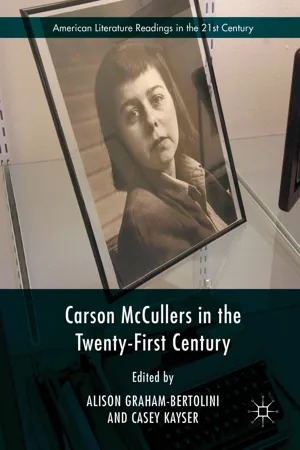
The contributors to this volume use diverse critical techniques to identify how Carson McCullers' writing engages with and critiques modern social structures and how her work resonates with a twenty-first century audience. The collection includes chapters about McCullers' fiction, autobiographical writing, and dramatic works, and is groundbreaking because it includes the first detailed scholarly examination of new archival material donated to Columbus State University after the 2013 death of Dr. Mary Mercer, McCullers' psychiatrist and friend, including transcripts of the psychiatric sessions that took place between McCullers and Mercer in 1958. Further, the collection covers the scope of McCullers' canon of work, such as The Heart Is a Lonely Hunter (1940), The Member of the Wedding (1946), and Ballad of the Sad Café (1943), through lenses that are of growing interest in contemporary literary studies, including comparative transatlantic readings, queer theory, disability studies, and critical animal theory, among others.
eBook - ePub
Carson McCullers in the Twenty-First Century
- English
- ePUB (mobile friendly)
- Available on iOS & Android
eBook - ePub
Carson McCullers in the Twenty-First Century
About this book
Information
© The Author(s) 2016
Alison Graham-Bertolini and Casey Kayser (eds.)Carson McCullers in the Twenty-First CenturyAmerican Literature Readings in the Twenty-First Century10.1007/978-3-319-40292-5_13Seeking the Meaning of Loneliness: Carson McCullers in China
Lin Bin1
(1)
Nanguang #3-520 College of Foreign Languages and Cultures, Xiamen University, No. 422, Siming South Road, Siming District, Xiamen City, Fujian Province,People’s Republic of China, 361005, China
Introduction
Carson McCullers (1917–1967) is a phenomenon in China, where she has been twice introduced to the reading public and aroused two waves of “McCullers craze” since the early 1980s. She has had a long-standing influence on Chinese readers of two successive generations. What strikes Chinese readers most about McCullers’ fictional work is her scathing representation of loneliness. McCullers scholars in China have thus been engaged in seeking the meaning of loneliness in her works over the past thirty years or so. In my opinion, McCullers’ “loneliness” has different meanings to the two generations of Chinese readers: for the first, it signifies isolation within a community, and for the other, it is more closely aligned with the concept of alienation in a crowd.
McCullers was first introduced to China in 1979 through the translation of her novella The Ballad of the Sad Café by Li Wenjun, which was followed in 1983 by the publication of the Chinese version of her short story “A Domestic Dilemma” by the same translator. These two translated works were part of the very first mass effort in China to introduce American literature to the public upon the official establishment of Sino-US diplomatic relations, two years after the Great Cultural Revolution was proclaimed to be formally ended with the downfall of the “Gang of Four.” 1 At this point, the Chinese, newly emerged from the suffocating cultural void of the previous decade, were recovering from their shock at the human capacity for cruelty and nursing their wounds from the wreckage of interpersonal relationships damaged by the Revolution. Their encounter with McCullers, and The Ballad of the Sad Café in particular, struck a chord of empathy in their hearts as the profundity of loneliness by betrayal and social exclusion was driven home in such a heartrending tone.
After a lapse of about twenty years, the second wave of the “McCullers craze” was initiated by Shanghai “Life, Reading, New Knowledge” Sanlian Bookstore Publishing House (to be shortened to “Shanghai Sanlian Bookstore” hereafter) in 2005, when almost all of the writer’s major fictional works were translated and successively published, in addition to her weighty biography The Lonely Hunter by Virginia Spencer Carr. The McCullers series quickly became top best sellers nationwide, attracting a new generation of readers while refreshing the older generation’s bittersweet memories concerning their first reading of The Ballad of the Sad Café. Once again, the readers became mesmerized by McCullers’ depiction of loneliness, which I believe has acquired a new meaning for Chinese readers in the contemporary context of China’s crisis of modernity, especially in terms of human alienation as closely associated with market economy and globalization.
Owing to the fact that the Chinese culture traditionally promotes the value of community over that of the individual, the conflict between individual and community, which is partially responsible for the current dilemma of modernity in China, remains the topmost concern in the Chinese mind. In this sense, McCullers, with her own crushing anxiety over isolation by community and also over alienation in a crowd, is culturally very Chinese at heart, which seems to me the very reason for her popularity with Chinese readers. With a sense of communal belonging always figuring as the essential element of Chinese identity, Chinese readers and scholars, including me, have been devoted to deconstructing McCullers’ loneliness by retrieving some redeeming hope in it; for instance, the critical revelation on the textual transgression of isolating boundaries sheds light on the very nature of the Chinese perspective in McCullers studies. This essay aims to resolve the myth of the “McCullers complex” among Chinese readers and to elaborate upon the “Chinese perspective” of McCullers’ reception and research in China by exploring the different social contexts of the two waves of the “McCullers craze,” which occurred in the early 1980s and the late 2000s respectively.
The First “McCullers Craze” in the 1980s: Isolation by Community
Chinese readers’ first impression of Carson McCullers was invariably shaped by Li Wenjun’s translation of The Ballad of the Sad Café. The translated work was first published in the epoch-making 2 inaugural issue of Foreign Literature and Art in July 1978 but reached only a small audience because of its limited circulation. Soon after, it gained a much enlarged scope of influence when included in Collected Contemporary American Short Stories produced by Shanghai Yiwen Press in April 1979, which served to bring into the Chinese public view quite a few names already prominent on the American literary scene. The collection covers Jewish writers such as Isaac Bashevis Singer, Bernard Malamud, Saul Bellow, and Philip Roth; Norman Mailer as a representative of New Journalism; Kurt Vonnegut, Jr. and Donald Barthelme as representatives of the school of Black Humor; postmodernist writers such as John Cheever, John Updike, and Joyce Carol Oates; African American writer James Baldwin; and also Carson McCullers as one of the major Southern school of writers along with Eudora Welty, Truman Capote, and Flannery O’Connor. With even a short story written by the dramatist Arthur Miller included (“The Misfit”), it practically represents the most brilliant achievements of American literature in the first half of the twentieth century. Among these authors, McCullers made one of the most successful debuts; with Chinese readers deeply impressed by her mesmerizing and heartrending narration of love and loneliness, she became an idol of a whole generation who developed a close affinity with the characters of her creation.
As the longest piece among the nineteen short stories incorporated into the collection, The Ballad of the Sad Café was highly recommended in the preface by Tang Yongkuan, late deputy editor-in-chief of Shanghai Yiwen Press and pioneer publisher of translated fictional works from the western world. As he aptly observes,
Mr. Tang calls for an understanding of human nature through an analogy between the fictional figures and people in real life. Moreover, what he highlights is not the grim atmosphere itself but the cheerful chorus, not the despair of a lover’s betrayal or the tension between the victim and the victimizer, but a broad heart that can readily make peace with all the grievances held against fellow human beings. No doubt, his critical standpoint was determined by the drastic change of political climate in China, when the country started to recover from the ills of the Cultural Revolution marked with a ghastly distorted domestic value system and a relentlessly implemented policy of cultural isolation from the outside world.Amelia and Cousin Lymon in The Ballad of the Sad Café seem to have an inner world of mystery; in particular, Cousin Lymon the hunchback’s last-moment betrayal at the duel [with Marvin Macy] of Amelia, who has lavished her love on him, abruptly turns the joyful and prosperous café into a heart-breaking scene and reduces lively Amelia from then on into a ghostly presence among the ruins of a demolished mansion so that the story appears shrouded in an atmosphere of grimness. But then, aren’t there people in real life whom we cannot see through at first sight? At the ending, the author describes a chain gang singing loudly in chorus while working away at the highway, whose voice seems to be “from the earth itself, or the wide sky … that causes the heart to broaden” (McCullers, Ballad 71). Hereby the author must intentionally imply that life and struggle will last forever and are bound to bring hope. (Tang 3–4)
In the wake of the landmark downfall of the “Gang of Four” in 1976, Chinese publishers, cautious in their newly acquired freedom and emboldened by a burning sense of mission, set about breaking new ground by publishing a series of American short story collections, 3 which served to fill in the gap left by the decade-long ban on all intellectual products of any foreign culture and were hence voraciously devoured by the intellectually and culturally starved Chinese readers. Scholars generally divide the translation history of British and American literature (1976–2008) into the following three stages: the post-Cultural-Revolution ice-out stage (October 1976–November 1978), the revisionist stage of renaissance in circles of literature and arts (November 1978–June 1989), and the developing stage of prosperity driven by market economy and globalization (Sun and Qingzhu 73). It was during the first stage that McCullers made her debut, together with quite a few other “politically correct” literary classics like Nikolai Gogol’s Dead Souls (translated by Lu Xun), William Shakespeare’s plays (translated by Zhu Shenghao), as well as the first volume of A Survey of American Literary History written by Dong Hengxun in January 1978, which marked the official induction of American literature into the country (Sun, H. 73–74). Because Western literature was previously condemned as “bourgeoisie literature” (as opposed to its proletarian counterpart) that seemed to be an “alien and formidable territory” to Chinese readers, the first translated works offered them quite a refreshing reading experience with an almost shocking impact (74), so it is no wonder that along with The Ballad of the Sad Café, McCullers’ name left an indelible initial impression on the memories of a whole generation of Chinese readers.
According to statistics, “Priced at 1.5 yuan RMB, 4 230,000 copies of the book were sold then, which shows how many people became acquainted with McCullers, not to mention the additional readers who got to know her through borrowed and used copies of the book. Over the years to follow they would frequently think of Miss Amelia and Cousin Lymon” (Zhang 9). Among these early readers is Su Tong, one of China’s top modernist writers who has been regarded as “McCullers’ hardcore follower” since he confessed in an essay of the late 1980s that as a senior high school student he “bought with his pocket money the very first book of literature in his life … through which he got his very first taste of American literature and of The Ballad of the Sad Café”; the influence of this novella on his own narrative style in his portrayal of the Chinese South he later duly acknowledged after he made fame as an established writer and pillar of modernist literature in China (qtd. in Li 3). The historical significance of the collection was revealed by Yang Yi when she pointed out the special role the text played in updating the Chinese readers’ understanding of contemporary American life and literature, because the stories “not only basically represent the styles and features of the literary schools currently in fashion in the US, but also reflect from various angles the American social life and mindset” (56). Yang believes the Southern school of writing “tends to be enveloped in a gloomy, mysterious and sentimental atmosphere, and though generally focused on analysis of the characters’ psychological activities, it tackles themes of gravity,” and she goes on to point out that “the human psyche in all its inscrutable morbidity that McCullers painstakingly delineates in The Ballad of the Sad Café is nothing but an intricate sign of the ‘lonely heart’” (57).
Another collection that helped bring McCullers into the limelight in China is Selected Short Stories by American Women Writers published by China Social Sciences Press in 1983. This text includes McCullers’ short story “A Domestic Dilemma” translated by Li Wenjun, along with works by women writers who each have an established reputation of distinction in American literary history, such as Kate Chopin, Edith Wharton, Willa Cather, Katherine Anne Porter, Eudora Welty, Flannery O’Connor, Sylvia Plath, and Joyce Carol Oates. With Charlotte Perkins Gilman’s “The Yellow Wallpaper” and Tillie Olson’s “I Stand Here Ironing” taken into account, this collection displays a feminist agenda, which is clearly defined in the editor Zhu Hong’s detailed introduction that was published in World Literature about two years before the collection itself came out. When it comes to Southern women writers, Zhu particularly draws attention to gender-related thematic concerns, declaring that “this collection makes it a point to include the works related to the subject of family and woman issues” and that McCullers’ selected piece “describes the commonplace scene in modern American family life with full sympathy and understanding: while the husband is working outside to make a living, the equally educated wife must stay at home, getting drunk in low spirits; and her spiritual crisis is also created by people’s indifference in big cities” (19). The theme of loneliness is stressed here by the critic in a culture- and gender-specific context, marked with inequality in separate spheres, as well as estrangement between individuals in urban life.
When Li Wenjun, McCullers’ first Chinese translator, was later interviewed about his early experience with McCullers’ translation, he unexpectedly disclosed the fact that Qian Zhongshu, 5 a renowned Chinese writer and scholar, turned out to be an even earlier reader of The Ballad of the Sad Café: “As I saw McCullers’ name in America’s literary journals time and again in 1967, I went to the library of the Institute of Literature [in Chinese Academy of Social Sciences] in search of her books and found The Ballad of the Sad Café, with only Qian’s signature on the check-out card” (qtd. in Cao, “August Afternoon”). Yet in reply to Li’s inquiry about the reason for his interest in McCullers, Qian simply said, “She’s fairly good.” Nevertheless, his favorable first impression prompted him to check out the book as soon as the library was allowed to re-open in the 1970s, and upon re-reading he decided to translate it for Chinese readers because he believed that its attraction lies in “her exceptional point of view and narrative style of ballad that effectively convey her understanding of the complexities of life.” Li elaborated on his point in 1990, promoting the novella once again by ranking it among such classics as Henry James’s Daisy Miller, William Faulkner’s The Bear, and Ernest Hemingway’s The Old Man and the Sea in an article with a title that lays bare the authorial intention—“The Call for Love and Understanding,” which is reinforced by his lengthy quote of McCullers’ well-known soliloquy about “the lover and the beloved … [who] come from different countries” (Ballad 26). However, he poses a challenge against the then prevailing Western interpretation of McCullers’ theme of love to the effect that love is proved incapable of altering the eternal state of lonely human existence. 6 From his point of view,
It is no doubt logically legitimate for the critics to come to this conclusion through an analysis of characters and plot and on the basis of the author’s own comments. But does it ...
Table of contents
- Cover
- Frontmatter
- From Adaptation to Influence: Carson McCullers on the Stage
- “Impromptu Journal of My Heart”: Carson McCullers’ Therapeutic Recordings, April–May 1958
- Collaborative Life Writing: The Dialogical Subject of Carson McCullers’ Dictaphone “Experiments” and Posthumous Autobiography, Illumination and Night Glare
- Telling It “Slant”: Carson McCullers, Harper Lee, and the Veil of Memory
- Musings between the Marvelous and Strange: New Contexts and Correspondence about Carson McCullers and Mary Tucker
- The Image of the String Quartet Lurking in The Heart Is a Lonely Hunter
- Entering the Compound: Becoming with Carson McCullers’ Freaks
- “To be a Good Animal”: Toward a Queer-Posthumanist Reading of Reflections in a Golden Eye
- Coming of Age in the Queer South: Friendship and Social Difference in The Heart Is a Lonely Hunter
- Queer Eyes: Cross-Gendering, Cross-Dressing, and Cross-Racing Miss Amelia
- “Nature is Not Abnormal; Only Lifelessness is Abnormal”: Paradigms of the In-valid in Reflections in a Golden Eye
- An “archaeology of [narrative] silence”: Cognitive Segregation and Productive Citizenship in McCullers’ The Heart Is a Lonely Hunter
- Seeking the Meaning of Loneliness: Carson McCullers in China
- “The Ballad of Two Sad Cafés”: Nicholasa Mohr’s Postwar Narrative as ‘Writing Back’ to Carson McCullers
- Jester’s Mercurial Nature and the Hermeneutics of Time in McCullers’ Clock Without Hands
- Backmatter
Trusted by 375,005 students
Access to over 1.5 million titles for a fair monthly price.
Study more efficiently using our study tools.
Frequently asked questions
Yes, you can cancel anytime from the Subscription tab in your account settings on the Perlego website. Your subscription will stay active until the end of your current billing period. Learn how to cancel your subscription
No, books cannot be downloaded as external files, such as PDFs, for use outside of Perlego. However, you can download books within the Perlego app for offline reading on mobile or tablet. Learn how to download books offline
Perlego offers two plans: Essential and Complete
- Essential is ideal for learners and professionals who enjoy exploring a wide range of subjects. Access the Essential Library with 800,000+ trusted titles and best-sellers across business, personal growth, and the humanities. Includes unlimited reading time and Standard Read Aloud voice.
- Complete: Perfect for advanced learners and researchers needing full, unrestricted access. Unlock 1.5M+ books across hundreds of subjects, including academic and specialized titles. The Complete Plan also includes advanced features like Premium Read Aloud and Research Assistant.
We are an online textbook subscription service, where you can get access to an entire online library for less than the price of a single book per month. With over 1.5 million books across 990+ topics, we’ve got you covered! Learn about our mission
Look out for the read-aloud symbol on your next book to see if you can listen to it. The read-aloud tool reads text aloud for you, highlighting the text as it is being read. You can pause it, speed it up and slow it down. Learn more about Read Aloud
Yes! You can use the Perlego app on both iOS and Android devices to read anytime, anywhere — even offline. Perfect for commutes or when you’re on the go.
Please note we cannot support devices running on iOS 13 and Android 7 or earlier. Learn more about using the app
Please note we cannot support devices running on iOS 13 and Android 7 or earlier. Learn more about using the app
Yes, you can access Carson McCullers in the Twenty-First Century by Alison Graham-Bertolini, Casey Kayser, Alison Graham-Bertolini,Casey Kayser in PDF and/or ePUB format, as well as other popular books in Literature & Literature General. We have over 1.5 million books available in our catalogue for you to explore.