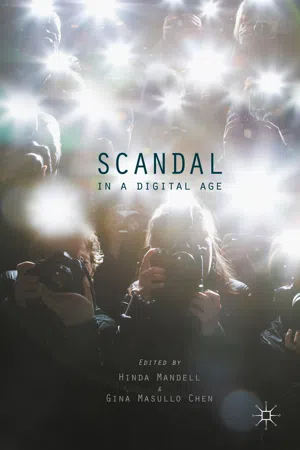
This book explores the way today's interconnected and digitized world marked by social media, over-sharing, and blurred lines between public and private spheres shapes the nature and fallout of scandal in a frenzied media environment. Today's digitized world has erased the former distinction between the public and private self in the social sphere. Scandal in a Digital Age marries scholarly research on scandal with journalistic critique to explore how our Internet culture driven by (over)sharing and viral, visual content impacts the occurrence of scandal and its rapid spread online through retweets and reposts. No longer are examples of scandalous behavior "merely" reported in the news. Today, news consumers can see the visual evidence of salacious behavior whether through an illicit tweet or video with a simple click. And we can't help but click.
eBook - ePub
Scandal in a Digital Age
- English
- ePUB (mobile friendly)
- Available on iOS & Android
eBook - ePub
Scandal in a Digital Age
About this book
Information
Topic
SozialwissenschaftenSubtopic
JournalismusHistorical Perspectives on Scandal
© The Author(s) 2016
Hinda Mandell and Gina Masullo Chen (eds.)Scandal in a Digital Age10.1057/978-1-137-59545-4_11. Introduction: Scandal in an Age of Likes, Selfies, Retweets, and Sexts
Hinda Mandell1 and Gina Masullo Chen2
(1)
School of Communication, Rochester Institute of Technology, Rochester, NY, USA
(2)
School of Journalism, The University of Texas at Austin, Austin, TX, USA
It was the day before Valentine’s, and one congressman was clearly besotted with a blonde bikini model—so much so that he could not keep his attention on the president’s “State of the Union” address. Congressman Steve Cohen (D-TN), representing a district that includes Memphis, Tennessee, was spotted picking up his phone amid his peers in Congress. He felt compelled to send that special someone a private message on Twitter.
Except he sent it publicly as a tweet.
“nice to know you were watchin SOTU(state of the union). Happy Valentines beautiful girl. ilu,” wrote Congressman Cohen, as President Barack Obama addressed the nation in 2013 about the country’s issues surrounding the longtime debt crisis, tax reform, and Medicare.
Cut to the news media’s perspective:
America’s economic vitality? B-O-R-I-N-G!
A sex scandal that stars a 64-year-old politician and a 24-year-old woman?
Now we are talking.
Across the land, editors snapped their fingers and journalists pounced on Congressman Cohen, ready to uncover a naughty relationship. Cohen deleted the tweets within minutes, adding to an air of illicit mystery. The next day, the congressman—who is not married—came clean as he spoke with reporters in his office: The bikini model was actually his long-lost daughter. The tweets were “fatherly rather than flirtatious,” wrote the New York Daily News the following day. 1 During this private news conference, Cohen said he learned of his paternal relationship to this woman only three years ago, and they were both attempting to establish a father–daughter bond. Cohen said, according to NBC News:
When she let me know she was watching the State of the Union address, I was thrilled that she wanted Steve Cohen to be part of her. I had such joy, that I couldn’t hold back from tweeting her. 2
Meanwhile, five months after the SOTU Twitter incident, a DNA test revealed that the young model was not actually Cohen’s daughter—saddening Cohen 3 —and marking “case closed” on what began as a congressman’s cryptic tweets to a comely woman. 4
The Cohen kerfuffle emphasizes that if a politician tweets—and then deletes—messages to an attractive woman, the nature of their relationship can only be one thing: scandalous. But in this instance, the truth revealed itself to be far less salacious than the facts originally seemed.
This book represents an effort to probe the frenzied, knee-jerk, and titillating relationship between scandal, news, social media, and the public in a digital age.
It is dangerous out there.
For this reason, it is worth revisiting the elegantly phrased nod to discretion immortalized by Martin Lomasney—a Massachusetts politician from last century who famously said, “Never write if you can speak; never speak if you can nod; never nod if you can wink.” 5 But because Lomasney was born 20 years before the invention of the telephone (The phone! Who has time to talk to someone in real time these days?), his guide needs a twenty-first-century approach. Here is our attempt to update Lomasney’s charming—if antiquated—wisdom:
Don’t sext when you can talk dirty offline. Don’t talk when you can whisper in person. Don’t whisper when you can wink. Make sure you have the consent of all those involved. Have them sign non-disclosure agreements. Don’t share passwords. Know that everything’s hackable. Never email. And dear lord: Put the iPhone away when the clothes come off.
Life, indeed, was much simpler back then.
But even our amended homage to Lomasney does little to help someone who is recorded without his or her awareness—and whose actions are certainly scandalous. Consider the case of the former British Member of Parliament, Lord John Sewel, who was 69 at the time of an incident that caught him—on video—in a rather delicate and unflattering situation in 2015. Ironically, Sewel was also chairman of the Privileges and Conduct Committee, which oversees the behavior of Lords behaving badly in Parliament. Therefore, he likely did know better than to enjoy a romp with prostitutes in London while snorting coke, fondling them, and making derogatory comments about Asians. 6 But he partied anyhow, and—unfortunately for this lusty lord—the sex workers captured the rendezvous using a hidden camera. Footage, easily available through a simple Google search, shows the politician lounging in an orange brassiere and snorting three lines of coke. To Sewel, perhaps Lomasney would advise: Do not party with women who are not your wife, when you can just party with your wife. Sewel added insult to spousal injury when he “turned a framed picture of his wife face-down” 7 during the tryst. Lomasney himself never married.
This book offers a collection of essays and studies on scandal in a digital age when our misdeeds and private moments can be broadcast to a worldwide audience in less time than it takes to enjoy a cool sip of water. The scandals that we are interested in are not just any old, analog example of people behaving recklessly with wild abandon. Rather, we are interested in how the misuse of technology facilitates scandal and how technology itself can capture our most private moments and share them to an eager crowd of 7 billion and counting, ready and armed to comment, retweet, share, and like. Our scandals include politicians’ misdeeds, as well as those of celebrities, journalists, religious leaders, and even private people.
Elsewhere, we have argued that scandals represent a social institution because there is the habitual way that scandals unfold in the news and there is the presence of “character” types who fulfill roles specific to their status or position. 8 When approaching scandals one at a time, the events constituting one scandal may appear distinct from the next one that comes down the line. But when scandal is viewed as a social institution—in aggregate—with set agents and patterns of behavior, then it is possible to pinpoint the repetition of processes and to identify a scandal script. In scandal, one can find a consistent narrative, which sociologist Joshua Gamson (who appears in this book) has labeled “a common script.” 9 This script includes an “accusation or revelation, broadcast, denial and/or confession, and, frequently, a comeback or attempted comeback.” 10
While we have established a general scandal “script,” what exactly defines a scandal? The simple definition is a “breach of virtue exposed” that causes public disapproval. 11 John Thompson, a sociologist at the University of Cambridge who wrote the foundational book Political Scandal: Power and Visibility in the Media Age, describes five qualities to scandal. 12
- 1.Scandals involve the breach of “values, norms, and moral codes.” 13
- 2.Scandals involve secrecy or hush-hush activity.
- 3.People disapprove of this moral breach once it becomes public.
- 4.Some folks express their outrage.
- 5.There is the risk of a damaged reputation for those involved in the scandal.
Public revelation is central for an event to explode into one hot mess of a scandal. 14 Therefore, media play a central role in the evolution of a scandal. It is the platform that allows people to “consume” its juicy contents. If the public is not aware of the event in question, then a scandal cannot transpire. (Of course, that does not mean the scandalous event never happened. It certainly did. It is just that the public did not find out about it. The phenomenon is equivalent to that old tree in the forest, albeit with a modern twist: If a celebrity made a sex tape but never leaked it to the public, can its existence be scandalous?) Or think of it this way: “Corruption [or scandalous activity] is a constant, and scandal is a variable.” 15
But there is something distinctly different about scandal in our digital age versus the analog age: We have long been socialized to set our gaze as voyeurs upon the personal lives of others. As a routine part of our day, we have normalized online lurking and Googling and peeping into the digital footprint of strangers and friends alike. And the media enables and indulges our peccadilloes to pursue our superficial curiosity about others’ private moments. Clay Calvert, the journalism scholar and author of Voyeur Nation, coined a term for this phenomenon: “Mediated voyeurism.” It involves “the consumption of revealing images of and information about others’ apparently real and unguarded lives, often yet not always for the purposes of entertainment but frequently at the expense of privacy and discourse, through the means of the mass media and Internet.” 16
Mediated voyeurism certainly facilitates our eager consumption of scandal. But it is not as if our collective interest in scandal only emerged with the digital technologies that sculpted us as voyeurs. Indeed, the historian John H. Summers writes that our proclivity to probe private details in public life has roots with the founding of the USA (and certainly, one would presume, goes back to the start of civilization!). “In the early republic and throughout the nineteenth century, American political culture subjected the sexual character of officeholders to closer, steady, and often unflattering scrutiny, as most voters insisted a man of virtue constituted ‘the only safe depository of public trust.’” 17 Of course, as the republic grew up to become the USA, and as journalists emerged as polished professionals eager to embed themselves within elite circles of influence in the early twentieth century, the practic...
Table of contents
- Cover
- Frontmatter
- 1. Historical Perspectives on Scandal
- 2. When Privates Go Public
- 3. Digital Surveillance
- Backmatter
Trusted by 375,005 students
Access to over 1.5 million titles for a fair monthly price.
Study more efficiently using our study tools.
Frequently asked questions
Yes, you can cancel anytime from the Subscription tab in your account settings on the Perlego website. Your subscription will stay active until the end of your current billing period. Learn how to cancel your subscription
No, books cannot be downloaded as external files, such as PDFs, for use outside of Perlego. However, you can download books within the Perlego app for offline reading on mobile or tablet. Learn how to download books offline
Perlego offers two plans: Essential and Complete
- Essential is ideal for learners and professionals who enjoy exploring a wide range of subjects. Access the Essential Library with 800,000+ trusted titles and best-sellers across business, personal growth, and the humanities. Includes unlimited reading time and Standard Read Aloud voice.
- Complete: Perfect for advanced learners and researchers needing full, unrestricted access. Unlock 1.5M+ books across hundreds of subjects, including academic and specialized titles. The Complete Plan also includes advanced features like Premium Read Aloud and Research Assistant.
We are an online textbook subscription service, where you can get access to an entire online library for less than the price of a single book per month. With over 1.5 million books across 990+ topics, we’ve got you covered! Learn about our mission
Look out for the read-aloud symbol on your next book to see if you can listen to it. The read-aloud tool reads text aloud for you, highlighting the text as it is being read. You can pause it, speed it up and slow it down. Learn more about Read Aloud
Yes! You can use the Perlego app on both iOS and Android devices to read anytime, anywhere — even offline. Perfect for commutes or when you’re on the go.
Please note we cannot support devices running on iOS 13 and Android 7 or earlier. Learn more about using the app
Please note we cannot support devices running on iOS 13 and Android 7 or earlier. Learn more about using the app
Yes, you can access Scandal in a Digital Age by Hinda Mandell, Gina Masullo Chen, Hinda Mandell,Gina Masullo Chen in PDF and/or ePUB format, as well as other popular books in Sozialwissenschaften & Journalismus. We have over 1.5 million books available in our catalogue for you to explore.