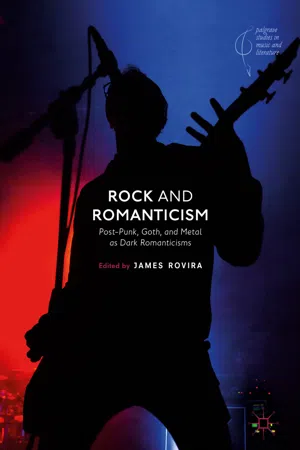
Rock and Romanticism: Post-Punk, Goth, and Metal as Dark Romanticisms explores the relationships among the musical genres of post-punk, goth, and metal and American and European Romanticisms traditionally understood. It argues that these contemporary forms of music are not only influenced by but are an expression of Romanticism continuous with their eighteenth- and nineteenth-century influences. Figures such as Blake, Wordsworth, Coleridge, Byron, Keats, Mary Shelley, Percy Shelley, Friedrich, Schlegel, and Hoffman are brought alongside the music and visual aesthetics of the Rolling Stones, the New Romantics, the Pretenders, Joy Division, Nick Cave, Tom Verlaine, emo, Eminem, My Dying Bride, and Norwegian black metal to explore the ways that Romanticism continues into the present in all of its varying forms and expressions.
- English
- ePUB (mobile friendly)
- Available on iOS & Android
eBook - ePub
About this book
Information
© The Author(s) 2018
James Rovira (ed.)Rock and RomanticismPalgrave Studies in Music and Literaturehttps://doi.org/10.1007/978-3-319-72688-5_11. Introduction: Theorizing Rock/Historicizing Romanticism
James Rovira1
(1)
Department of English, Mississippi College, Clinton, MS, USA
James Rovira
I am indebted to Sherry Truffin and Steve Wexler for generous feedback on this introduction.
End AbstractReading about Allman’s life is like reading about the life of an English Romantic poet. And maybe that’s what he was.1—Rolling Stone, “Correspondence,” August 10, 2017
When one of my undergraduate professors at Rollins College, Dr. Roy Starling, introduced his class to British Romanticism, he did so by describing what it was like for listeners when Bob Dylan plugged in his guitar at the 1965 Newport festival: electrifying, frightening, and transgressive. He didn’t mean to say at the time that Dylan was a Romantic poet, but that Wordsworth was a rock star. He suggested that Wordsworth’s poetry in the 1790s had an effect similar to rock in the 1950s and 1960s and then over and over again in subsequent decades. This comparison undoubtedly came readily to mind because the influence of the English Romantics upon rock, especially since the 1960s, is both pervasive and well known, with William Blake being the most important Romantic poet for the rock and roll generation. Musicians such as Bob Dylan , the Fugs , and the Doors referred to his poetry in the 1960s, Emerson, Lake & Palmer in the 1970s, Daniel Amos in the 1980s, Patti Smith in the 1990s, the Martha Redbone Roots Project in 2012, U2’s Songs of Innocence in 2014, and U2 again in Songs of Experience, released in 2018. Substantial work is devoted simply to cataloging Blake in music.2 This musical interest in Blake is unsurprising, for Blake first sang his poems at informal social gatherings, drawing the attention of musical scholars of his day who notated his original tunes.3 But Wordsworth and Coleridge make their appearances on rock albums as well, Coleridge most famously in Iron Maiden’s 1984 adaptation of “The Rime of the Ancient Mariner.” Since Bob Dylan’s reception of the Nobel Prize in Literature in 2016 seems to have placed beyond question rock’s literary potential, this anthology seeks not only to demonstrate the influence of Romantic literature on rock, which is already the subject of much attention, but to argue that rock itself is a late-twentieth-century expression of Romanticism—an extension, continuation, partner, or doppelgänger of this eighteenth- and nineteenth-century phenomenon.
Theorizing Rock as Romanticism by Historicizing Romanticism
What is Romanticism? And what do I mean by calling rock a modern expression of Romanticism? When Mary Wollstonecraft used the phrase “romantic notions of honour” to describe one of two ways of motivating soldiers (the other being discipline and command) in her 1792 Vindication of the Rights of Woman, few readers would have been confused by her use of the term “romantic” to refer to the values, traditions, or aesthetic of medieval romance . Not long after, Byron would similarly use the word “romantic” to describe erotic relationships, medieval romances, and contemporary works or even scenery that reminded him of a medieval aesthetic . But in his 1820 response to an essay about Manfred that Goethe published earlier that year, Byron registers a use of the term “Romantic” new to him, especially in relationship to English literature: “I perceive that in Germany, as well as in Italy, there is a great struggle about what they call ‘Classical’ and ‘Romantic’,—terms which were not subjects of classification in England, at least when I left it four or five years ago.”4 Byron dislikes this new use of the term “Romantic,” especially when set in opposition to “Classical” authors whom Byron assumes to be Pope and Swift . So while he has no problem with the word “Romantic” being used to describe a medieval aesthetic or a structure of feeling, he objects to its use in a classification system for literature.
Despite Byron’s distaste, the term “Romantic” as part of a classification system of European literature and art continued throughout the nineteenth century though attempts to coherently define the term failed repeatedly. Ongoing concern about the meaning of the term “Romantic” manifested itself during the early twentieth century in an argument between Irving Babbitt and A.O. Lovejoy. This argument was initiated by Lovejoy’s negative review of Babbitt’s Rousseau and Romanticism (1919) published in the May 1920 issue of Modern Language Notes that eventually led to Lovejoy’s now famous PMLA essay “On the Discrimination of Romanticisms” (1924). Lovejoy’s opening remarks observe that his own article is being published one hundred years after “M.M. Dupuis and Cotonet … began an enterprise which was to cause them, as is recorded, ‘twelve years of suffering,’ and to end in disillusionment—the enterprise of discovering what Romanticism is, by collecting definitions and characterizations of it given by eminent authorities.”5 Summarizing uses of the term “Romantic” since then, Lovejoy arrives at the oft-quoted conclusion that the “word ‘romantic’ has come to mean so many things that, by itself, it means nothing. It has ceased to perform the function of a verbal sign.”6 As of the time of this writing we are approaching the one-hundredth anniversary of the publication of Lovejoy’s essay, and it remains the most compelling and definitive statement of the problem: what exactly does the word “Romanticism” mean?
His challenge to make the word “Romanticism” a meaningful term in a classification system is twofold: first, to acknowledge the diversity of phenomena that fall under the umbrella of the word “Romanticism,” and next, to make that umbrella a conceptually coherent entity, because once we acknowledge a variety of Romanticisms we imply the existence of a single entity that exists in a plurality of forms. A number of twentieth-century scholars attempted to meet Lovejoy’s challenge, including René Welleck in 1949 and then Morse Peckham in 1951, who argued that Lovejoy met his own challenge in the concluding chapters of The Great Chain of Being (1936). Romanticism is organicism in Peckham’s opinion, a single construct expressed in “positive” and “negative” modes that comfortably house the constellation of attributes typically associated with Romanticism.7 None of these definitions have been convincing enough to stick, however. By 1993, in his introduction to the Cambridge Companion to British Romanticism Stuart Curran would acknowledge Lovejoy’s contributions and then affirm that due to the increasing sophistication of modes of historical and philosophical inquiry, “the problem of contemporary definition has been exacerbated—or perhaps rendered obsolete,” along with the need to identify a single entity behind the plural form “Romanticisms.”8 By that time, however, Robert Sayre and Michael Löwy published “Figures of Romantic Anti-Capitalism” (1984) in New German Critique, which was subsequently republished in G.A. Rosso’s and Daniel P. Watkins’s Spirits of Fire: English Romantic Writers and Contemporary Historical Methods (1990). It appeared in that anthology alongside a number of essays applying Sayre’s and Löwy’s thesis, Michael Ferber’s thorough critique of it, and their response to Ferber . Their work was later revised and expanded to book length in Romanticism Against the Tide of Modernity (2001).
Both their essay and book credit Lovejoy for his statement of the problem and then take as their starting point a definition of Romanticism derived from Lukács . Romanticism is “a critique of modernity, that is, of modern capitalist civilization, in the name of v...
Table of contents
- Cover
- Front Matter
- 1. Introduction: Theorizing Rock/Historicizing Romanticism
- 2. Empathy for the Devil: The Origins of Mick Jagger’s Devil in John Milton’s London
- 3. “Bliss was it in that shirt to be alive”: Connecting Romanticism and New Romanticism through Dress
- 4. “Crying like a woman ‘cause I’m mad like a man”: Chrissie Hynde, Gender, and Romantic Irony
- 5. A Northern “Ode on Melancholy”?: The Music of Joy Division
- 6. “Little crimeworn histories”: Nick Cave and the Roots-Raves-Rehab Story of Rock Stardom
- 7. Postcards from Waterloo: Tom Verlaine’s Historical Constellations
- 8. Manner, Mood, and Message: Bowie, Morrissey, and the Complex Legacy of Frankenstein
- 9. Tales of the Female Lover: The Poetics of Romantic Desire in P. J. Harvey’s To Bring You My Love and Is This Desire?
- 10. Emocosms: Mind-Forg’d Realities in Emo(tional) Rock Music
- 11. “I possess your soul, your mind, your heart, and your body”: External and Internal Gothic Hauntings in Eminem’s Relapse
- 12. “The female is such exquisite hell”: The Romantic Agony of My Dying Bride
- 13. Ashes against the Grain: Black Metal and the Grim Rebirth of Romanticism
- Back Matter
Trusted by 375,005 students
Access to over 1.5 million titles for a fair monthly price.
Study more efficiently using our study tools.
Frequently asked questions
Yes, you can cancel anytime from the Subscription tab in your account settings on the Perlego website. Your subscription will stay active until the end of your current billing period. Learn how to cancel your subscription
No, books cannot be downloaded as external files, such as PDFs, for use outside of Perlego. However, you can download books within the Perlego app for offline reading on mobile or tablet. Learn how to download books offline
Perlego offers two plans: Essential and Complete
- Essential is ideal for learners and professionals who enjoy exploring a wide range of subjects. Access the Essential Library with 800,000+ trusted titles and best-sellers across business, personal growth, and the humanities. Includes unlimited reading time and Standard Read Aloud voice.
- Complete: Perfect for advanced learners and researchers needing full, unrestricted access. Unlock 1.5M+ books across hundreds of subjects, including academic and specialized titles. The Complete Plan also includes advanced features like Premium Read Aloud and Research Assistant.
We are an online textbook subscription service, where you can get access to an entire online library for less than the price of a single book per month. With over 1.5 million books across 990+ topics, we’ve got you covered! Learn about our mission
Look out for the read-aloud symbol on your next book to see if you can listen to it. The read-aloud tool reads text aloud for you, highlighting the text as it is being read. You can pause it, speed it up and slow it down. Learn more about Read Aloud
Yes! You can use the Perlego app on both iOS and Android devices to read anytime, anywhere — even offline. Perfect for commutes or when you’re on the go.
Please note we cannot support devices running on iOS 13 and Android 7 or earlier. Learn more about using the app
Please note we cannot support devices running on iOS 13 and Android 7 or earlier. Learn more about using the app
Yes, you can access Rock and Romanticism by James Rovira in PDF and/or ePUB format, as well as other popular books in Literature & Medieval & Early Modern Literary Criticism. We have over 1.5 million books available in our catalogue for you to explore.