- English
- ePUB (mobile friendly)
- Available on iOS & Android
eBook - ePub
About this book
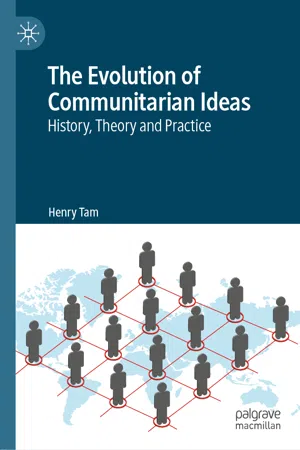
This book deals with three key questions about communitarian ideas: how to distinguish what constitutes communitarian thinking; what lessons to take from the historical development of communitarian arguments; and why their practical implications are relevant in devising reforms at the local, national, and global levels. Each chapter covers a distinct period, with a critical exposition of the leading thinkers of that time who contributed to communitarian philosophy and politics. Beginning with an examination of the rise of proto-communitarian ideas in classical Western and Eastern thought, the book closes with a review of communitarian responses to the emergent social and technological changes in the 21st century. Readers will learn about the core features and significance of communitarian theories and practices in relation to morality, education, the economy, freedom and security, community development, and democratic governance; and how they compare and contrast with other ethical andintellectual outlooks.
Information
Topic
FilosofiaSubtopic
Storia mondiale© The Author(s) 2019
H. TamThe Evolution of Communitarian Ideashttps://doi.org/10.1007/978-3-030-26558-8_11. The Roots of Communitarian Ideas
Lineage, Meaning and Significance
Communitarian ideas offer a distinct approach to dealing with the perennial challenges that arise from human interactions . Rather than characterising them as some third or fourth option alongside prevailing modes of thinking, we may understand their meaning and significance better by recognising them as the on-going adaptation and application of what is arguably the ‘first way’ in ethics—the way of reciprocal cooperation.
The Golden Rule of treating others as one would have others treat one was not only implicit in the mutually supportive behavioural traits of early human communities (Bowles and Gintis 2011), it was also explicitly accepted as the core moral injunction in every ancient civilisation from Egypt and Persia to India and China (Kainz 1988, pp. 46–48; Neusner and Chilton 2008). A corollary of this ethos is that people are expected, not to refer exclusively to one’s own inclinations or defer routinely to others’ demands, but to explore with others on a mutually respectful basis how they should behave towards one another. However, as relatively simple community structures gave way to more complex forms of social organisation, the gap between the recommended norm and actual practices began to widen.
The divergence was accelerated when tribes and clans were increasingly merged into larger political entities. Some individuals were able to secure much more power than the rest in the name of organising for better production or protection. Amongst them would be those who, driven by selfish impulse or delusion of infallibility, declared that they were so ‘superior’ that it was unobjectionable for them to treat others in ways they would never expect or allow others to treat them in return. And because of the greater power they had acquired or inherited (to deceive, bribe, intimidate, harm), they could impose asymmetric treatment on those around them. In time, supporters and critics of the powerful would argue about what rulers should or should not do, by invoking notions such as the proper character of leaders, hallowed traditions , universal duties , the will of God , the glory of one’s nation , the size of the economy , the rights of individuals, or the sum of human happiness . These notions, whatever their merits might be under different interpretations, shifted the ensuing debates away from what was once the primary focus on cooperative human relations. Instead of looking to work out with others what would be appropriate under varied circumstances, people were directed to look at themselves—their own power, rights , desires, religious faith , economic interests, inherited loyalty—to establish what should be done.
But the ethos of reciprocity was not entirely forgotten. In this book, we will examine how thinkers with communitarian ideas continued through the ages to contribute to theories and practices relating to the development of cooperative community life. Together, they have reminded us of the value of interdependence , and provided us with evolving guidance on how we should live as mutually supportive members of overlapping communities.
Before we proceed with our detailed exposition, we should dispel a number of misconceptions of the term ‘communitarian’, which has only entered our political lexicon relatively recently. A key distinction should be drawn at the outset between casual usage and serious attribution based on historical understanding. The former comprises generic, rhetorical, and pre-conceived deployment of the term. Some people use ‘communitarian’ in a generic way to describe just about anything connected with the notion of community. For example, a book about communities is cited as a communitarian publication, a talk about the activities going on in a local community is described as a communitarian speech. Such usage is broad and may be considered unobjectionable so long as no one takes it as a pointer to what constitutes communitarian ideas.
The rhetorical use is mostly found amongst commentators who associate the term ‘communitarian’ with their own personal vision of a good society, and are inclined to ascribe it to any public figure they wish to claim as backing that vision. Despite their contrasting approaches and policies, Bill Clinton, George W. Bush, and Barrack Obama have all been described in the US as ‘communitarians’ (Milbank 2001; Marshall 2012; Ferenstein 2013). In the UK, commentators in the media have applied the ‘communitarian’ label to politicians with vastly different agendas such as Labour leader, Tony Blair1; Conservative leader, Theresa May; and Green leader, Caroline Lucas (Gove 2017; Williams 2017).
As for preconceived usage, this happens when writers associate any invocation of ‘community’ with certain socio-political features they have strong reservations about. Consequently, they express their opposition to ‘communitarian’ ideas because they assume such thinking must be, for example, naïvely idealising a form of community life that never actually existed and never will (Phillips 1993); inherently incapable of challenging communal prejudices and oppression (Frazer 1999); or crudely seeking to bring all aspects of community under the control of some big government (Frohnen 1995).
By contrast, any serious attribution of ‘communitarian’ would fully take into account its affinity with what can be called the conceptual DNA to be found in the core formulations of ‘communitarian/communitarianism’. There are broadly five sets of such formulations that are found in the history of the concept, which are distinct from any generic, rhetorical, or pre-conceived usage.
The first set of formulations appeared around the middle of the nineteenth century. They related to the ideas and practices of Robert Owen and people who wanted to apply these to the development of cooperative arrangements to facilitate better social and economic relations (Owen 1991). ‘Communitarian’ emerged as a common term for describing Owenite efforts to set up new forms of enterprise, work communities, and associations of workers, and it became widely used by subsequent historians to refer to their development (Bestor 1950; Harrison 1969; Claeys 1989).
While a common aspiration was to realise the age-old potential for collaboration and solidarity , the strategies that were tried out pointed, not to a return to some idealised past, but to new rules and structures to deal with the prevailing reality. Not all the experimental models worked, but one notable success was the cooperative group that came to be known as the Rochdale Pioneers (Holyoake 2017). Formed in 1844, this group of worker-owners pooled their resources to buy goods needed by local people and sell them at a reasonable price with any profit to be shared amongst members of the group. Customers and workers alike could become members and everyone had an equal vote in determining how the group was run. This approach proved highly effective in terms of its social impact and economic sustainability, and most importantly, was generally replicable not just in the grocery business in England, but in all sectors across the world. The communitarian ethos of the Rochdale Pioneers became a key influence over the development of the cooperative movement, and led to the founding of the International Co-operative Alliance in 1895. At the beginning of the twenty-first century, around 1 billion people in 96 countries belonged to a cooperative .2
The second set of formulations of ‘communitarian’ came via the commentary on the writings of Alasdair MacIntyre (1981, 1988), Michael Sandel (1982), Michael Walzer (1983, 1987), and Charles Taylor (1985, 1989), all of whom had penned critiques with a common target—the ideas of John Rawls . Despite significant differences in their epistemological and political views, these four philosophers came to be considered as sharing a ‘communitarian’ stance in opposing a form of liberalism that is premised on what they deemed a deeply flawed conception of the self (Avineri and de-Shalit 1992; Mulhall and Swift 1992; Frazer and Lacey 1993; Bell 1993). The culprit in question is the notion of an atomised individual, with no ties to anyone else, no preferences based on practical concerns or prior obligations, supposedly capable of calculating in the abstract what should or should not be done from one’s point of view. Furthermore, it is not the deliberative interactions between these individuals which are expected to play a role in determining the rules and principles that will govern their behaviour, but the assumption that these will be defined by the identical conclusions each individual will in isolation arrive at.
It could be argued that Rawls was only making a hypothetical case to indicate how people, unencumbered by ‘incidental’ factors, would converge on a very similar set of moral guidelines. But the communitarian objections dismiss this as misconceived on two levels. First of all, a person conceptually stripped of all relational connections with others is not the ‘real’ person with the utmost clarity of thought, but an isolated entity with no sense of belonging, obligations, or concerns, without which there can be no meaningful moral reflections. Secondly, even the narrowest ‘rational ’ calculation of what one would rather have in a hypothetical world could not be assumed to lead to the same conclusion for everyone, unless a universal disposition towards the same degree of risk-taking and desire-satisfaction is built into the assumption. Otherwise, while some people might routinely stick with l...
Table of contents
- Cover
- Front Matter
- 1. The Roots of Communitarian Ideas
- 2. The Emergence of Communitarian Challenges: 1400s–1600s
- 3. Towards Enlightened Communities: The Eighteenth Century
- 4. Beyond Gemeinschaft and Gesellschaft: Nineteenth to Early Twentieth Century
- 5. Critiques of Depersonalisation: 1920s–1980s
- 6. Communitarianism Articulated: 1989–2001
- 7. Tackling Community Disempowerment Post-2001
- 8. Tomorrow’s Communities
- Back Matter
Trusted by 375,005 students
Access to over 1.5 million titles for a fair monthly price.
Study more efficiently using our study tools.
Frequently asked questions
Yes, you can cancel anytime from the Subscription tab in your account settings on the Perlego website. Your subscription will stay active until the end of your current billing period. Learn how to cancel your subscription
No, books cannot be downloaded as external files, such as PDFs, for use outside of Perlego. However, you can download books within the Perlego app for offline reading on mobile or tablet. Learn how to download books offline
Perlego offers two plans: Essential and Complete
- Essential is ideal for learners and professionals who enjoy exploring a wide range of subjects. Access the Essential Library with 800,000+ trusted titles and best-sellers across business, personal growth, and the humanities. Includes unlimited reading time and Standard Read Aloud voice.
- Complete: Perfect for advanced learners and researchers needing full, unrestricted access. Unlock 1.5M+ books across hundreds of subjects, including academic and specialized titles. The Complete Plan also includes advanced features like Premium Read Aloud and Research Assistant.
We are an online textbook subscription service, where you can get access to an entire online library for less than the price of a single book per month. With over 1.5 million books across 990+ topics, we’ve got you covered! Learn about our mission
Look out for the read-aloud symbol on your next book to see if you can listen to it. The read-aloud tool reads text aloud for you, highlighting the text as it is being read. You can pause it, speed it up and slow it down. Learn more about Read Aloud
Yes! You can use the Perlego app on both iOS and Android devices to read anytime, anywhere — even offline. Perfect for commutes or when you’re on the go.
Please note we cannot support devices running on iOS 13 and Android 7 or earlier. Learn more about using the app
Please note we cannot support devices running on iOS 13 and Android 7 or earlier. Learn more about using the app
Yes, you can access The Evolution of Communitarian Ideas by Henry Tam in PDF and/or ePUB format, as well as other popular books in Filosofia & Storia mondiale. We have over 1.5 million books available in our catalogue for you to explore.