This book discusses the economics of transport infrastructure and the economic theorizing around transport infrastructure from 1850 to today. Transport infrastructure systems are continuously evolving over time. Since the mid-1800s these systems have grown in complexity and outreach. They have been important drivers of economic development but have also been important as economic agents in themselves. Over time transport infrastructure systems have taken on different functions as providers of simpler transport services or more developed value chain components. Transport infrastructure has also been a source for different arguments about economic theory and practice.
Transport infrastructure systems are analysed from an institutional perspective where the long-term development of the ownership and financing of the systems, as well as the connection to different policy areas are elaborated. A longitudinal study of Sweden's transport infrastructurepolicy is used to exemplify driving factors causing change and transformation of the systems over time with different scale and scope.
1.1 The Traditional Arguments for Government Intervention and the Challenges to These Arguments
Transport infrastructure systems of different kinds are signified by heavy and long-term investments and often connected to different views on the strategic development of economies, nations, and the way we live. Therefore, transport infrastructure over time has been an area for interest by governments, and for other actors.
In Western Europe and many other countries, government’s interest in these systems has a long tradition from medieval times to the development of postal services in the seventeenth century and up to the modern industrial era, when transport volumes started to grow and new technology made transportation cheaper and faster. The long tradition of government regulations around the construction and maintenance of roads can be exemplified through the inclusion of these in the very first legal texts from the thirteenth and fourteenth centuries in Sweden (Bulletinen 2012).
The industrial revolution increased the demand for transport infrastructure. Starting in the earliest industrialized country, Britain, and quickly spreading around the Western world new transport infrastructure was developed. This meant that the scope of transport infrastructure functionality and operations also changed quickly. A deepened competition between different transport modes evolved and the scale of transport infrastructure assets also increased from local systems to more national structures. Railroad corporations, perhaps apart from inland waterways and shipping organizations like the East Indian Companies, were among the first mega-organizations to evolve (Chandler 1977, 1990).
Three phases in the development of transport infrastructure can generally be identified in most countries, according to Millward (2005, 2011). The first is the entrepreneurial phase where private corporations are active in shaping the first systems. Governments started to become more interested in the systems as they grew into large financial and influential systems with network effects that were vital to government control. Theories on whether governments should intervene in order to regulate both the provision of transport services and the price level were developed during the nineteenth century. These theories have had a persistent influence on the views around transport infrastructure development, financing, regulation, and ownership.
A wave of nationalizations during the mid-1900s marked the next major phase in the development of transport infrastructure, according to Millward. Railroads and roads on the national level were brought under government ownership in many countries, partly as a response to the lack of profitability of railroads and a perceived need to economize in order to reap large-scale effects in the systems.
The third phase in this development came in the 1980s when a general deregulation and liberalization took place in many countries. This primarily included liberalization and market openings in transportation, while the organization and regulation of transport infrastructure were more stable. In some countries, and Sweden is a good example, a separation of the railroad system into infrastructure and transportation services was implemented, which was the start of further deregulation. EU policies in the transport policy area have also supported the further process of strengthening reform and deregulation in the sector.
Recently has there been a tendency for weakening momentum in these policies, as exemplified by Johnson and Turner (2007). Whether the outcomes of the sustained financial crisis in many countries in the EU will bring further or less EU-led coordination is still to be seen. Initiatives from the EU since some years back such as the focus on developing Core Network Corridors (CNSs) and the introduction of novel financing tools following the financial crisis of 2008–2009 seem to signal something of a new era in relation to transport infrastructure coordination in the EU, but outcomes are still uncertain.
In economics literature, there has been a discussion around transport infrastructure systems more closely based on the division of services and goods in an economy in the categories of public and private goods. A wide scholarly debate, but also a more practical discussion, on the cooperation between actors in the public and private sectors when it comes to transport infrastructure provision and operations has played out, and still continues.
The prevailing strengthened role of the government in the transport infrastructure sector can also be discussed as an example of path dependency, which can be interpreted both in a broader and in a narrower form, as suggested by Piersson (2000). The broader form views causality between present and earlier stages as fundamental. In contrast, the narrower view is more based on the presence of sunk costs, meaning that as a development starts it is costly to change to another development path or technology. The fact that government ownership of transport infrastructure has been essentially unchallenged might in this light be understood both as a consequence of the influence of economic and political arguments favoring prevailing government engagement and as an effect of the substantial investment necessary for any organization to challenge the government with competing systems.
Other reasons for the government to take on a more active role in the transport infrastructure sector have been a political interest in influencing regional development, distributional effects in general, and the government’s interest to control land use and rights of way in connection with transport infrastructure planning and construction.
There has also been a view in political discussions that regional development and regional growth have been positively connected to transport infrastructure systems, and that transport infrastructure policy can be used as an efficient means of reaching the fulfillment of regional policy and growth objectives. An early example of this view is the doctoral thesis by Heckscher (1907), analyzing the importance of railroad construction in Sweden in the nineteenth century for regional growth.
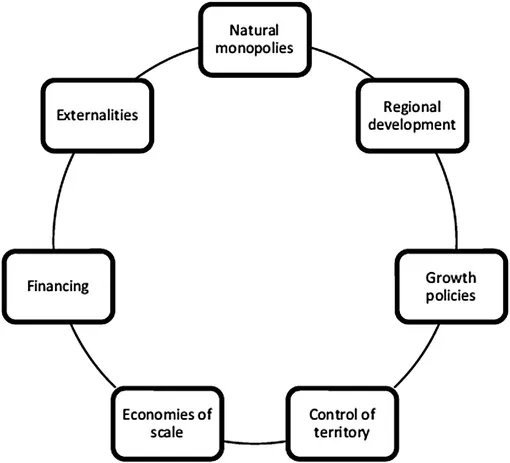
In addition to this, governments have generally had an interest in controlling the territory (physically) via the transport systems, as a necessary means for the core functions of the government (police, defense, tax collection, and education) to be carried out. These broad policy reasons for government intervention have often been included in the natural monopoly arguments without clear distinctions between the different arguments. A similar description of arguments in favor of government intervention in many industries with parallel features has been presented by Bogart (2009) and Clifton et al. (2011).
Clifton et al. have pointed to economic, military, redistributional, and social motivations for government intervention in the systems. Some of the arguments that are often raised in this discussion, arguments which have over time often been intertwined without clear separation, are depicted in Fig. 1.1. The varying importance and strength of these arguments over time in forming the Swedish government’s policies around transport infrastructure has been discussed by Hasselgren (2013).
Fig. 1.1
The traditional arguments for government intervention in transport infrastructure
Today, many of these arguments for national government intervention seem to be less relevant in the arguments for sustained government ownership and the financing of transport infrastructure. The possibility to introduce road and railroad pricing based on new payment technology solutions have made it less necessary to lean on taxation of fuel as the main source of funding of roads. On the one hand, this is a threat to the government’s revenues from road-related taxes; however, on the other hand, it is a possibility. For railroads specifically, more developed charging for different users (operators) of the railroads can be introduced. There is also a possibility to add cost-based elements to the prices, whereby proxies for external cost effects of transport systems can be included in the pricing system.
New technology thus has made the introduction of market structures in the transport infrastructure sector and the financing of private corporations in transport infrastructure more likely than before. This also weakens one of the core traditional arguments in favor of government intervention in the area.
Klein (2012) discusses technological change and its effects on government intervention such as measures used for the alleviation of the effects of natural monopolies. Klein focuses on the fact that technological development could weaken arguments for government intervention, as technology makes payment systems for roads possible to implement. Yet, it could be argued that technological development allows for increased government regulation and intervention. The government will simply be in a position to control and regulate more aspects of the economy as information collection and more effective control measures are developed. Klein suggests that technological change will also likely make the economy more complex. An example could be the development of Information Technology (IT), which has enabled the cheaper collection of information but at the same time made society and the economy more complex. The knowledge frontier seems to be a target that is moving all the time. Even if technology is improving there might, therefore, be good reasons to question the viability of government intervention.
The changing distribution of decision rights and competence between different spatial levels in most countries, with tendencies for strengthening local and regional levels, combined with more ambitious coordination at the international level in the EU has also challenged the government’s role as infrastructure provider. Scale effects are of course still important in the sector, but it is perhaps more likely to find them now at the international level and perhaps also at the regional and local level than before. This development speaks in favor of a future challenge of the national level and the national government.
It can of course also be discussed whether transport infrastructure policy is an efficient means of furthering regional policy and regional growth objectives. For example, is there anything other than (or wider than) time saving and quality improvement effects that could be connected to new investments in infrastructure and upgrading of the existing infrastructure through reinvestment? Growth and positive regional growth effects in relation to new infrastructure might also be more a case of redistribution between different locations than pure net growth effects. This has in fact been one of the criticisms tow...
Table of contents
Cover
Front Matter
1. Government Ownership of Roads and Railroads—Why?
2. Theoretical Background
3. Economic Theory and Transport Infrastructure
4. Planning and Coordination of Transport Infrastructure
5. Sweden’s Transport Infrastructure History—Coevolution and Conflict
Back Matter
Trusted by 375,005 students
Access to over 1.5 million titles for a fair monthly price.
Study more efficiently using our study tools.
Frequently asked questions
Yes, you can cancel anytime from the Subscription tab in your account settings on the Perlego website. Your subscription will stay active until the end of your current billing period. Learn how to cancel your subscription
No, books cannot be downloaded as external files, such as PDFs, for use outside of Perlego. However, you can download books within the Perlego app for offline reading on mobile or tablet. Learn how to download books offline
Perlego offers two plans: Essential and Complete
Essential is ideal for learners and professionals who enjoy exploring a wide range of subjects. Access the Essential Library with 800,000+ trusted titles and best-sellers across business, personal growth, and the humanities. Includes unlimited reading time and Standard Read Aloud voice.
Complete: Perfect for advanced learners and researchers needing full, unrestricted access. Unlock 1.5M+ books across hundreds of subjects, including academic and specialized titles. The Complete Plan also includes advanced features like Premium Read Aloud and Research Assistant.
Both plans are available with monthly, semester, or annual billing cycles.
We are an online textbook subscription service, where you can get access to an entire online library for less than the price of a single book per month. With over 1.5 million books across 990+ topics, we’ve got you covered! Learn about our mission
Look out for the read-aloud symbol on your next book to see if you can listen to it. The read-aloud tool reads text aloud for you, highlighting the text as it is being read. You can pause it, speed it up and slow it down. Learn more about Read Aloud
Yes! You can use the Perlego app on both iOS and Android devices to read anytime, anywhere — even offline. Perfect for commutes or when you’re on the go. Please note we cannot support devices running on iOS 13 and Android 7 or earlier. Learn more about using the app
Yes, you can access Transport Infrastructure in Time, Scope and Scale by Björn Hasselgren in PDF and/or ePUB format, as well as other popular books in Business & International Business. We have over 1.5 million books available in our catalogue for you to explore.