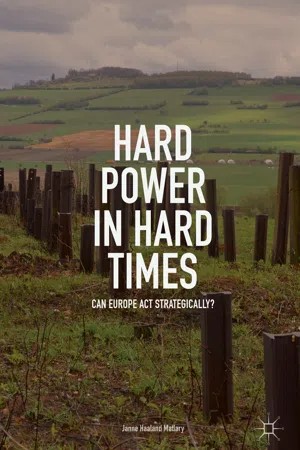
This book analyses whether European leaders are able to deal with the 'hard power' problems of military provocation, mass migration, and terrorism. Russia's 2014 annexation of Crimea was just one example of recent revisionist policies by the state. In 2015, Europe experienced a massive influx of illegal immigrants and refugees whilst also suffering many terrorist attacks in recent years. Common to these policy challenges is the need for using hard power (military, police) in order to confront, stop, stabilize and hinder undesirable outcomes. European politicians are mostly used to wielding incentives-based policy and are unfamiliar with strategic thinking. How well do the British, French, and German governments deal with this triad of hard power problems? What about NATO and the EU? This book examines the responses to determine whether European politicians can still act strategically.
- English
- ePUB (mobile friendly)
- Available on iOS & Android
eBook - ePub
About this book
Information
© The Author(s) 2018
Janne Haaland MatlaryHard Power in Hard Timeshttps://doi.org/10.1007/978-3-319-76514-3_11. External and Internal Shocks: Policy Needs Beyond ‘Win-Win’
Janne Haaland Matlary1
(1)
Department of Political Science, Blindern, University of Oslo, Oslo, Norway
The primary purpose of this book is to examine the need for strategic action in current European security policy. The secondary purpose is to analyse the empirical state of affairs with regard to strategic ability. I examine recent cases of the use of force as well as challenges to territorial and border security to determine whether states in Europe take the lead in policy-making that concern their continent, or are mere contributors. The emphasis is not on operational art per se, but on whether governments exhibit strategic logic when they use force in one way or another. Russia, and particularly its actions in Ukraine in 2014 and onwards, constitutes a major case study of this book.
By 2014 Europe was beginning to realize—the hard way—that it faced the twin strategic challenges of global terrorism and old-fashioned geopolitics, which ‘descended’ on the continent around the same time. It was during that year that Putin annexed Crimea and heavy fighting in the eastern part of Ukraine ensued. The same year, Daesh , or Islamic State of Iraq and the Levant (ISIL),1 and other terrorist actors stepped up their activity, attacking in Europe and elsewhere. The killing of almost the entire staff at Charlie Hebdo early in January 2015 and the massacres in Paris on Friday 13 November the same year marked a turning point. Subsequent attacks in Brussels, London, and Berlin added to the seriousness of the terrorist challenge in Europe. The values of liberal democracy were, literally speaking, under fire. Russian sabre-rattling also continued at a brisk pace, with attempts to provoke North Atlantic Treaty Organization (NATO) reactions in the Baltics with mock attacks on American ships and planes there and transgressions of international airspace. Russia also intervened militarily in Syria in the autumn of the same year.
In many ways, Europe was ‘home alone’ in the face of these developments. The US had announced its so-called pivot to Asia two years before, along with major cuts in its defence spending. President Obama was reluctant to embrace a leading role in security and defence policy and asked Europeans to take much more responsibility for their own security needs.2 He made the point that he did not want to ‘follow the Washington playbook’ of using military force in order to lead in world politics.3 In not following through with a military attack on Syria after the so-called red line he had announced on the use of chemical weapons had been crossed, he did not weaken American extended deterrence, he argued, for his was a different type of foreign policy. One may add that this foreign policy looked more like Europe’s—the US would no longer be the world’s ‘policeman’. The surprising election of Donald Trump as US president in November 2016 brought even more uncertainty to this picture. While Trump seemed to advocate isolationism and protectionism, he was also an activist and took seemingly radical positions on Russia, China, and NATO. Pointing to burden-sharing , or rather the lack of it, he demanded that the European members of NATO pay up and reach the self-imposed 2 per cent of gross domestic product (GDP) contribution very quickly. The message to Europe was clear and unmistakable: Carry the burden in terms of cost and risk in your own region.
The US’s retreat from being the world’s policeman was a development long in coming, but it could not have happened at a more unfortunate time: Europe was also cutting defence spending across the alliance, partly because it assumed that the US would pick up the bill, as usual, and partly because the economic crisis was so severe. Even more severe, however, was long-term youth unemployment. In addition, mass migration across the Mediterranean exploded. Greece, in particular, was inundated with migrants and refugees, unable to cope, and the European Union (EU)’s common policy did not work. It was sauve qui peut—every state for itself, and several European states even built border fences themselves to physically stop the flow of migrants. The Greek crisis became a Greek drama when migrants could not transit to their preferred destinations farther north. Faced with these challenges, spending on defence was certainly at the very bottom of the political list of priorities.
Under these circumstances, Europe was put in a situation where it had to react to two strategic challenges simultaneously: It became the protagonist in a strategic game with Russia while also having to deal with strategic terrorism. Instead of working in partnership with Russia, Europe had to deal with Russia as an adversary. It also had to fight terrorism, which was linked to a third crisis, brought about by the migration crisis that had to do with borders, policing, and territorial security in a very basic sense. Russia, terrorism, and mass migration had to be dealt with by a generation of European politicians unused to thinking strategically and ill at ease with using hard power tools.
Strategy is at the heart of statecraft, the traditional role of the statesman. The ‘tools’ of strategy are unitary action capacity, national interest, and the means to defend them. Strategic interaction is not a ‘win-win’ game, but rather one of adversarial interchange. What one actor in a strategic game does has implications for the other actor. This interaction is the essence of strategy itself. If a player chooses to remain passive and does nothing, this choice is also strategically relevant. Is remaining passive the same as appeasement? Or is it a rejection of the agenda that the opponent is trying to set and, as such, a true strategic move made from a position of strength?
These questions are essential for assessing whether Europe responded and continues to respond well to the challenges mentioned above. If European governments faced with the current situation were to do nothing out of the ordinary, it would not only be strategically unwise but also signal weakness and fear—it would often in fact amount to appeasement, to giving in to pressure and fear. Behaving in normal political ways with linear policy thinking is inappropriate when one’s state, and indeed one’s entire continent, faces fundamental strategic risks and even immediate threats.
This book considers what strategic interaction, thinking, and action require in Europe today, given the challenges at hand. It argues that European leaders have largely forgotten, or perhaps never learnt, what these entail. Politicians, who do not recall the Cold War, much less know much about the Second World War (WWII), are not likely to take much interest in security and defence issues. Although strategy is an essential part of what we call statesmanship, it is difficult, and often unpleasant, to deal with adversaries and enemies. ‘Fair weather politics’ is much easier and follows what we can term the ‘Brussels playbook’ of normal, linear, and rule-based decision-making. When European countries have gone to war in the period after 1990, it has mostly been in the form of so-called humanitarian interventions where the claim could be made that military power was a ‘force for good’, as Tony Blair used to say. The language of deterrence and coercion, on the other hand, has been far from common. Only with the resurgence of Russia has deterrence once again become a key word in NATO debates. It is still an awkward thing to discuss in political circles in many European states, especially in Germany.
It is frightening to Europeans that Russia can no longer be assumed to be moving in a Western direction. The assumption that Russia will become a liberal democracy is no longer tenable. Yet adversarial interaction—strategy—is not a common mode of policy among the political elites of Europe. The latest case of this kind of policy was the Cold War, which is not replicated at present, although some of the strategic elements are similar. As one NATO ambassador put it, ‘we need new concepts; it is a conceptual challenge to politicians in particular’.4
NATO no longer works in partnership with Russia; in fact, the two entities have no interaction beyond standard diplomatic relations and the occasional NATO-Russia Council meeting. Russian leaders have labelled NATO a major threat, arguing that the sanctions imposed by the EU and the US are aimed at overthrowing the Russian government. Western leaders are, for the most part, unused to managing this kind of strategic interaction, where the name of the game is conflict, not cooperation. If, however, conflict and state rivalry are the natural features of great power politics, Western leaders need to learn, or relearn, the nature of strategic interaction.
The term hard power in this book describes the use of not only military but also economic means to influence the behaviour of other actors. Economic coercion in the form of sanctions or boycotts is not the main topic of this book, although sanctions often form part of the UN Security Council’s (UNSC) work. In the current policy response to the case of Russian meddling in Ukraine and the annexation of Crimea there are US and EU sanctions. It has proven very difficult to uphold the EU sanctions, despite US insistence. However, what poses the most difficulty for Europe—and perhaps for every democracy—is the use of military force. European states have used military force in many operations since the Cold War, but that does not amount to having had or having a strategy for its use. The use of force to defend the state and promote its interests is something entirely different from its use in an ‘optional’ operation where little is at stake.
Hard power also includes police power, border controls, and anti-terrorism measures. The state’s three tools of action are diplomacy, economic means, and military/police means. The conceptual opposite of hard power is soft power, a much more famous term, and one that Joseph Nye has written much about.5 He points out that soft power is much more effective than hard power in most cases because it relies on persuasion and attractiveness, whereas hard power is coercive. The moment coercion is removed, the induced behaviour may stop as well. Persuasion, however, often leads to a target to accept something, or even to embrace it on an intellectual or emotional level.
This is undoubtedly true, but the policy situations that typically require hard power are conflictual and uncertain. There is little, if any, trust between parties and therefore little scope for persuasion. This typically occurs when a state and its population are threatened and the state’s control of its territory is at stake. European states have, for the most part, not had to confront such situations since the end of the Cold War, and at that time there was a peaceful transition to a type of liberal-democratic order all over Europe, if in name only in Eastern Europe and the Balkans. Yet there has been no violent conflict within or between European states since the 1999 Kosovo campaign. For t...
Table of contents
- Cover
- Front Matter
- Part I. Strategic Challenges
- Part II
- Back Matter
Trusted by 375,005 students
Access to over 1.5 million titles for a fair monthly price.
Study more efficiently using our study tools.
Frequently asked questions
Yes, you can cancel anytime from the Subscription tab in your account settings on the Perlego website. Your subscription will stay active until the end of your current billing period. Learn how to cancel your subscription
No, books cannot be downloaded as external files, such as PDFs, for use outside of Perlego. However, you can download books within the Perlego app for offline reading on mobile or tablet. Learn how to download books offline
Perlego offers two plans: Essential and Complete
- Essential is ideal for learners and professionals who enjoy exploring a wide range of subjects. Access the Essential Library with 800,000+ trusted titles and best-sellers across business, personal growth, and the humanities. Includes unlimited reading time and Standard Read Aloud voice.
- Complete: Perfect for advanced learners and researchers needing full, unrestricted access. Unlock 1.5M+ books across hundreds of subjects, including academic and specialized titles. The Complete Plan also includes advanced features like Premium Read Aloud and Research Assistant.
We are an online textbook subscription service, where you can get access to an entire online library for less than the price of a single book per month. With over 1.5 million books across 990+ topics, we’ve got you covered! Learn about our mission
Look out for the read-aloud symbol on your next book to see if you can listen to it. The read-aloud tool reads text aloud for you, highlighting the text as it is being read. You can pause it, speed it up and slow it down. Learn more about Read Aloud
Yes! You can use the Perlego app on both iOS and Android devices to read anytime, anywhere — even offline. Perfect for commutes or when you’re on the go.
Please note we cannot support devices running on iOS 13 and Android 7 or earlier. Learn more about using the app
Please note we cannot support devices running on iOS 13 and Android 7 or earlier. Learn more about using the app
Yes, you can access Hard Power in Hard Times by Janne Haaland Matlary in PDF and/or ePUB format, as well as other popular books in Politics & International Relations & European Politics. We have over 1.5 million books available in our catalogue for you to explore.