This book is a comparative study of the development of sociology in Britain and France between 1920 and 1940, taking a broad definition of the discipline to examine divergence across the channel in the interwar years. Rocquin charts the tension between differing schools of thought, presenting an alternative history of Europe based on cultural and intellectual struggle, and variation in theoretical visions of society - a divide that is still crucial in understanding the present situation between Continental Europe and the United Kingdom. This is a compelling addition to the history of sociology, and will be of interest to students and scholars across history, historical sociology, politics, European studies, and the sociology of knowledge.
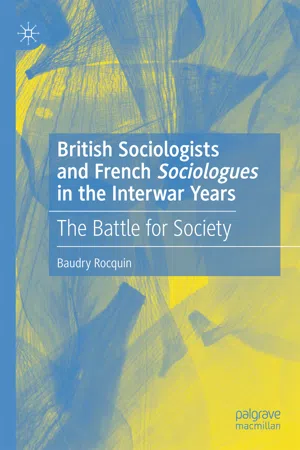
eBook - ePub
British Sociologists and French 'Sociologues' in the Interwar Years
The Battle for Society
- English
- ePUB (mobile friendly)
- Available on iOS & Android
eBook - ePub
British Sociologists and French 'Sociologues' in the Interwar Years
The Battle for Society
About this book
Information
© The Author(s) 2019
Baudry RocquinBritish Sociologists and French 'Sociologues' in the Interwar Years https://doi.org/10.1007/978-3-030-10913-4_11. Introduction
Baudry Rocquin1
(1)
University of Strasbourg, Strasbourg, France
Baudry Rocquin
As Thatcher put it as late as 1987, ‘You know, there is no such thing as society. There are individual men and women, and there are families’. There was a strong continuity of mistrust since the nineteenth century towards a discipline that would ‘empower’ society in any way thus making it ‘form men’s minds and control their behaviour’ (Lukes 1973). 1 There seemed to be nothing more pernicious and unacceptable than this fuzzy theory.
This, so to say, justified the British ‘lacuna’ in the domain: Sociology seemed like a product unsuitable to the British mindset and to the country owing to a strong belief in society where the individual was considered an illusion, and Marxism opposed (Goldman 1987; Anderson 1992). This is the typical explanation.
For a long time indeed, British sociology has been considered a ‘failure’ in that it would not have been able to compete with other countries in the field of ideas for being too ‘conservative’ (Soffer 1982). But for British writers, on the contrary this showed how the discipline , supposed to be a science of society, was unnecessary and obnoxious proving on the contrary that ‘everything was alright’ in Britain (Goldman 1987). Politics was open, universities were closed to this strange mixture of Latin and Greek (Abrams 1968). Who needed a sociology was probably a country that required a crutch to progress owing to an intellectual handicap.
This book argues, by taking a comparative and transnational approach, in fact that the country one had in mind when arguing this was a long-standing rival, where that science thrived. Another cause for this long distrust of sociology originally came from the fact that it was… French!
This unfortunate association between a strange science (sociology ) that seemed unfathomable to Britain in the first place and its French origins was too much to bear and accept in academia, especially at Oxbridge . This is what American observers had noted for a long time (Palmer 1927; Harper 1933), but this aspect had been downplayed because histories of British sociology (and also of French sociology , on the other hand such as [Heilbron 2015]) have always considered it a domestic phenomenon and limited its investigations to native ideas—which could not make entire sense. The history was partial and biased. At the same time, it is easy to understand why taking inspiration from a foreign, rival country was hard to swallow—just like it was hard for the French, who prided themselves, with Émile Durkheim , of inventing the discipline , that the British could be genuine competitors.
As a result of this long-time rivalry, there was a battle for society between budding British sociologists and well-established French sociologues that took place during the interwar years. This period saw the most exciting developments for the discipline in Britain , while the old French hegemony over sociologie slowly waned, and yet one had not the slightest idea of what had happened between 1919 and 1940. It remained for a long time the most nebulous era for sociology despite several efforts (Abrams 1968; Halsey 2004; Evans 1986).
This was the period when the battle for society, the second one after 1890 (see Chapter 2) that was initially won by Emile Durkheim against Herbert Spencer , was discretely won by the British. This book argues that, opposed to what had always been thought and said, the interwar years were far from a no-go zone for British sociologists ; on the contrary it was a time of great methodological innovations (see Chapter 5 on the social survey ), institutional advances (see Chapter 3) and new ideas (see Chapter 4) that put British sociologists at the forefront of the battle for society with the French especially. All major concepts of post-war US sociology originated from interwar British sociology , and it is time to recall this fatherhood.
What did this have to do with the French? The thing is that sociologie was invented by one man, Émile Durkheim , whose ideas would split the sociological movement in Britain in two. This book is not a history of the Durkheimian movement which has largely been written already (Besnard 1983), however it brings a novel perspective on its development by taking a comparative approach. It also renews the perspective on British sociology by showing how important the opposition to France in the battle for society was in the interwar years, but it is neither a book about social theory itself like (Scott 2018).
Durkheimianism , as his movement of ideas was called, is defined in Chapter 2. However, it is useful to recall that, as the back cover of (Lukes 1973) rather provokingly states, Durkheim’s theory in the 1890s more or less said that ‘society forms men’s minds and controls their behaviour’. This hypothesis determines Durkheim theory and means that individuals are neither free nor fully responsible for their own acts because ‘it’s society’s fault’. This still resonated with Thatcher’s controversial comment of 1987. Durkheimianism reflected the French assumption that the State (or Society) was absolutist, as opposed to English traditions of Liberalism and Idealism . Society was a reality for one, an illusion for the other.
Durkheim’s assertion that ‘Morality is social’ also meant that morality was relative for the French, not based on individual psychology (and thus universal as the British sociologist Edvard Westermarck (1932) had explained) and was thus imposed by Society and not natural (as the Hobbes/Rousseau controversy had showed). According to Durkheim, people were constrained to be moral, they were not it naturally. 2 Durkheim’s sociology was based on the French philosophical assumption on society and opposed the Victorian, ethical ideal prevailing in Britain .
Finally, ‘When told that the facts contradicted his theories, [Durkheim] used to reply: “the facts are wrong”’ (Lukes 1973, 33). Durkheim also embodied the stereotype about the French rationalist/intellectualist bias. As such, he exemplified the Cartesian belief that theory was preceding over facts. It appears that this opposed the English empiricist tradition in philosophy following, especially, Locke. Durkheimianism was equated to an ideology and a blindness to reality for the British.
As a result, Durkheim epitomised the contradictions between the French and British traditions—and was therefore subject to a conscious and voluntary ignorance, if not opposition, in the UK, until Lukes’ illuminating essay in 1973 (Lukes 1973). Sociologie was seen, from the beginning, as a despised French science unsuitable to Britain , all the more since it was associated with the laissez-faire excesses of Herbert Spencer .
But this book argues that it is time to dispel this myth: Sociology was not all Durkheimian, and it has never been wholly or only French, it was always British at the same time. Chapter 3 shows how under ‘a bunch of Scottish amateurs’, sociology was adapted on British grounds from a French, non-Durkheimian inspiration owing to the ideas of the engineer Frédéric Leplay . Patrick Geddes and Victor Branford established a successful, but academically despised because French-inspired and amateurishly conducted, Edinburgh School of Sociology.
It is a mistake nowadays to still see it as foreign, or worse as French. As Chapter 4 shows, a native British tradition also evolved in the work of Leonard Hobhouse , Morris Ginsberg and all the golden generation of esteemed thinkers at the interwar London School of Economics and Political Science (LSE ) who contributed to the British sociological tradition under the name social services, socia...
Table of contents
- Cover
- Front Matter
- 1. Introduction
- 2. Sociologie, a French Science?
- 3. Accepting the French: The Edinburgh School of Sociology
- 4. Rejecting the French: Classical British Sociology at the London School of Economics
- 5. Modernising British Sociology: The Rise of the Social Survey
- 6. Accepting the British: Sociologists and Their Reception in France
- 7. Two Sciences, a Common Concern: French Sociologie and British Social Anthropology
- 8. Conclusion
- Back Matter
Trusted by 375,005 students
Access to over 1.5 million titles for a fair monthly price.
Study more efficiently using our study tools.
Frequently asked questions
Yes, you can cancel anytime from the Subscription tab in your account settings on the Perlego website. Your subscription will stay active until the end of your current billing period. Learn how to cancel your subscription
No, books cannot be downloaded as external files, such as PDFs, for use outside of Perlego. However, you can download books within the Perlego app for offline reading on mobile or tablet. Learn how to download books offline
We are an online textbook subscription service, where you can get access to an entire online library for less than the price of a single book per month. With over 1.5 million books across 990+ topics, we’ve got you covered! Learn about our mission
Look out for the read-aloud symbol on your next book to see if you can listen to it. The read-aloud tool reads text aloud for you, highlighting the text as it is being read. You can pause it, speed it up and slow it down. Learn more about Read Aloud
Yes! You can use the Perlego app on both iOS and Android devices to read anytime, anywhere — even offline. Perfect for commutes or when you’re on the go.
Please note we cannot support devices running on iOS 13 and Android 7 or earlier. Learn more about using the app
Please note we cannot support devices running on iOS 13 and Android 7 or earlier. Learn more about using the app
Yes, you can access British Sociologists and French 'Sociologues' in the Interwar Years by Baudry Rocquin in PDF and/or ePUB format, as well as other popular books in Social Sciences & Social History. We have over 1.5 million books available in our catalogue for you to explore.