This book offers an intellectual history of one of the leading Shi'i thinkers and religious leaders of the 20th-century in Lebanon, Shaykh Muhammad Mahdi Shams al-Din. The author examines his role as the foremost figure of Shi'i intellectual life, a key associate of Musa al-Sadr, and president of the Islamic Shi'i Supreme Council of Lebanon, having maintained the independence of this institution until his death from the domination of Shi'i political parties. The core of the book consists of three interrelated main themes that constitute the major threads of Shams al-Din's intellectual legacy: a discussion of Islamic government involving a critique of Khomeini's theory of wil?yat al-faq?h, the role of Islam within civil government, and the necessity for political integration of the Shi'a in their Arab nation-states to protect them from policies that raise doubts over their political allegiance to their respective countries. The project will appeal to scholars, students, academics, and researchers in Middle Eastern politics and history.
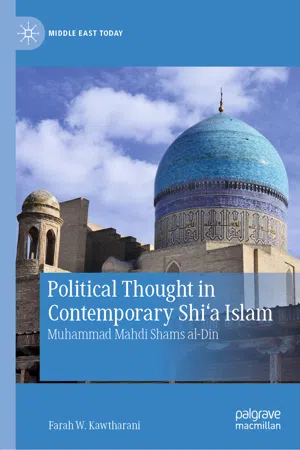
eBook - ePub
Political Thought in Contemporary Shi‘a Islam
Muhammad Mahdi Shams al-Din
- English
- ePUB (mobile friendly)
- Available on iOS & Android
eBook - ePub
About this book
Information
© The Author(s) 2020
F. W. KawtharaniPolitical Thought in Contemporary Shi‘a IslamMiddle East Todayhttps://doi.org/10.1007/978-3-030-28057-4_11. Introduction
Farah W. Kawtharani1
(1)
McGill University, Montreal, Canada
Farah W. Kawtharani
The main focus of this study is the intellectual work and political career of Shaykh Muhammad Mahdi Shams al-Din (d. 2001), a distinguished Shi‘i religious figure of the twentieth century, and one of the most prominent and influential modern Shi‘i intellectual figures in Lebanese history. The significance of his work lies in his linking together of several key Islamic themes relevant to the current Islamic and sectarian state of affairs in Middle Eastern countries. Shams al-Din examined various theories of Islamic government and the role of Islam in multi-confessional societies. His writings and political career centered on forging a civil role for Islam in the public space of modern states, establishing equitable citizenship and political reform in sectarian-based systems of government like Lebanon’s, the safeguarding of Shi‘i minorities in multi-confessional societies, and the protection of Islam from two threats, first that of Communism and second that of radical and militant Islamist movements.
The book analyzes the political thought of Shams al-Din mainly surrounding the issue of government and governmental authority. In particular, it examines his reformist approach in conceptualizing and reformulating the notion of government in two contexts: first within the Islamic tradition and second within a multi-confessional nation-state in a way that also accommodates the needs of an Islamic society. A fundamental preoccupation in Shams al-Din’s thought, in the later stage of his career, was to find ways for Islam to coexist and thrive within multi-confessional nation-states. Because of his experiences in Lebanon and Iraq, he was preoccupied in his consideration of legitimate government—and Islam’s role in it—with trying to theorize a system of government that would be suitable for modern Muslim-majority societies living under the secular jurisdiction of contemporary nation-states, paying particular attention to Shi‘i populations living as minorities or within a multi-confessional society. His intellectual concerns intersected with his political career, which culminated in holding a high official religious position as head of Lebanon’s Islamic Shi‘i Supreme Council (ISSC), and thus brought him in contact and in collaboration with state officials, policy-making, and legislation. In that sense, his thought was a by-product of intellectual engagement steeped in the realities and constraints of political responsibility.
Shams al-Din’s innovative work involved a legal critique of Ayatollah Ruhollah Khomeini’s political theory of wilāyat al-faqīh (the Guardianship of the Jurist), which vests absolute governmental powers in the Guardian-Jurist. In connection with this critique, Shams al-Din developed his own theory of wilāyat al-umma ‘ala nafsiha (the umma’s sovereignty upon itself), which advocates for the establishment of an Islamic government, delegating limited authority to religious jurists (fuqahā’) and investing most powers in the hands of the umma (Muslim community) collectively. This was his response to the widespread repercussions of Khomeini’s thesis, politically on Shi‘a living outside Iran and theologically on Shi‘i ‘ulama whose authority was undermined by the Iran’s Islamic Revolution and by the absolute powers that Khomeini’s theory vested in the Guardian-Jurist. Shams al-Din’s theory of wilāyat al-umma was his own elaboration on the theme of Islamic government as a concept, which he developed and debated during the 1960s and 1970s within the Shi‘i scholarly and political circles of Iraq and Iran. However, his later scholarship was to develop around the prospects of political integration for Shi‘i minority populations living in either multi-confessional societies or Sunni-dominated ones. These intellectual concerns led him to examine the concept of civil government (al-dawla al-madaniyya), which prepared the groundwork for a potentially viable form of government—accepted by Islamic tenets—for multi-confessional societies. He saw this as specifically important for Lebanon, which was witnessing the rise of Shi‘i political Islam and the political empowerment of the Shi‘a in which the Islamic Republic of Iran played a pivotal role.
His theoretical engagements with the concept of government were conjoined with intellectual attempts to secure a public voice for civil Islam and the reinforcement of religion in society in order to protect it from two perceived threats: first, during the 1970s, from leftist secularizing forces that aimed to restrict religion to very limited private spaces such as family law, and second, from Islamism, which in its quest for power, undermined the traditional role of clerics or religious scholars (‘ulama). For that purpose, he was vested in the protection of the Shi‘i juristic tradition and its plurality; he wanted to ensure that the ‘ulama had a protected function within the public sphere and in collaboration with the nation-state.
The book situates Shams al-Din’s intellectual legacy in three contexts that have impacted and shaped the evolution of Shi‘i political thought in regard to government: The first being the transnational context of Shi‘i religious relations across Iraq, Iran, and Lebanon; the second is the national context of Lebanon’s nation-building processes, sectarian politics, inter-confessional relations, and civil war (1975–1990); and the third is the context in which the political mobilization of Lebanese Shi‘a took place and gave rise to Hezbollah since 1984.
By locating the intellectual history of Shams al-Din as a prominent theorist in the religious and political movements of Shi‘i communities, both nationally in Lebanon and transnationally in Iraq and Iran, the book weaves together several themes. It first addresses Islamic reformist thought in regard to government and then links it nationally to inter-confessional relations within sectarian systems, specifically that of Lebanon, before finally linking it transnationally to critiques of Khomeini’s theory upon which the Islamic Republic of Iran is founded. It also contextualizes Shi‘i Islamic political thought within the broader political mobilization and sociopolitical transformations of the Shi‘a throughout the Middle East, who moved from favoring the leftist and Communist movements of the 1970s to Islamist movements in the 1980s due mainly to the influence of the Najaf seminaries in Iraq and the Islamic Revolution in Iran.
I show the interconnectedness of these historical and political contexts and their impact on the development of reformist trends in the twentieth-century Shi‘i Islamic thought, demonstrating the ways in which these trends respond, adapt, and are shaped by the political constraints raised by the jurisdictions and policies of nation-states, be they Islamic or secular. The book also shows that the development of a militant and revolutionary version of Shi‘ism under Khomeini did not totally obfuscate the earlier civil form of Shi‘ism that was open to parliamentary and constitutional forms of government, and which originally developed in Iran at the dawn of the twentieth century. This civil form of politically engaged Shi‘ism was first elaborated in the activism and work of two of the most illustrious and influential Shi‘i Iranian scholars and religious leaders of Najaf’s religious seminaries: Akhūnd Muḥammad Kāẓim Khurasānī (d. 1911) and Ayatollah Muḥammad Ḥussein Nā’īnī (d. 1936). These scholars supported the Constitutional Revolution of Iran in 1906 and wrote about a constitutional and parliamentary form of government in the abs...
Table of contents
- Cover
- Front Matter
- 1. Introduction
- 2. Shams al-Din and the Islamic Scene of Lebanon in the Turmoil of the 1970s and 1980s
- 3. The Shi‘i Imamate Doctrine: Historical and Conceptual Developments
- 4. Against the Absolutist Government: Shams al-Din’s Critique of Khomeini’s Thesis Wilāyat al-Faqīh
- 5. (Im)Permissibility of Cooperation with Unjust Rulers and Modern Governments in Shi‘i Doctrine
- 6. Shams al-Din and Sectarianism in Lebanon
- 7. Where Islam Stands in Civil Government
- 8. Conclusion
- Back Matter
Trusted by 375,005 students
Access to over 1.5 million titles for a fair monthly price.
Study more efficiently using our study tools.
Frequently asked questions
Yes, you can cancel anytime from the Subscription tab in your account settings on the Perlego website. Your subscription will stay active until the end of your current billing period. Learn how to cancel your subscription
No, books cannot be downloaded as external files, such as PDFs, for use outside of Perlego. However, you can download books within the Perlego app for offline reading on mobile or tablet. Learn how to download books offline
Perlego offers two plans: Essential and Complete
- Essential is ideal for learners and professionals who enjoy exploring a wide range of subjects. Access the Essential Library with 800,000+ trusted titles and best-sellers across business, personal growth, and the humanities. Includes unlimited reading time and Standard Read Aloud voice.
- Complete: Perfect for advanced learners and researchers needing full, unrestricted access. Unlock 1.5M+ books across hundreds of subjects, including academic and specialized titles. The Complete Plan also includes advanced features like Premium Read Aloud and Research Assistant.
We are an online textbook subscription service, where you can get access to an entire online library for less than the price of a single book per month. With over 1.5 million books across 990+ topics, we’ve got you covered! Learn about our mission
Look out for the read-aloud symbol on your next book to see if you can listen to it. The read-aloud tool reads text aloud for you, highlighting the text as it is being read. You can pause it, speed it up and slow it down. Learn more about Read Aloud
Yes! You can use the Perlego app on both iOS and Android devices to read anytime, anywhere — even offline. Perfect for commutes or when you’re on the go.
Please note we cannot support devices running on iOS 13 and Android 7 or earlier. Learn more about using the app
Please note we cannot support devices running on iOS 13 and Android 7 or earlier. Learn more about using the app
Yes, you can access Political Thought in Contemporary Shi‘a Islam by Farah W. Kawtharani in PDF and/or ePUB format, as well as other popular books in Politics & International Relations & Middle Eastern Politics. We have over 1.5 million books available in our catalogue for you to explore.