This book explores the role of self-medication in reflexive response to victimhood and victim recovery. Based on interviews, counsellor focus groups and a self-medication survey, it situates self-medication among the coping strategies that may be set in formal and informal networks. Victims primarily seek validation, and this book reviews self-medication with particular focus on how victim-survivors develop a variety of reflexive responses in their attempt to carve out a dignified response to victimization. Validation may be achieved through the pursuit of justice, but many victims suffer from multiple or complex victimisation, with limited social chances necessary to achieve a just outcome. Routines, beliefs and an ordered pathway distinguish a dignified identity and more or less successful recovery adaptations. This book also addresses the practical implications of the findings for support organisations.
eBook - ePub
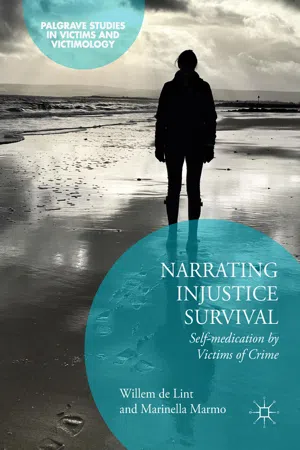
Narrating Injustice Survival
Self-medication by Victims of Crime
- English
- ePUB (mobile friendly)
- Available on iOS & Android
eBook - ePub
About this book
Information
© The Author(s) 2018
Willem de Lint and Marinella MarmoNarrating Injustice SurvivalPalgrave Studies in Victims and Victimologyhttps://doi.org/10.1007/978-3-319-93494-5_11. Victims of Crimes, Self-Medication and Narratives of (In)Justice
Willem de Lint1 and Marinella Marmo1
(1)
College of Business, Government and Law, Flinders University, Adelaide, SA, Australia
Narratives of (In)Justice
How victims 1 review their self-medication using alcohol and other drugs (AOD), whether licit or illicit, is a significant feature of their—and our—understanding of recovery. Victimology 2 is concerned with exploring the reflexive experience of the victim; and there is a growing body of work that is focused on how people who have experienced various types and incidents of victimisation develop strategies or remedies that may assist their progression from victimhood. In this regard, the relationship between AOD use and victimisation is a matter of longstanding criminological interest (Jacobsen et al. 2001; Logan et al. 2002). However, the role of self-medication in shaping or influencing reflexive responses to victimhood, victim recovery and the survivor narrative is ripe for investigation (Morrison et al. 2011). Much scholarly interest in this matter is focused on a simple binary approach that more or less assumes that self-medication is indicative of non-recovery, and therefore the less consumption, the more recovery. Thus, if victims are not improving themselves sufficiently or constructively, they are self-medicating and failing to build the necessary tools for recovery.
This book addresses this issue and adds new nuances to this discourse. The survey research carried out for this book shows that there is indeed an increase in AOD consumption after victimisation. However, this book also draws upon interviews with victims and two focus groups with counsellors to explore and link the victim’s reflexive engagement with active and passive recovery and validation in its many forms. As revealed through our analysis of these interviews and case studies, the binary does not reflect the reality of victims; the assumption that the use of AOD is delaying of or destructive to recovery is not universally correct.
In this book, we are distinguishing the victim narrative from a victim careers perspective. What do we mean by narrative? As explored in Chapter 6, everyone is involved in what Giddens (1991) describes as a ‘reflexive project of the self.’ Every project is unique, comprised of a relation with significant events and the charting of a course that permits engagement with and/or a reappropriation of desires, interests and aspirations. As Giddens and others have pointed out, the way people engage in this reflexive work involves some standard tropes or formulaic storylines concerning how events are plotted and thematised or given meaning.
As is well-known, self-medication is often an adaptive measure taken by victim-survivors in temporary or indefinite support of onto-existential necessities. Giddens (1991, p. 180) notes that ‘therapy is an expert system deeply implicated in the reflexive project of the self.’ He adds that it is ‘a methodology of life planning’ that may either ‘promote dependence or passivity’ or ‘permit engagement and re-appropriation’ (p. 180). In turning to AOD use after trauma, individuals may qualify or amend the view of their own recovery narrative or way forward. Taking note of what Giddens (1986) maintains about active agents—that is, that people are situated actors who try to manipulate affordances, or structural ladders, in response to their situation—our approach is to provide a nuanced account of victim-survivor careers by way of the subject’s reflection.
The tools and pace of recovery are those chosen by each individual. Self-medication may serve the purpose of dulling or displacing engagement, akin to taking time out from the work of recovery. It may be instrumental and a necessary antecedent or co-requisite of a unique recovery path, and thus ought not to be dismissed. That is to say, and as we shall see in Chapters 5 and 6, self-medication is a strategy deployed by victim-survivors that at turns engages and disengages them in their proactive efforts to integrate their daily habits on a pathway according to an affirmative belief. Unpacking their partaking of a recovery narrative is of particular importance for our understanding of their recovery. In sum, an assessment of the views of both victims and counsellors on AOD self-medication suggests the need for this more nuanced account. Narratives of survival emerge from the accounts captured in this research.
The Self-Medicating Victim
AOD use and misuse has been of longstanding interest to criminologists and policymakers because it is concurrent with crime, delinquent behaviour and ‘disorderly’ conduct (Goldstein 1985; Dingwall 2005; AIC 2006; Bennett and Holloway 2009; SAPOL 2010). AOD use may well be directly linked to thrill-seeking or other behaviours that are criminalised (Hovarth and Zuckerman 1993). In turn, early childhood trauma is related to thrill-seeking and this is related to AOD consumption. Early trauma predicts not only possible transit to the criminal justice system as an offender, but also future victimisation (Smith 2017).
There has been far less investigation of AOD consumption in victimology, but the picture emerges as follows. It is well known that self-medication, whether through alcohol, licit or illicit drugs, is linked to victimisation, especially unresolved trauma or post-traumatic stress disorder (PTSD) (Frieze et al. 1987; Ullman 2003; Morrison et al. 2011; Jordan 2013). A handful of empirical studies internationally have examined the experiences of victims in relation to their substance or alcohol use or abuse (Jacobsen et al. 2001; Logan et al. 2002; Grayson and Nolen-Hoeksema 2005; Schuck and Widom 2001; Ullman 2003; Ullman et al. 2007). There is a link between victimisation, mental health problems and AOD use (Dore et al. 2012; Kaysen et al. 2007; Morrison et al. 2011; Resnick et al. 2007). AOD use is associated with a range of concurrent risks related to the health, safety and security of victims (Morrison et al. 2011). For instance, victims of trauma will experience greater vulnerability to drug crime deprivations (Laslett et al. 2015; see also Kaysen et al. 2007; Morrison et al. 2011).
We are beginning to learn more about the use of AOD as a coping strategy. Including AOD use, victims of crime cope with PTSD by turning to a variety of mechanisms. As self-medication, AOD is explored as a means of disengagement (Flynn and Graham 2010; Guggisberg 2010; Morrison et al. 2011). To dull or defer engagement or in the modulation of vulnerabilities (Khantzian 2009), self-medication is adopted by traumatised individuals to manage their daily routines and goals. Through our fieldwork, we have collected data that suggests that AOD consumption following victimisation increases and is more frequent (de Lint et al. 2017).
It is known that, as with many social problems, the nature of the social support and specialised community support networks is crucial to victim assistance (Budde and Schene 2004; Latta and Goodman 2011; Liang et al. 2005; Lugton 1997). 3 There is a positive link between social support networks and violence and victimisation (see Budde and Schene 2004; Murray and Graybeal 2007). How formal and informal support networks function to reduce the prevalence of behaviour that leads to victimisation, revictimisation or future criminal behaviour (Latta and Goodman 2011; Murray and Graybeal 2007) is a matter of some importance on which current research hopes to shed light (de Lint et al. 2017). The...
Table of contents
- Cover
- Front Matter
- 1. Victims of Crimes, Self-Medication and Narratives of (In)Justice
- 2. Methods, Collaboration with VSS and Victim Reflexivity
- 3. Self-Medication and Avoidance Coping
- 4. Validation—Informal and Formal Support in Narratives of Recovery
- 5. Adaptations in Recovery
- 6. Meaning Work and Chance
- 7. Validation, Chance and Justice
- Back Matter
Trusted by 375,005 students
Access to over 1.5 million titles for a fair monthly price.
Study more efficiently using our study tools.
Frequently asked questions
Yes, you can cancel anytime from the Subscription tab in your account settings on the Perlego website. Your subscription will stay active until the end of your current billing period. Learn how to cancel your subscription
No, books cannot be downloaded as external files, such as PDFs, for use outside of Perlego. However, you can download books within the Perlego app for offline reading on mobile or tablet. Learn how to download books offline
Perlego offers two plans: Essential and Complete
- Essential is ideal for learners and professionals who enjoy exploring a wide range of subjects. Access the Essential Library with 800,000+ trusted titles and best-sellers across business, personal growth, and the humanities. Includes unlimited reading time and Standard Read Aloud voice.
- Complete: Perfect for advanced learners and researchers needing full, unrestricted access. Unlock 1.5M+ books across hundreds of subjects, including academic and specialized titles. The Complete Plan also includes advanced features like Premium Read Aloud and Research Assistant.
We are an online textbook subscription service, where you can get access to an entire online library for less than the price of a single book per month. With over 1.5 million books across 990+ topics, we’ve got you covered! Learn about our mission
Look out for the read-aloud symbol on your next book to see if you can listen to it. The read-aloud tool reads text aloud for you, highlighting the text as it is being read. You can pause it, speed it up and slow it down. Learn more about Read Aloud
Yes! You can use the Perlego app on both iOS and Android devices to read anytime, anywhere — even offline. Perfect for commutes or when you’re on the go.
Please note we cannot support devices running on iOS 13 and Android 7 or earlier. Learn more about using the app
Please note we cannot support devices running on iOS 13 and Android 7 or earlier. Learn more about using the app
Yes, you can access Narrating Injustice Survival by Willem de Lint,Marinella Marmo in PDF and/or ePUB format, as well as other popular books in Social Sciences & Civil Rights in Law. We have over 1.5 million books available in our catalogue for you to explore.