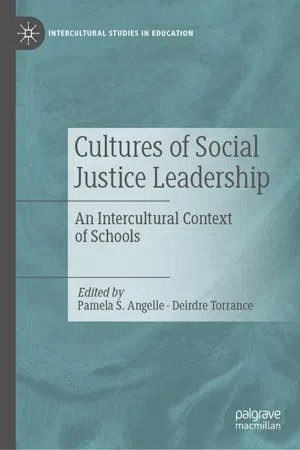
This book explores our understanding of school leaders' actions as they work to enact a socially just school culture. Including unique case studies from around the globe, the editors and contributors examine whether this work is enhanced or diminished by the context in which the school is placed. While the onus of emphasising social justice is placed on the school leader, they must enact this within the micro/meso/macro context of the school setting. Rich in both the unique stories of these schools and their successes and challenges in the enactment of social justice, these global case studies act as a lens for social justice leadership in a variety of regions and at international levels. The global scale combined with detailed analysis of this book will appeal to scholars of education and social justice as well as school leaders and policy makers.
eBook - ePub
Cultures of Social Justice Leadership
An Intercultural Context of Schools
- English
- ePUB (mobile friendly)
- Available on iOS & Android
eBook - ePub
Cultures of Social Justice Leadership
An Intercultural Context of Schools
About this book
Information
Topic
EducationSubtopic
Comparative Education© The Author(s) 2019
Pamela S. Angelle and Deirdre Torrance (eds.)Cultures of Social Justice LeadershipIntercultural Studies in Educationhttps://doi.org/10.1007/978-3-030-10874-8_11. The Influence of Global Contexts in the Enactment of Social Justice
Deirdre Torrance1 and Pamela S. Angelle2
(1)
Moray House School of Education , University of Edinburgh, Edinburgh, Scotland, UK
(2)
Department of Educational Leadership and Policy Studies, University of Tennessee, Knoxville, TN, USA
Introduction and Overview
Competition in the global marketplace has placed education under increasing pressure to deliver improved services to meet the needs of society. In response, over the past thirty years, the discourse surrounding educational administration, management and more recently leadership has significantly changed, responding to increased international concern with the school improvement agenda. Leadership is now believed to positively impact on school achievement and pupil attainment, with corresponding efforts to increase leadership capacity across a school’s staff and wider community. However, despite such attention placed on and belief in educational leadership it is under-developed, tending towards the prescriptive rather than empirically based (Dimmock 2012). Conceptualisations of educational leadership continue to evolve, both in theory and in practice. Leadership is often interpreted as involving a relationship of social influence, fluid in its practice across the school organisation, responsive to context and purpose, although whose influence and for what purpose is less often discussed (Torrance 2018).
In more recent years, the concept of social justice leadership has emerged within the literature and policy discourse to describe the work of school leaders seeking to enhance the educational experience of all learners (Torrance and Forde 2017a), in a bid to reduce inequalities in education systems (King and Travers 2017, p. 147). Despite the current international interest in social justice generally and social justice leadership more specifically, the concept of social justice is inherently problematic. Indeed, Gewirtz (1998) argues that the concept of social justice in studies of educational policy is under-theorised in research. Its usage reflects a ‘broad range of philosophical and political traditions’ (Barnett and Stevenson 2015, p. 520). As such, defining social justice is problematic since it is understood differently in different fields with definitions derived from a specific discipline (Robinson 2017) and understood differently in diverse societies (Taysum and Gunter 2008). Furthermore, conceptions of social justice need to be fluid and open to change, responsive to ‘time, place and political context’ (Hajisoteriou and Angelides 2014, p. 897). This volume, within the Palgrave MacMillan series Intercultural Studies in Education, takes as its focus social justice leadership in a variety of international settings. It explores social justice across difference contexts, cultures and school-based social groups. In so doing, it provides unique insights to enhance understandings of social justice leadership and to support ongoing discussion in this field.
This introductory chapter provides an overview of the volume as a whole, together with an outline of the volume’s structure and a brief introduction to the focus of each chapter. It begins with an overview of social justice leadership, including an overview of the International School Leadership Development Network (ISLDN) from which this body of work emanates. The chapter then lays the foundations for the importance of context in the enactment of social justice. Indeed, context formed one of the key parameters set for the volume’s chapters, which are identified for the reader in order to explain the guiding principles to which each chapter’s authors adhered. Finally, a brief outline of each chapter is provided to aid the reader with navigating the volume.
Overview of the ISLDN Project
Through collaboration, the British Educational Leadership, Management, and Administration Society (BELMAS) and the University Council on Educational Administration (UCEA) formed the BELMAS-UCEA International School Leadership Development Network (ISLDN) (Angelle 2017a; Young 2017). The ISLDN grew out of discussions that first took place at the UCEA Conference of 2008, with a memorandum of understanding signed at the BELMAS conference of 2009. In 2010, BELMAS and UCEA launched the ISLDN comparative study, examining the preparation and development of school leaders. The Network has since developed to form two strands: (a) preparing and developing leaders who advocate for social justice and (b) preparing and developing leaders for high-need, low-performing schools.
As is discussed in more detail in the next section, the ISLDN research project has drawn from the work of Cribb and Gewirtz (2005) as a starting point for understanding social justice and also from the work of Lee (2010), particularly her micro-political toolkit which highlights the significance of organisational context. Members of Strand A of the ISLDN project have created a continually developing framework within which individual cases of school leadership can be situated, with factors identified to help illuminate the context within which school leaders work. That framework originally drew on previous work by Dimmock et al. (2005), locating schools in a local (micro) context within the national (macro) context. More recently, the ISLDN project has developed that framework further (Morrison 2017), to enable the exploration of the school leader (micro) factors, school (meso) context factors and countrywide (macro) context factors.
The ISLDN research project seeks to better understand how conceptualisations of social justice are articulated by school leaders, and how such articulations inform the actions of school leaders. Moreover, it seeks to better understand what school leaders do when there exists a dislocation between their own sense of social justice and, for example, the notions of social justice articulated in policy discourses. The chapter authors of this volume are members of the ISLDN, appreciative of the opportunity to work collaboratively to enhance comparative understandings of social justice in different international contexts. Through such collaboration, the intention is to deepen our understanding of how school principals lead their schools in ways that reduce inequalities. The ISLDN project has been guided by two overarching issues: how school leaders ‘make sense’ and then ‘do’ social justice.
Overview of Social Justice Leadership
Robinson (2017) traces the development of the construct ‘social justice’ from the early 1900s in the United States and in Britain, expounded through the work of John Dewey in the 1930s, developed further in the 1970s by John Rawls. The term, ‘social justice’ is increasingly used within the international school leadership literature, across diverse contexts by those holding wide-ranging views (Blackmore 2009a; Bogotch 2008). Perhaps unsurprisingly, the term has become rather ambiguous, representing ‘diverse, complex and dynamic meanings’ (Davis et al. 2014, p. 7). While ‘social justice’ may well be problematic with the term being difficult to define, Shields and Mohan (2008, p. 291) provide a helpful frame for the exploration of social justice leadership across different international contexts:
Our concept of social justice is one that identifies issues of power and inequity in schools and society and that challenges personal and systemic abuses of power as well as alienating and marginalizing beliefs, values, and practices.
As previously highlighted, the work of the ISLDN research project formatively drew from Cribb and Gewirtz (2005) as a basis for understanding social justice, as well as Lee’s (2010) micro-political toolkit highlighting the significance of organisational context. Lee’s framework underlines the issues arising from differences in goals, leading to compromise and accommodation within schools as complex organisations. Cribb and Gewirtz’s perspective is helpful for an international research group in acknowledging that social justice can take multiple forms, recognising inconsistent and conflicting approaches, competing perspectives that can create problems and tensions. King and Travers (2017, p. 148) explain that the intention behind its use is often to capture a commitment, in some form, to tackling social injustice:
Social justice is generally accepted as a set of moral values or beliefs centred around justice, respect, equity, and equal opportunities for all regardless of race, ethnicity, creed, (dis)ability, gender, class, economic status, and other marginalizing circumstances.
Headteachers/principals, regardless of how inclusive or exclusive their style of leadership practice, have a key role to play in the social justice leadership of schools (Angelle 2017b; Blackmore 2006; King and Travers 2017; Richardson and Sauers 2014). Working at the micro level, the headteacher plays a significant role in shaping the conditions for learning (Forde and Torrance 2017), exerting influence both across the school as an organisation, and at the individual classroom and teacher level (Torrance and Forde 2017b). Indeed, the ‘desire to make a difference and contribute to the greater good is the genesis of the social justice leader’ (Robinson 2017, p. 29). Subsequently, Bogotch and Shields (2014, p. 10) believe that ‘educational leadership and social justice are, and must be, inextricably interconnected’. McNae (2017, p. 268) goes further to expound: ‘How socially just leaders make sense of their leadership overall is an essential part of being a socially just leader’. However, ...
Table of contents
- Cover
- Front Matter
- 1. The Influence of Global Contexts in the Enactment of Social Justice
- 2. Social Justice Leadership for Academic, Organisational and Community Sustainability in High-Needs Schools: Evidence from New Zealand, Belize and the USA
- 3. Social Justice Leadership, Perceptions and Praxis: A Cross-Cultural Comparison of Palestinian, Haitian and Turkish Principals
- 4. Systems of Education Governance and Cultures of Justice in Ireland, Scotland and Pakistan
- 5. School Leadership, Curriculum Diversity, Social Justice and Critical Perspectives in Education
- 6. Leadership for Social Justice in Schools in Mexico, New Zealand, and Spain
- 7. Leadership for Social Justice: Intercultural Studies in Mexico, United States of America, and Spain
- 8. Local Implementation of National Policy: Social Justice Perspectives from the USA, India, and Wales
- 9. The Significance of Context in the Enactment of Social Justice
- Back Matter
Trusted by 375,005 students
Access to over 1.5 million titles for a fair monthly price.
Study more efficiently using our study tools.
Frequently asked questions
Yes, you can cancel anytime from the Subscription tab in your account settings on the Perlego website. Your subscription will stay active until the end of your current billing period. Learn how to cancel your subscription
No, books cannot be downloaded as external files, such as PDFs, for use outside of Perlego. However, you can download books within the Perlego app for offline reading on mobile or tablet. Learn how to download books offline
Perlego offers two plans: Essential and Complete
- Essential is ideal for learners and professionals who enjoy exploring a wide range of subjects. Access the Essential Library with 800,000+ trusted titles and best-sellers across business, personal growth, and the humanities. Includes unlimited reading time and Standard Read Aloud voice.
- Complete: Perfect for advanced learners and researchers needing full, unrestricted access. Unlock 1.5M+ books across hundreds of subjects, including academic and specialized titles. The Complete Plan also includes advanced features like Premium Read Aloud and Research Assistant.
We are an online textbook subscription service, where you can get access to an entire online library for less than the price of a single book per month. With over 1.5 million books across 990+ topics, we’ve got you covered! Learn about our mission
Look out for the read-aloud symbol on your next book to see if you can listen to it. The read-aloud tool reads text aloud for you, highlighting the text as it is being read. You can pause it, speed it up and slow it down. Learn more about Read Aloud
Yes! You can use the Perlego app on both iOS and Android devices to read anytime, anywhere — even offline. Perfect for commutes or when you’re on the go.
Please note we cannot support devices running on iOS 13 and Android 7 or earlier. Learn more about using the app
Please note we cannot support devices running on iOS 13 and Android 7 or earlier. Learn more about using the app
Yes, you can access Cultures of Social Justice Leadership by Pamela S. Angelle, Deirdre Torrance, Pamela S. Angelle,Deirdre Torrance in PDF and/or ePUB format, as well as other popular books in Education & Comparative Education. We have over 1.5 million books available in our catalogue for you to explore.