This innovative book examines the discourse of reality television, and the elasticity of language in the popular talent show The Voice from a cross-cultural perspective. Analysing how and why elastic language is used in persuasion and comforting, a comparison between Chinese and English is made, and the authors highlight the special role that elastic language plays in effective interactions and strategic communication. Through the lens of the language variance of two of the world's most commonly spoken languages, the insights and resources provided by this book are expected to advance knowledge in the fields of contrastive pragmatics and cross-cultural communication, and inform strategies in bridging different cultures. This study highlights the need to give the elastic use of language the attention it deserves, and reveals how language is non-discrete and strategically stretchable. This book will be of interest to academics and postgraduate students engaged in elastic/vague language studies, cross-cultural pragmatics, media linguistics, discourse analysis, sociolinguistics and communication studies.
eBook - ePub
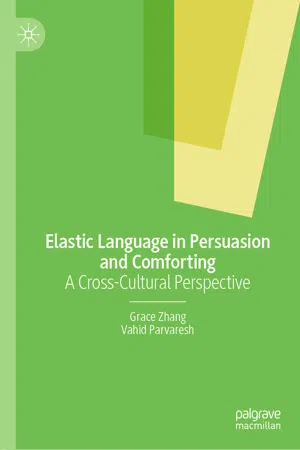
Elastic Language in Persuasion and Comforting
A Cross-Cultural Perspective
- English
- ePUB (mobile friendly)
- Available on iOS & Android
eBook - ePub
Elastic Language in Persuasion and Comforting
A Cross-Cultural Perspective
About this book
Information
Subtopic
Film & Video© The Author(s) 2019
G. Zhang, V. ParvareshElastic Language in Persuasion and Comfortinghttps://doi.org/10.1007/978-3-030-28460-2_11. Introduction
Grace Zhang1 and Vahid Parvaresh2
(1)
School of Education, Curtin University, Bentley, WA, Australia
(2)
School of Humanities and Social Sciences, Anglia Ruskin University, Cambridge, UK
- Man:
- Will you marry me?
- Woman:
- Maybe.
The man is proposing to the woman and her response, maybe, has more than one potential meaning (Verschueren, 1999). The most likely meaning is that she is uncertain about whether to marry this man; another interpretation could be that she is playing hard to get. Maybe is a type of language which is termed ‘elastic language’ (EL) (Zhang, 2015). EL refers to utterances with fluidity, where language interpretations overlap. EL enables language stretching which refers to a phenomenon where unspecific utterances are modified to accommodate particular communicative needs.
This book is a pragmatic study, investigating EL in Chinese and English from a cross-cultural perspective. Cross-cultural pragmatics has been a growing research field over the past two decades (e.g. Wierzbicka, 2003), and is one which requires further exploration. This book provides an original contribution to this field of study by making a comparison between Chinese and English EL data. This is an important but somewhat neglected area of language use. Based on data derived from US and Chinese reality television shows, this study carries out a pragma-linguistic analysis to reveal shared and culturally specific linguistic features of language stretching. It exposes the illusion of precision and contributes to the field of pragmatics of language as a conceptual and empirical enrichment of the study of language stretching.
This study has benefitted from a mixed methods research design which utilises both quantitative and qualitative analyses. The data analysis consists of a multifaceted investigation which includes lexical patterns and pragmatic functions. Sociocultural factors that may trigger and influence language stretching were also investigated to provide a suitable analysis.
This particular chapter establishes the tone of the book and includes definitions of the terms that are used in this study. Research questions, the purpose of this study and the organisation of this book will also be discussed here.
1.1 Definitions
This section discusses four definitions: EL, elasticity, language stretching and vague language (VL). More detailed discussion on the terms can be seen in Chapter 2.
1.1.1 Elastic Language, Elasticity and Language Stretching
EL, according to Zhang (2015), refers to a language which is used like a piece of elastic: it can be stretched to suit various communicative goals. In this case, ‘stretch’ refers to “extending or modifying the scope or meaning of an expression, and is a technical term with no negative connotation” (p. 6). The main feature of EL is its fluidity, manifested as “unspecific and overlapping, context-dependent and socially variable” (p. 6). Elasticity is an inexplicit form of linguistic communication and can be stretched and negotiated to suit communicative purposes (Zhang, 2011, p. 573) . Elasticity refers to “the tendency of utterances to be fluid, stretchable and strategic”, and stretchability is manifested as “rubber-band-like and with multiple trajectories” (Zhang, 2015, p. 6) . For example, about, when added to 20, stretches 20 to the left and right to form an interval of numbers which potentially belong to about 20. Very stretches cold upwards to a greater degree of coldness and, conversely, a little stretches cold downwards to a lesser degree of coldness. About 20, very cold and a little cold are all examples of elastic expressions.
Language stretching refers to the ways in which unspecific utterances are modified to accommodate particular communicative needs. This study investigates language stretching in US and Chinese reality television discourse and provides a comparative analysis between different cultures to advance our knowledge of cross-cultural communication. Language stretching is enabled by employing EL which carries “non-specific and stretchable meaning, in that the speaker either cannot be more specific or (more often) strategically makes it less specific” (Zhang, 2015, pp. 4–5) . For example, in ‘He has left Perth, I think’, ‘I think’ is an elastic expression to mitigate the degree of certainty.
The deciding factor as to whether or not the elasticity of communication is ethical or effective rests on the interactants in question and their communicative goals, rather than on EL itself (Eisenberg, 1984; Glinert, 2010). Glinert (2010, p. 58) uses the concept of a rubber band to metaphorically describe how words are stretched to meet the needs of both sides in the interaction, for example, to serve the different face needs in a confrontational situation, or to resolve misunderstanding between people with different languages and different cultures.
Language stretching adheres to Grice’s (1975) cooperative maxims (e.g. ‘don’t say more than you need to say’), and Sperber and Wilson’s (1986/1995) relevance theory: effective communication enables interlocutors to obtain optimal cognitive effect with the least processing effort. While these two are relevant to this study in some respects, elasticity theory (Zhang, 2011, 2015) has been specifically developed to explain the phenomenon of EL, which will form the primary theoretical framework for this study. The theory proposes three interconnected principles of language, namely fluidity, stretchability and strategy, and four maxims, go approximate, go general, go scalar and go epistemic. In particular, it explains how and why we stretch our words in response to the demands posed by the context.
This study fills the research gap by exploring the richness and diversity of EL, and offers a new perspective derived from reality television discourse. In particular, the cross-cultural aspects and comparisons between speakers of English and Chinese contribute to its overall significance.
1.1.2 Vague Language
The term ‘EL’ is developed from the term ‘vague language’ (VL). The two terms are essentially interchang...
Table of contents
- Cover
- Front Matter
- 1. Introduction
- 2. Theoretical Foundations
- 3. Methodology
- 4. Elastic Language in the Chinese Data
- 5. Elastic Language in the English Data
- 6. Comparison Between the Chinese and English Findings
- 7. Elastic Language and Impact Factors
- 8. Conclusions
- Back Matter
Trusted by 375,005 students
Access to over 1.5 million titles for a fair monthly price.
Study more efficiently using our study tools.
Frequently asked questions
Yes, you can cancel anytime from the Subscription tab in your account settings on the Perlego website. Your subscription will stay active until the end of your current billing period. Learn how to cancel your subscription
No, books cannot be downloaded as external files, such as PDFs, for use outside of Perlego. However, you can download books within the Perlego app for offline reading on mobile or tablet. Learn how to download books offline
Perlego offers two plans: Essential and Complete
- Essential is ideal for learners and professionals who enjoy exploring a wide range of subjects. Access the Essential Library with 800,000+ trusted titles and best-sellers across business, personal growth, and the humanities. Includes unlimited reading time and Standard Read Aloud voice.
- Complete: Perfect for advanced learners and researchers needing full, unrestricted access. Unlock 1.5M+ books across hundreds of subjects, including academic and specialized titles. The Complete Plan also includes advanced features like Premium Read Aloud and Research Assistant.
We are an online textbook subscription service, where you can get access to an entire online library for less than the price of a single book per month. With over 1.5 million books across 990+ topics, we’ve got you covered! Learn about our mission
Look out for the read-aloud symbol on your next book to see if you can listen to it. The read-aloud tool reads text aloud for you, highlighting the text as it is being read. You can pause it, speed it up and slow it down. Learn more about Read Aloud
Yes! You can use the Perlego app on both iOS and Android devices to read anytime, anywhere — even offline. Perfect for commutes or when you’re on the go.
Please note we cannot support devices running on iOS 13 and Android 7 or earlier. Learn more about using the app
Please note we cannot support devices running on iOS 13 and Android 7 or earlier. Learn more about using the app
Yes, you can access Elastic Language in Persuasion and Comforting by Grace Zhang,Vahid Parvaresh in PDF and/or ePUB format, as well as other popular books in Media & Performing Arts & Film & Video. We have over 1.5 million books available in our catalogue for you to explore.