This original contribution to business ethics brings together chapters by leading European and Indian scholars and practitioners. Addressing issues of human values, ethics, spirituality and leadership in business the authors aim to create a dialogue and interchange between Indian and European cultural traditions. Topics include spiritual orientations to business in Hindu, Buddhist and Christian traditions; the effect of spirituality upon contemporary leadership theories; sustainable business models in India and Europe and a comparison between Indian and European philosophies of leadership. In exploring what India and Europe can offer to one another in the development of ethical business leadership, Ethical Leadership aims to demonstrate ways to achieve sustainability, peace and well-being.
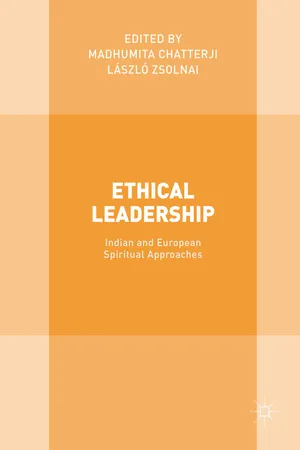
eBook - ePub
Ethical Leadership
Indian and European Spiritual Approaches
- English
- ePUB (mobile friendly)
- Available on iOS & Android
eBook - ePub
Ethical Leadership
Indian and European Spiritual Approaches
About this book
Information
© The Author(s) 2016
Madhumita Chatterji and László Zsolnai (eds.)Ethical Leadershiphttps://doi.org/10.1057/978-1-137-60194-0_11. Questions and Themes in Ethics and Leadership
Madhumita Chatterji1 and László Zsolnai2
(1)
IFIM Business School, Bangalore, India
(2)
Corvinus University of Budapest, Budapest, Hungary
The exchange of ideas between India and Europe about economics and politics dates back centuries. The most important figures in this regard include John Ruskin, Leo Tolstoy, Rabindranath Tagore and Mahatma Gandhi. However, the modern India-Europe dialogue on the spiritual and ethical basis of management and leadership started in the late twentieth century.
S. K. Chakraborty, former professor and founder of the Management Center for Human Values at the Indian Institute of Management in Calcutta, played a pioneering role in this dialogue. His books on the ethos of Indian management (Chakraborty 1991, 1993, 1995, 1999) inspired European management thinkers, including Peter Pruzan, professor at the Copenhagen Business School, to explore the differences and similarities between Indian and European approaches to management theory and practice. (Pruzan 1999, 2001, 2009)
In 2001, László Zsolnai (Corvinus University of Budapest, Hungary) organized the first-ever European conference on ‘spirituality in management’ in Szeged, Hungary. Both Chakraborty and Pruzan participated in this conference and joined in discussions with other European and Indian scholars and practitioners. (Zsolnai (Ed.) 2004)
The Szeged conference was instrumental in the founding of the European Spirituality in Economics and Society (SPES) Forum in Leuven, Belgium. The mission of the European SPES Forum is to promote spirituality as a vital element of social and economic life. SPES is an acronym, but it is also the Latin word for ‘hope’; the virtue that sustains our belief in a better future. The European SPES Forum focuses on investigating and promoting an experience-based spirituality that succeeds in making a connection between day-to-day activities and the inner, multifaceted quest for meaning. One of its main objectives is to provide a platform for the India-Europe dialogue on ethics and spiritual values in business and management. The Bangalore conference on Ethical Leadership in January 9–10, 2014 belongs to this stream of European SPES Forum activities.
In the following section, the most important questions and central themes of the chapters of this volume are detailed.
In his chapter, “Why Do We Need a Spiritual-Based Theory of Leadership?” Luk Bouckaert (Catholic University of Leuven, Belgium) starts with the observation that, while in the previous decennia the business ethics discourse emerged and expanded, the increasing modern interest in spirituality is now expressed through concepts such as spiritual-based leadership, deep change, spiritual capital or spirituality in the workplace. Bouckaert notes that enlightened business leaders often speak about their interests in Zen or other meditative practices. Eastern and Western religious traditions are explored as sources of wisdom and ethical discernment.
Why this shift from ‘business ethics’ to ‘business spirituality’? Does it represent a simple change in vocabulary, or does it point to a deeper source of intuition? And how can we integrate this spiritual sensitivity into a theoretical framework that can support sustainable and coherent managerial practice? Bouckaert warns that without a theoretical framework, spiritual awareness will remain the deeply personal interest of a minority of business leaders, or will only be contained in the back-stories of some exceptional companies. Embedding spirituality into management and decision-making processes requires a spirituality-based theory of leadership. In his chapter, Bouckaert explores some basic paradoxes within the current paradigm of economic rationality and elucidates how references to spirituality can help us to manage those paradoxes. Finally, he describes the concept and the practice of spiritual-based leadership.
In his chapter “Responsible Leadership and Reasonable Action” Zsolnai states that mainstream leadership practices often create negative impacts on nature, future generations and society as a whole. The principle of responsibility requires that leaders achieve their objectives in ecological, future-respecting and pro-social ways.
Zsolnai emphasizes that responsible leadership is consistent with the conception of reason advocated by Indian-American economist Amartya Sen. Reason is the discipline of subjecting one’s choice of action to reasoned scrutiny. Zsolnai identifies three classes of reason which may be applied to scrutinizing leadership choices. He argues that leadership choices should satisfy the criteria of ‘ecological reason’, ‘reason for future generations’ and ‘social reason’. The chapter presents illustrative cases of responsible leadership from India and Europe and discusses how spirituality can assist organizations in their transformation into ecologically sustainable, future-respecting and pro-social entities. Zsolnai concludes that spirituality plays a major role in developing responsible leadership. The spiritually enlightened leader goes beyond self-interested calculations and exercises genuine empathy with others while benefitting from an all-encompassing perspective.
In their chapter “An Ethics of Care induced from Kautilya’s Wisdom” Sharda Nandram (Nyenrode Business University, The Netherlands) and Ankur Joshi (Management Development Institute, New Delhi, India) state that, according to Kautilya (350–275 BC), a leader can only be successful if he or she considers philosophy to be of equal importance to economics and politics, because a philosophical foundation will infuse into praxis the principles of self-regulation, care and transcendence. Although Kautilya’s teachings originally referred to leaders in the context of politics (heads of state), they are applicable to other forms of leadership.
Kautilya took a holistic view of leadership which can now be equated with stewardship theory. The lack of application of this concept is a weakness in leadership approaches, but it is being incorporated into the management theory of stewardship. The concept of transcendence in leadership theory is new. Transcendence is the understanding that we are part of a larger universe, have extended responsibility and must obey the laws of nature. We can look back at Kautilya’s work to better understand how these principles can be applied and explained to leaders.
In their chapter “A Multidimensional View of Leadership from an Indian Perspective” V. Adinarayanan, V. Smrithi Rekha and D.G Sooryanarayan (Amrita University, Coimbatore, India) observe that there now exists a significant global movement that supports sustainable practices, green thinking, environmental consciousness, a wider sense of social responsibility and a more inclusive economics. We are also starting to witness a change in the fundamental objectives of business, away from a pure focus on profit to a more inclusive outlook. The authors believe that such a transition calls for a change in the thought processes of leadership. India, with its rich and well-established spiritual traditions, can provide a roadmap for the realization of this transition. In their chapter, the authors propose adopting a multidimensional view of leadership that employs an Indian perspective. They demonstrate the relevance of ancient Indian principles to modern day leadership, and explain how leadership can incorporate ethics by paying homage to Indian scripture.
In their chapter “Indian Spiritual Traditions as Inspiration for Ethical Leadership and Management in Europe”, Gerrit De Vylder (Catholic University of Leuven, Belgium) and Hendrik Opdebeeck (University of Antwerp, Belgium) explore the influence of Hindu, Buddhist and Sufi traditions on the work of European thinkers and management executives. The authors emphasize that while many management and organizational scholars recognize that cultural differences can significantly influence management and working practices, the impact of applying wisdom from other cultures to management practices remains largely unexplored.
De Vylder and Opdebeeck analyze the work of A. Osborne (who was influenced by Sri Ramana Maharshi, a Tamil guru who advocated Advaita Vedanta), A. Schweitzer (influenced by the Bhagavad Gita and Karma Yoga), E. F. Schumacher (influenced by Buddhism and Gandhi) and H. J. Witteveen (influenced by Inayat Khan, a North-Indian Sufi). The chapter provides the background for introducing ethical principles from Indian spiritual traditions into management, while also demonstrating that such principles do not contradict so-called ‘Western’ ethical approaches. De Vylder and Opdebeeck conclude through their comparison of Indian and European traditions that religion does not necessarily divide people, but can create common ground for better communication and ethics.
In their chapter “Integrating Servant Leadership and Ethical Leadership” Asi Vasudeva Reddy and A.V.S Kamesh (KL University, Guntur, India) review leadership styles. Leaders typically display the behavior needed to consistently influence and motivate subordinates, and are equipped with ethical and moral values, and a zeal to serve. The chapter calls for more ‘servant’ and ‘ethical’ leadership, and investigates the way these approaches can be implemented in organizations. Ethical leadership is transformational leadership coupled with a moral foundation, while servant leadership refers to an attitude of serving followers through the principle of stewardship. The authors critically review both models and offer a blended model of serving that fits into the organizational context. Their model stresses that leaders must be trained in morals to promote the common good.
In his chapter “Spiritual-Based Leadership from the Perspective of the Bhagavad Gita”, C. Suriyaprakash (Jansons School of Business, Coimbatore, India) analyzes the Spiritual-based Leadership Research Programme (SLRP) which investigated the nature, activities and results of leading from a spiritual perspective. The outcome of the program was the book Leading with Wisdom (Pruzan and Pruzan Mikkelsen 2007), in which the profiles of 31 spirituality-based executives from 15 countries, representing six continents, were detailed. These profiles were classified into universal values such as love, compassion, divinity and the like.
The chapter analyzes the profiles of the 31 spiritual-based leaders of the SLRP. It explores to what extent the lives of these leaders from diverse global cultures embody the principles and teachings of the Bhagavad Gita. The aim is to empirically verify and establish the cross-cultural relevance of the age-old wisdom contained in the Gita, resulting in a truly Indian model of leadership called Wisdom Leadership.
In her chapter “Literature as a Mirror for Leadership” Rita Ghesquière (Catholic University of Leuven, Belgium) refers to contemporary philosophers such as Martha Nussbaum, Richard Rorty and Jill Kerr Conway who believe in narrative ethics. They consider that the spiritual self can be approached through literature. While philosophy argues and teaches, literature demonstrates. Narratives hold up a mirror and confront the reader with an radically other phenomena that questions self-evident norms and values. The chapter focuses on examining three literary models that could help entrepreneurs and leaders to reflect on their positions and to make choices that are more conscious.
Ghesquière reminds us that the fable has its roots in popular tradition. Fables from different cultures often have similar messages, and they are by nature didactic. The story, often told through an animal protagonist, demonstrates a proof, while a saying recapitulates a message in a nutshell. Fables promote practical wisdom by associating concrete activities with general rules.
A novel, however, is far more complex, emphasizes Ghesquière. Novels can provide a broad panoramic view of society, politics and economics, and enhance our awareness of life’s opportunities. By reading novels, a reader develops the capacity to see the world through another person’s eyes. An autobiography is situated at the border of fiction. Reading about other people’s lives holds a specific attraction; it involves a process of continuous reflection about our own existence.
In their chapter “Mindfulness and Non-Violence in Doing Business” Gabor Kovacs and Andras Ocsai (Corvinus University of Budapest, Hungary) start with the observation that both mindfulness and non-harming are traditional Indian virtues. In modern times, more emphasis has been placed on mindfulness than non-harming. Mindfulness has become an important practice of many successful entrepreneurs, CEOs and other leaders.
Mindful leadership is defined as intentionally paying attention to the present moment in a non-judgmental way. Mindfulness can be a key competence of leaders through which they can gain courage, enthusiasm and awareness. Leaders, now more than ever, cultivate mindfulness for the purpose of bringing their mind’s capabilities to bear on the practice of leadership.
Kovacs and Ocsai believe that non-harming is more important than even before, especially now that humanity has the power and technology to influence and change the vital functioning of the planet. The authors describe business models that operate with the goal to practically implement the principle of non-harming, for example community-supported agriculture, ethical banking and the slow food movement. They also present cases of entrepreneurial initiatives that are based on the goals of non-harming: Windhorse Evolution, the Apopo Foundation, Interface and the Social Venture Network.
In her chapter “Connectedness and Spirituality: Hindu and Christian Examples of Spiritual-Based Entrepreneurship” Katalin Illes (University of Westminster, London, UK) reminds that interest in spirituality is growing in Western countries, where ego-driven, materialistic behavior permeates organizations and society as a whole.
Illes believes that spiritual traditions can help by putting human existence into a broader context, and support the integration into daily life of moral values and behaviors that can create a happier and more meaningful existence. Her chapter includes two cases: one involving a Hindu social entrepreneur, and one concerning a Christian social entrepreneur. Illes concludes that by tapping into the timeless wisdom of our human heritage we can connect with others in meaningful ways, overcome cultural, political and religious barriers and find new ways of working together.
In their chapter “Going Beyond Profit: A Case Study of the CSR Initiative of Titan, Tata Group” Madhumita Chatterji (IFIM Business School, Bangalore, India) and Nitha Palakshappa (Massey University, New Zealand) give an introduction to the Tata Group, one of the biggest business conglomerates in India. They then describe Tata’s precision engineering division, Titan, making reference to the strategy, business ventures and social responsibility that are ingrained in the company. They argue that the foundation of the Tata Group’s values appears to be an outcome of applying the spiritual principle of proactively giving back to society. The authors analyze the branding strategy, product categories and Corporate Social Responsibility (CSR) initiatives of Tanishq, the jewelry division of Titan, through a focus on “Mr Perfect” and “Karigar Park”, two of Tanishq’s innovative CSR initiatives.
Tanishq seeks to support social welfare activities without exception as it strives to follow the Tata tradition of going beyond the financial bottom line. Company leaders appear to have realized that having a profitable company which is neither ethical nor sustainable is not supportable by society at large. ‘Exemplifiers’ and ‘self-promoters’ both want to be admired, but the former are more concerned with projecting integrity than projecting their success. Stakeholder commitment (i.e. ensuring the business is held in high esteem) and trust (i.e. expecting the organization to act with integrity) are typically considered to be two important components of corporate reputation. The authors conclude that Tanishq is a self-exemplifier, trusted for its commitment to stakeholders’ wellbeing and the common good.
In the chapter “Spirituality and Effectiveness in Today’s Workplace” Lakshminarasimha (IBS Bangalore, India) observes that modern digital workplaces are strongly goal-oriented and dehumanizing. Stress, combined with poor interpersonal relationships leads to the formation of a negative atmosphere in the workplace and reduce...
Table of contents
- Cover
- Front Matter
- Part I. Introduction
- Part II. Spirituality as an Inspiration for Leadership
- Part III. Ethical Leadership in Practice
- Part IV. Conclusions
- Correction to: An Ethics of Care Induced from Kautilya’s Wisdom
- Back Matter
Trusted by 375,005 students
Access to over 1.5 million titles for a fair monthly price.
Study more efficiently using our study tools.
Frequently asked questions
Yes, you can cancel anytime from the Subscription tab in your account settings on the Perlego website. Your subscription will stay active until the end of your current billing period. Learn how to cancel your subscription
No, books cannot be downloaded as external files, such as PDFs, for use outside of Perlego. However, you can download books within the Perlego app for offline reading on mobile or tablet. Learn how to download books offline
Perlego offers two plans: Essential and Complete
- Essential is ideal for learners and professionals who enjoy exploring a wide range of subjects. Access the Essential Library with 800,000+ trusted titles and best-sellers across business, personal growth, and the humanities. Includes unlimited reading time and Standard Read Aloud voice.
- Complete: Perfect for advanced learners and researchers needing full, unrestricted access. Unlock 1.5M+ books across hundreds of subjects, including academic and specialized titles. The Complete Plan also includes advanced features like Premium Read Aloud and Research Assistant.
We are an online textbook subscription service, where you can get access to an entire online library for less than the price of a single book per month. With over 1.5 million books across 990+ topics, we’ve got you covered! Learn about our mission
Look out for the read-aloud symbol on your next book to see if you can listen to it. The read-aloud tool reads text aloud for you, highlighting the text as it is being read. You can pause it, speed it up and slow it down. Learn more about Read Aloud
Yes! You can use the Perlego app on both iOS and Android devices to read anytime, anywhere — even offline. Perfect for commutes or when you’re on the go.
Please note we cannot support devices running on iOS 13 and Android 7 or earlier. Learn more about using the app
Please note we cannot support devices running on iOS 13 and Android 7 or earlier. Learn more about using the app
Yes, you can access Ethical Leadership by Madhumita Chatterji, László Zsolnai, Madhumita Chatterji,László Zsolnai in PDF and/or ePUB format, as well as other popular books in Business & Business Ethics. We have over 1.5 million books available in our catalogue for you to explore.