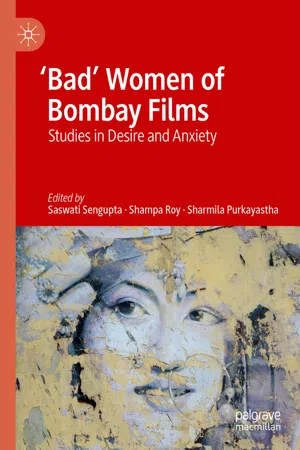
This book presents a feminist mapping of the articulation and suppression of female desire in Hindi films, which comprise one of modern India's most popular cultural narratives. It explores the lineament of evil and the corresponding closure of chastisement or domesticity that appear as necessary conditions for the representation of subversive female desire. The term 'bad' is used heuristically, and not as a moral or essential category, to examine some of the iconic disruptive women of Hindi cinema and to uncover the nexus between patriarchy and other hierarchies, such as class, caste and religion in these representations.
The twenty-one essays examine the politics of female desire/s from the 1930s to the present day - both through in-depth analyses of single films and by tracing the typologies in multiple films. The essays are divided into five sections indicating the various gendered desires and rebellions that patriarchal society seeks to police, silence and domesticate.
eBook - ePub
'Bad' Women of Bombay Films
Studies in Desire and Anxiety
- English
- ePUB (mobile friendly)
- Available on iOS & Android
eBook - ePub
'Bad' Women of Bombay Films
Studies in Desire and Anxiety
About this book
Information
Subtopic
Film & Video© The Author(s) 2019
S. Sengupta et al. (eds.)'Bad' Women of Bombay Filmshttps://doi.org/10.1007/978-3-030-26788-9_11. Introduction: Breaking Bad
Saswati Sengupta1 , Shampa Roy1 and Sharmila Purkayastha1
(1)
Department of English, Miranda House, Delhi University, Delhi, India
hum hein mata-e-kucha o bazaar ki tarah
uthti hein har nigah kharidaar ki tarah. (Dastak 1970)1
I am like a commodity in market-lanes
all eyes gaze on me as though of a buyer.
‘Bad’ Women of Bombay Films: Studies in Desire and Anxiety is a feminist mapping of the articulation and suppression of female desires in Hindi films. It explores the lineament of evil and the corresponding closure of chastisement or domesticity that appear as necessary conditions for the representation of subversive female desires. The book also foregrounds articulations that challenge and dismantle such imprisonments. Our “ways of seeing”3 and the “visual pleasure in narrative cinema”4 as facilitated by the “camera obscura”—“a metaphor for the functioning of ideology by Marx and for the process of the unconscious by Freud”—is the convergence of representations, power relations and their material bases.5
Films, arguably the dominant cultural narrative of our times, play a significant role in the ideological manoeuvering of desire that has been conceptualized variously as “troubled water” (Sartre), signifying a “lack” (Freud, Lacan), an internalization of social codes and “a function of market economy” (Deleuze and Guattari), gendered and, yet, fundamentally inventive (Irigaray, Grosz).6 Further, this gendered map of desire is underscored by the cultural, social and economic differences among women (Spivak).7 Ashis Nandy in a dismissive mode summarizes that, “the popular Hindi film is not concerned with the inner life of the characters on screen”.8 But Hindi cinema where meaning is fabricated through the warp and woof of songs, choreographed dances, formulaic plots with their predictable generic endings, costumed characters enacted often by larger than life “stars” has developed “a distinctly expressive melodramatic language of affect”.9 The grammar and semiotics of interiority in Hindi films is different from that of realism, the dominant western mimetic mode since the late eighteenth century whose attention to quotidian details helps represent its plot developments and characterizations as teleological and natural, mystifying in the process its ideological positions.
Even a random harvest of Hindi films, where the formulaic, the fantastic and the real cohabit, yields desiring women. The declaration of their agency is quite often through songs, albeit penned by male lyricists and helmed by male directors. The singing female figures are often framed against open and expansive landscapes, quite at odds with the confinements of their domesticated lives:This articulation of selfhood that also resonates the decolonized new nation through the evocative word azad/free is often enacted as an exploration of an unknown space visually represented by women negotiating the public terrain on foot, carts, cycles, cars and trains:The female journey is usually truncated by the appearance of the hero and the allure of heterosexual romance but the layering over cannot erase entirely the admission of female picaresque machalti arzoo/intoxicating desire (Parakh 1960).12 This yearning desire to seize the moment is articulated sometimes as an inchoate awakening—
badti chaloon gaati chaloon apni lagan mein
aaj mein azad hoon duniya ke chaman mein…. (Chori Chori 1956)10
Singing, I move on in my own pursuit
today I’m free in the garden of this world.
mausam mastana rasta anjana
jane kab kis more pe ban jaye koi afsana... (Satte Pe Satta 1982)11
The weather is carefree, the road uncertain
who knows what turn it takes to create a legend.
chanchal ho gaye ghungroo mere raton raat kya? (Abhinetri 1970)13
Have my anklets become lively overnight?
—and sometimes as a conscious break from the past:Domestic duties, wifehood and motherhood will eventually discipline these women through the teleological plot of traditional satisfaction. But for the moment they revel in their exhilarating sexuality, and in their freedom to explore and challenge institutionalized faiths:
aaj phir jeene ki tamanna hai… (Guide 1965)14
Today, I wish to live again….
hoon abhi mein jawaan ae dil …
mujh ko behak jaane de, batein na kar hosh ki… (Aar-Paar 1952)15
I am young right now, my heart
let me lose my way, let there be no talk of being sensible…
y...
Table of contents
- Cover
- Front Matter
- 1. Introduction: Breaking Bad
- Part I
- Part II
- Part III
- Part IV
- Part V
- Back Matter
Trusted by 375,005 students
Access to over 1.5 million titles for a fair monthly price.
Study more efficiently using our study tools.
Frequently asked questions
Yes, you can cancel anytime from the Subscription tab in your account settings on the Perlego website. Your subscription will stay active until the end of your current billing period. Learn how to cancel your subscription
No, books cannot be downloaded as external files, such as PDFs, for use outside of Perlego. However, you can download books within the Perlego app for offline reading on mobile or tablet. Learn how to download books offline
Perlego offers two plans: Essential and Complete
- Essential is ideal for learners and professionals who enjoy exploring a wide range of subjects. Access the Essential Library with 800,000+ trusted titles and best-sellers across business, personal growth, and the humanities. Includes unlimited reading time and Standard Read Aloud voice.
- Complete: Perfect for advanced learners and researchers needing full, unrestricted access. Unlock 1.5M+ books across hundreds of subjects, including academic and specialized titles. The Complete Plan also includes advanced features like Premium Read Aloud and Research Assistant.
We are an online textbook subscription service, where you can get access to an entire online library for less than the price of a single book per month. With over 1.5 million books across 990+ topics, we’ve got you covered! Learn about our mission
Look out for the read-aloud symbol on your next book to see if you can listen to it. The read-aloud tool reads text aloud for you, highlighting the text as it is being read. You can pause it, speed it up and slow it down. Learn more about Read Aloud
Yes! You can use the Perlego app on both iOS and Android devices to read anytime, anywhere — even offline. Perfect for commutes or when you’re on the go.
Please note we cannot support devices running on iOS 13 and Android 7 or earlier. Learn more about using the app
Please note we cannot support devices running on iOS 13 and Android 7 or earlier. Learn more about using the app
Yes, you can access 'Bad' Women of Bombay Films by Saswati Sengupta, Shampa Roy, Sharmila Purkayastha, Saswati Sengupta,Shampa Roy,Sharmila Purkayastha in PDF and/or ePUB format, as well as other popular books in Media & Performing Arts & Film & Video. We have over 1.5 million books available in our catalogue for you to explore.