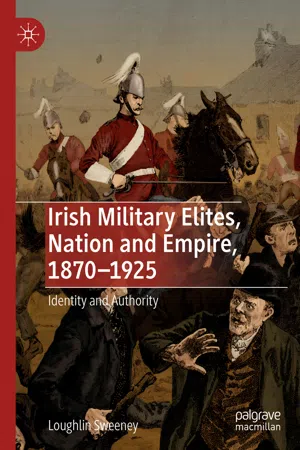
This book is a social history of Irish officers in the British army in the final half-century of Crown rule in Ireland. Drawing on the accounts of hundreds of officers, it charts the role of military elites in Irish society, and the building tensions between their dual identities as imperial officers and Irishmen, through land agitation, the home rule struggle, the First World War, the War of Independence, and the partition of Ireland. What emerges is an account of the deeply interwoven connections between Ireland and the British army, casting officers as social elites who played a pivotal role in Irish society, and examining the curious continuities of this connection even when officers' moral authority was shattered by war, revolution, independence, and a divided nation.
eBook - ePub
Irish Military Elites, Nation and Empire, 1870–1925
Identity and Authority
- English
- ePUB (mobile friendly)
- Available on iOS & Android
eBook - ePub
About this book
Information
© The Author(s) 2019
Loughlin SweeneyIrish Military Elites, Nation and Empire, 1870–1925https://doi.org/10.1007/978-3-030-19307-2_11. Introduction
Loughlin Sweeney1
(1)
John Endicott College of International Studies, Daejeon, Korea (Republic of)
When the Irish ambassador laid a laurel wreath at the Cenotaph in London on Remembrance Sunday 2014, it was the first time a representative of the Irish government had done so since 1946, when Ireland was still a member of the British Commonwealth. Ambassador Dan Mulhall said of the occasion that it demonstrated ‘no contradiction between the rightful commemoration of our own struggle for independence … and remembering the Irish war effort a century ago’; rather, ‘the coincidence of these two sets of events merely serves to highlight the complexity of our national history.’1 The recognition by the State that Irishmen had fought and died in British uniform, and that this fact is worthy of remembrance, evinces a significant shift in public attitudes towards the long and complex relationship between Ireland and the British Army. The First World War has long represented different things in the popular mythologies and cultural traditions of the North and South of Ireland, as Catriona Pennell, Anne Dolan, and others have examined in detail.2 Remembrance of British military service before 1914 evinced an uneasy complicity with the crimes of empire. For many years in the Republic, the British Army was a booming silence, its remains dotting the physical and mental landscape: its former forts strung along the coastline; the stentorian imperial architecture of its barracks and official buildings commanding Ireland’s towns and cities; the whispers of forgotten campaigns in epigraphs on tombstones and monuments; the glinting symbols of British rule—medals and badges sporting crowned heads, crowned harps, elephants, and tigers—tucked away into drawers and forgotten. In Northern Ireland, the British Army was until very recently a painful and immediate presence.
When President Mary McAleese attempted, in the 1990s, to rehabilitate the memories of Irishmen who fell in the First World War, the political context of the Troubles was too present; the memory of catastrophe still too raw and current. In the intervening years, a remarkable change in public attitudes has taken place as increasingly confident Irish publics look to the foundational events of the modern Irish state a century ago.3 Now, it appears that the public is hungry for a popular history that embraces the complexity of these events, and casts them not as legends within the national narrative, but as confused, ambiguous, and contested, paralleling contemporary struggles between religious and national identities in other parts of the world. Where once the commemorative rituals and signifiers of Irish nationality were framed as evidence for exceptionalism, now they are desired as explanations of context.
This book concerns the social history of one overlooked aspect of the British Army in Ireland: the Irish military elite. Three broad thematic areas are considered: social context, military identities, and moral authority. The officer corps is envisaged not simply as a British imposition, but as an organic component of the Irish establishment, characterised by strong ties to Ireland’s civilian social elite, and by its position at a crucial intersection between Ireland, Britain, and the wider British Empire. In the opening chapters, officers will be shown to represent a key aspect of the increasingly close interconnections between the British Army and Irish society in the late nineteenth and early twentieth centuries. The evidence of hundreds of Irish officers is marshalled to illustrate the social, demographic, and imaginative boundaries of the Irish officer corps, and the sometimes surprising ways these seemingly monolithic boundaries could be moulded or stretched by Irish officers.
By examining questions of social advancement, elite socialisation, professionalism, and national identity, the middle chapters of this book identify a nineteenth-century tradition of ‘military Irishness’, and within this context, elaborate the role of Irish officers in the dislocating events of the Great War and Irish independence. In addition to examining prominent military Irishmen, the stories of Irish officers who have thus far been neglected by historians, or who have only been studied as part of a more general Irish ‘establishment’, will be placed to the fore. Studying these officers’ forgotten voices can provide a new perspective on a crucial period of Irish history: the long maturation of Irish nationalism between the 1870s and the 1920s, culminating in the revolutionary period which created the contemporary political structures on the island of Ireland.
The final chapters will portray the decline of Irish officers’ social position, faced with the challenges of the War of Independence, partition, and the Irish Civil War. The Irish military establishment lost its moral authority in this period, though the identity of military Irishness nonetheless survived in small pockets in Ireland, persisted in the overseas British Empire, and attracted Irishmen to serve in the British Army around the world following southern independence.
This book is not a collection of accounts of battle, or a list of the births, deaths, and campaigns of a complete set of Irish officers of the Victorian and Edwardian officer corps. It does not pretend to complete objectivity in its reporting of these men’s lives, which is, in any case, an impossibility due to the limitations of the available sources. It resists prescriptively assigning a definitive answer to the question of what ‘Irishness’ is. Rather, it intends to be an exploration of what a particular, privileged, if increasingly beleaguered segment of the Irish elite imagined itself to represent, and how this sense of identity coloured its interactions with other parts of Irish society, and with different conceptions and performances of Irishness. It is the collective biography of an elite out of place, faced with the erosion of its authority and the irrelevance of its sense of identity.
Military Context
From the creation of a formalised, structured fighting force in the seventeenth century until the time of the Napoleonic Wars, the British Army had been constituted of aristocratic gentlemen who raised bodies of men from the locality, drilled and equipped them, and led them into battle. A centralised army administration emerged during the course of the nineteenth century, with the establishment and growth of training institutions (artillery and engineer officer training began at Woolwich in 1741, training for line officers was instituted at Sandhurst in 1801, and an Army Medical School was eventually established in 1860), and the increasing policymaking authority of the Commander in Chief and War Office. Eventually, an Imperial General Staff was created following the South African War. However, the fundamental ethos and relational paradigm of the British Army remained that of aristocratic officers with a paternalistic attitude to their men, whose essential qualification for their position was tied to their class. The officer class, like the Peerage, represented a sticky form of social distinction that resisted impulses to reform for a long period, and reproduced an archaic sense of identity. How this phenomenon operated in Ireland, in the period when the political and cultural idea of the Irish nation was moving increasingly rapidly in radical new directions, is the central question posed by this book.
At the turn of the nineteenth century, two events took place that prefaced the ever-closer connections between the British Army and Ireland. First, in 1793, the proscription on Catholics and dissenters serving in the British forces, one of the infamous Penal Laws, was abolished, and the era of the ‘Wild Geese’, Catholic gentry and aristocrats serving in the Irish Brigades of continental armies, drew to a close.4 Many of these Catholic aristocrats’ former holdings in Ireland had, in the meantime, been awarded to English officers in recognition of military service, and the male descendants of these Ascendancy officers inaugurated another strand of the Irish military tradition.5 The other event that tied the military and Ireland together was the Napoleonic War, which necessitated the garrisoning of large numbers of troops in Ireland and the construction of new fortifications, stations, and barracks. A key location for organising and drilling soldiers was the Curragh in County Kildare, which was expanded with permanent facilities on the eve of the Crimean War, and which by the late nineteenth century was the largest military installation in the United Kingdom.6 In the following decades, the creation of these institutions provided economic opportunities in garrison towns, a steady income for the young men of rural populations, and a way of life for Irish elites. The persistent poverty of the country ensured a large pool of potential recruits; crises in Ireland, like the Famine and the Fenian revolts, and wars in the empire, provided a steady demand for soldiers. From the eighteenth-century militia and fencible units, to the cavalry of Waterloo and the Crimea, to the dashing exploits of colonial adventurers, the army also provided a prestigious, exciting, and increasingly desirable career to the Irish upper classes.7
The civil and military reforms taking place in the latter half of the nineteenth century afforded many opportunities to Irish candidates for colonial service. From the 1870s, the eminent Victorian soldiers Garnet Wolseley and Frederick Roberts, both Irishmen, gathered around themselves ‘rings’ of talented officers with differing backgrounds and ideas about professionalisation.8 The way in which the Irishness of these two men interacted with their public and professional roles, not only as imperial popular heroes but also as Commanders-in-Chief in Ireland in the 1890s, will be assessed, as will the extent to which the officer corps professionalised, and the potential for demographic change this afforded.
The abolition of the purchase of commissions in 1871, the outcome of an early attempt at officer professionalisation, constitutes the starting point of the period under consideration. Its end point extends beyond the turmoil of the War of Independence, partition, and Civil War, to highlight the continuities that existed after partition. The popular militarism of the beginning of the twentieth century, which was a function of Ireland’s connection to the wider British Empire and manifested itself in public ritual, consumer culture, military ceremonial, and other forms of imperial ornamentalism, began to release its hold on the population as Irish national politics took centre stage. It was to be replaced by different touchstones of identity, concurrent with the creation of two new political units on the island of Ireland in the 1920s. In this crucial period for the formation of modern Ireland, the relationship between the British army and Irish society was of central importance. Professionalisation, class, and empire defined that relationship, and the changing role played by army officers in Irish society reflects the changing nature of Irish identity.
According to Lawrence McBride’s The Greening of Dublin Castle, the advance of constitutional nationalism in Ireland went hand in hand with the professionalisation of the elite spaces of the Irish social structure; the civil service bureaucracy and judiciary increasingly adopted professional norms which dislodged old-fashioned, aristocratic forms of the reproduction of privilege, allowing an increasing number of middle-class administrators into elite spaces. This, in McBride’s analysis, allowed for a broadening of acceptable political opinions, lending a respectability to the moderate nationalism that many of these new middle class elites espoused.9 Contra McBride, however, this relationship between professionalisation and constitutional nationalism does not appear to bear out within the officer corps. Rather, the opposi...
Table of contents
- Cover
- Front Matter
- 1. Introduction
- 2. Defining an Irish Military Elite
- 3. ‘One Ought To Do What One Can for People in His Circ’: Patronage and Affinity among Irish Military Elites
- 4. Ireland’s Imperial Moment: Wolseley and Roberts in Command
- 5. Aid to the Civil Power: The Military Establishment, the Land War, and the Home Rule Crisis, 1879–1914
- 6. Status Quo Ante Bellum: The Irish Military Establishment, 1914
- 7. Irish Officers in the Great War
- 8. The Irish Military Elite and the War of Independence 1918–22
- 9. Barriers Broken: Partition, the Free State, and Empire, 1922–25
- 10. Conclusion
- Back Matter
Trusted by 375,005 students
Access to over 1.5 million titles for a fair monthly price.
Study more efficiently using our study tools.
Frequently asked questions
Yes, you can cancel anytime from the Subscription tab in your account settings on the Perlego website. Your subscription will stay active until the end of your current billing period. Learn how to cancel your subscription
No, books cannot be downloaded as external files, such as PDFs, for use outside of Perlego. However, you can download books within the Perlego app for offline reading on mobile or tablet. Learn how to download books offline
Perlego offers two plans: Essential and Complete
- Essential is ideal for learners and professionals who enjoy exploring a wide range of subjects. Access the Essential Library with 800,000+ trusted titles and best-sellers across business, personal growth, and the humanities. Includes unlimited reading time and Standard Read Aloud voice.
- Complete: Perfect for advanced learners and researchers needing full, unrestricted access. Unlock 1.5M+ books across hundreds of subjects, including academic and specialized titles. The Complete Plan also includes advanced features like Premium Read Aloud and Research Assistant.
We are an online textbook subscription service, where you can get access to an entire online library for less than the price of a single book per month. With over 1.5 million books across 990+ topics, we’ve got you covered! Learn about our mission
Look out for the read-aloud symbol on your next book to see if you can listen to it. The read-aloud tool reads text aloud for you, highlighting the text as it is being read. You can pause it, speed it up and slow it down. Learn more about Read Aloud
Yes! You can use the Perlego app on both iOS and Android devices to read anytime, anywhere — even offline. Perfect for commutes or when you’re on the go.
Please note we cannot support devices running on iOS 13 and Android 7 or earlier. Learn more about using the app
Please note we cannot support devices running on iOS 13 and Android 7 or earlier. Learn more about using the app
Yes, you can access Irish Military Elites, Nation and Empire, 1870–1925 by Loughlin Sweeney in PDF and/or ePUB format, as well as other popular books in History & British History. We have over 1.5 million books available in our catalogue for you to explore.