Through
a comprehensive analysis of cognitive factors and eco-innovation attributes,
this book provides an understanding into why and how renewable energy
technologies are adopted in an emerging market. Drawing on theories such as
theory of reasoned action and theory of planned behaviour, Eco-Innovations in Emerging Markets proposes an extended cognitive
model to analyse consumer behaviour in this area. Through the use of advanced
statistical techniques such as Partial Least Squares, the book presents empirical
data and discusses the implications they pose for policy makers and corporate
managers.
Pável Reyes-MercadoEco-Innovations in Emerging Markets10.1057/978-1-137-58742-8_1
Begin Abstract
1. Macro Perspectives on Eco-Innovations
Pável Reyes Mercado1
(1)
Anáhuac University México, School of Business and Economics, Huixquilucan, México
Abstract
This chapter introduces the background of the study, motivation to develop this research, presents the purpose of the study, the research objectives, and associated research questions. Afterwards, theoretical, practical, and methodological contributions are identified. Finally, the chapter presents the structure of the research.
Energy is the most habitual service of modern times. There is general consensus that higher consumption of energy causes an increase in economic growth in terms of GDP (Lee and Chang 2008; Shiu and Lam 2004; Chontanawa et al. 2008; Coers and Sanders 2012). However, the use of any form of energy must address the particular needs in terms of social, economic, political, and environmental aspects. Current economic models focus on energy protection for various reasons such as avoiding oil crises (Soytas and Sari 2006) or reducing its dependency on the decreasing fossil fuel reserves (Klass 2003). The extensive use of this type of energy involves the usage of natural resources that are non-renewable; that is, that these resources will last for a finite period of time until they are exhausted. In contrast, renewable energy is derived from natural processes that are naturally and constantly replenished (Koroneos et al. 2003). Renewable resources have the advantage of being friendly to the environment since they emit few pollutants to the atmosphere. As the service economy expands all around the world, global energy trends show that renewable energy has been increasingly adopted (REN21 2011) despite the strong reliance economies still have on fossil fuels.
The diffusion and adoption of technological innovations in renewable energy play a critical role since only with the use of such technological innovations would society achieve a green economy paradigm. The diffusion process of innovations in renewable energy is suggested to be influenced in similar ways to the general innovations by both endogenous and exogenous mechanisms (Kemp and Volpi 2008). Besides, there are a variety of factors that affect the innovation process of such technologies in both demand and supply sides as geographical and technological distances along demand–pull effects , and technological opportunity (Verdolini and Galeotti 2011). It has been suggested that one critical variable is price and, thus, external support for the adopter (e.g., subsidies). Price variable has been included in percolation models to predict the adoption levels when subsidies and neighbouring adopters are modified (Cantono and Silverberg 2009). The diffusion rate increases upon a range of subsidy and disappears when the subsidy is out of the effective range. Another critical factor that influences the diffusion of technological innovations in renewable energy is policy. Particularly, climate and innovation policies may hinder the efforts of diffusing such technologies if they are not included into the research framework (Rao and Kishore 2010).
Because of the detrimental features of fossil fuels for the environment, increasing prices and depletion with time, the main challenge to current energy policy makers and corporate strategists is to develop adequate and profitable energy services that allow the transition to a green economy. Green economy is “one that results in improved human well-being and social equity, while significantly reducing environmental risks and ecological scarcities” (UNEP 2011). Green economy also incorporates low-carbon growth, and innovation. It is argued that a strategy to develop a low-carbon economy is to cultivate low-carbon economy consciousness by training up low-carbon consuming habits and lifestyle (Xin et al. 2010). Moreover, the recent growth of CO2 emissions has been led by the emerging economies in spite of the recent crises (Peters et al. 2011). In particular, the latest global financial crisis was considered as a lost opportunity since the emissions trend could not change its current trajectory. Similarly, the 2 °C threshold was proposed in the late 1990s to focus the efforts on avoiding dangerous anthropogenic climate impacts. Given the unfeasibility of this limit, the likelihood of an increase between 3 °C and 4 °C was set. The consequences of such temperature raise involve a high number of countries and stakeholders that may use all available mechanisms to minimize the probability of high temperature climate change. Particularly, non-nation-state actors (NNSAs)—regional, city, local government, private sector, non-for-profit organization, and individuals—are proposed to engage in limiting emissions. Agenda for research includes understanding the ways in which NNSAs may contribute to mitigate emissions and adapt to a warmer world and how they can promote them in both, international and domestic stages (New et al. 2011).
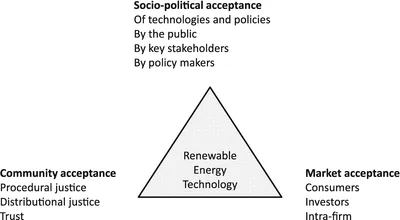
In order to make a transit from the current economic paradigm to a green economy, the adoption and diffusion of renewable energy technological innovations becomes a critical concern that needs prompt clarification. Adoption and diffusion are entangled concepts that have to be explained. According to Rogers (1962), adoption is a concept that involves the analysis and explanation of the factors influencing the purchase of innovations. While diffusion is the process by which an innovation is communicated over time through certain channels to reach the members of a social system. The case of renewable energy innovations involves a multidimensional perspective that has been disregarded in the literature. Socio-political, community, and market acceptance are included in a basic model to depict the complexities and challenges that faces the diffusion and adoption of the environmental innovations (Wüstenhagen et al. 2007).
Figure 1.1 depicts how the market acceptance relates to the participation of both consumers and producers. In the market acceptance apex, consumers may “switch” from their current sources of power to another one. This choice includes the offer of alternate sources (e.g. solar, wind, and biomass power) which are technologically feasible at the micro-level, that is, its usage by households. While market acceptance involves users and producers of renewable energy, community and sociopolitical apexes comprise the participation of more stakeholders as government, NGOs, and the impacted local stakeholders.
Fig. 1.1
Social acceptance of renewable energy innovation (Adapted from Wüstenhagen et al. (2007))
Current Context for the Research
Current global economy relies heavily on fossil fuels. In 2009, oil represented 32.5 % of primary energy production while coal shared of 28.1 % in the mix. In third place, natural gas contributed with 20.6 % of energy production. Renewable sources represented a share of 13.2 % and finally nuclear power participated with 5.7 % of production (IEA 2011). Similarly, Mexico also relies on fossil fuels. In 2010, oil and its condensates represented 66.0 % of primary energy production while natural gas contributed with 24.3 % of energy production. In contrast with global trend, renewable sources represented a share of 6.9 %. Finally, coal contributed marginally to energy production with 2.2 % and nuclear power participated with 0.7 % (SENER 2011, p. 25). Relative to the primary energy production by renewable sources, it is possible to identify specific contributions by source. Traditional biomass, which includes wood pellets and sugar cane bagasse, participated with 54.5 %. Matured technologies such as hydropower contributed with 20.7 % and geothermal supplied 23.4 %. Finally, more innovative technologies such as wind power accounted with 0.15 % while solar power represented 0.7 %. The consumption of energy by sector show that transport sector uses up 48 % while industrial sector consumes 29 %. Residential, commercial and public consumption reaches 20 % and agricultural uses 3 % (SENER 2011, p. 36).
During the period 2002–2008, energy use in residential sector increased by an average of 1.4 % yearly (SENER 2011). Energy consumption in Mexican urban households is based mainly on the use of electricity and gas. Such consumption is also influenced by the income decile in which the household is located, that is, the higher the income decile, the higher the energy consumption level. Energy consumption also depends on the number of persons living in the household and its physical size (Sanchez Peña 2012). In contrast with other countries, there is a lack of specific micro-data about final use of energy by appliance and energy source in households in Mexico . However, estimates show that households allocate 47.0 % of their energy consumption to water boiling, followed by 27.5 % to food preparation, and 9.9 % to refrigeration. Lighting consumes 6.7 % while remaining applications consumes 8.9 % (SENER 2011).
Technologies in renewable energy are thought to fulfil the social, economic, and climate needs of societies. Innovations in renewable energy replenish from the natural sources of energy available in different geographic locations. The global trend of renewable energy consumption which has been raising in the last 25 years along with the higher investment levels allocated to these technologies have generated a high growth rate in installed capacity. In the last 10 years, the investments focused on technologies associated to renewable energies in developing countries have shown prominent growth rates. Specifically, solar and wind technologies have received attention due to its decreasing unitary cost and easiness to deploy (UNEP 2011).
Green energies are natural energy inputs that do not deplete within time, and they foster decentralization and flexibility of technical solutions. Green energies are suggested to be a feasible way to make the transition towards a green economy (Midilli et al. 2006). Green economy also incorporates low-carbon growth, and innovation of renewable energy technologies (Xin et al. 2010). However, it is not sure that economic orthodoxy is able to face the complexities of climate challenge leads to reframe the economic growth along with a simultaneous decarbonisation (Anderson and Bows 2008). Such perspectives call for the ...
Table of contents
Cover
Frontmatter
1. Macro Perspectives on Eco-Innovations
2. Research Foundations: Retrospects and Prospects
3. Research Model
4. Research Approach
5. Unveiling Consumers’ Insights
6. Driving Change: Converging Business and Policy
7. Challenges Ahead
Backmatter
Trusted by 375,005 students
Access to over 1.5 million titles for a fair monthly price.
Study more efficiently using our study tools.
Frequently asked questions
Yes, you can cancel anytime from the Subscription tab in your account settings on the Perlego website. Your subscription will stay active until the end of your current billing period. Learn how to cancel your subscription
No, books cannot be downloaded as external files, such as PDFs, for use outside of Perlego. However, you can download books within the Perlego app for offline reading on mobile or tablet. Learn how to download books offline
Perlego offers two plans: Essential and Complete
Essential is ideal for learners and professionals who enjoy exploring a wide range of subjects. Access the Essential Library with 800,000+ trusted titles and best-sellers across business, personal growth, and the humanities. Includes unlimited reading time and Standard Read Aloud voice.
Complete: Perfect for advanced learners and researchers needing full, unrestricted access. Unlock 1.5M+ books across hundreds of subjects, including academic and specialized titles. The Complete Plan also includes advanced features like Premium Read Aloud and Research Assistant.
Both plans are available with monthly, semester, or annual billing cycles.
We are an online textbook subscription service, where you can get access to an entire online library for less than the price of a single book per month. With over 1.5 million books across 990+ topics, we’ve got you covered! Learn about our mission
Look out for the read-aloud symbol on your next book to see if you can listen to it. The read-aloud tool reads text aloud for you, highlighting the text as it is being read. You can pause it, speed it up and slow it down. Learn more about Read Aloud
Yes! You can use the Perlego app on both iOS and Android devices to read anytime, anywhere — even offline. Perfect for commutes or when you’re on the go. Please note we cannot support devices running on iOS 13 and Android 7 or earlier. Learn more about using the app
Yes, you can access Eco-Innovations in Emerging Markets by Pável Reyes-Mercado in PDF and/or ePUB format, as well as other popular books in Commerce & Commerce Général. We have over 1.5 million books available in our catalogue for you to explore.