This book proposes that the performance of archival research is related to the experience of tourism, where an individual immerses herself in a foreign environment, relating to and analyzing visual and sensory materials through embodiment and enactment. Each chapter highlights a particular set of tangible objects including: pocket diaries, portraits, drawings, magic lanterns, silhouettes, waxworks, and photographs in relation to actresses, authors, and artists such as: Elizabeth Inchbald, Sally Siddons, Marguerite Gardiner the Countess of Blessington, Isabella Beetham, Jane Read, Madame Tussaud, and Amelia M. Watson. Ultimately, operating as an archival tourist in my analyses, I offer strategies for thinking about the presence of women artists in the archives through methodologies that seek to connect materials from the past with our representations of them in the present.
eBook - ePub
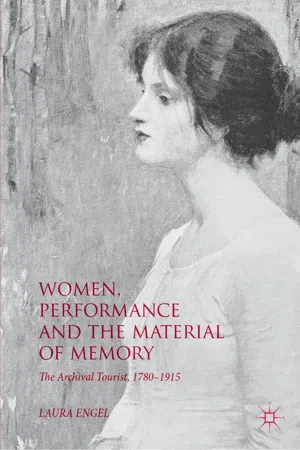
Women, Performance and the Material of Memory
The Archival Tourist, 1780–1915
- English
- ePUB (mobile friendly)
- Available on iOS & Android
eBook - ePub
About this book
Information
© The Author(s) 2019
Laura EngelWomen, Performance and the Material of Memoryhttps://doi.org/10.1057/978-1-137-58932-3_11. Introduction: The Archival Tourist
People are much of the time “tourists” whether they like it or not. (Urry 2002, 74)
A figure stands in the middle of a museum gallery dressed in a richly ornate gown. The details of the dress—ochre, red, and gold fabric, high baroque neck, pronounced sleeves, glimmering embroidery, and tiny ropes of pearls—match almost exactly the figure in the portrait behind it by Rubens of the Princess Marguerite de Condé , almost as if the gown in the painting had stepped out of the frame and become mysteriously animated and embodied. The dress on the mannequin is the creation of contemporary artist Isabelle de Borchgrave , who specializes in designing exquisite garments inspired by formal portraits. 1 De Borchgrave’s gowns are made of paper that is manipulated, painted, glossed, folded, and decorated to simulate historical artifacts. At face value, the dresses, which are mostly imagined from eighteenth- and nineteenth-century portraits , are technically astounding. Their “realness” transports the viewer into a space of wonder and uncanny displacement. The figures in the portraits have come to life—as living historical pictures—yet they are ultimately fake and bodiless, like projections or spirits.
Placed in the context of the museum, de Borchgrave’s dresses represent the alluring draw of tangibility. Although you cannot actually touch them, you can walk among them and walk between the painting on the wall and the projected figure. In this way, de Borchgrave’s dressed figures conjure the performative and embodied nature of the portrait process, reminding museum patrons of the actual body that sat for the portrait in the past. For the spectator , standing in between de Borchgrave’s mannequin and the Rubens portrait , the painting transforms from a flat, two-dimensional medium into a conduit to traces of past performances (of the artist, his assistants, the model, and the original spectators). Moving around the dress it is almost as if you have gone behind the scenes of the painting itself and are now able to go “backstage,” perhaps to see what the painter may have witnessed but is now lost. At the same time, the paper dress is also a multilayered theatrical illusion designed to provoke a sense of presence and history that is ultimately false. The fragile material of the dress and its status as an art object is disconnected from the original presence of an embodied female figure, as well as that figure’s experience as a living person.
Like the encounter between the portrait , the dress, and the spectator , this book is interested in what Esther Milne has called “technologies of presence” in various material forms. 2 In thinking about objects through performance as props, costumes , or accessories within scenes, I explore how particular artifacts serve as the material of memory and connect the past to the present. De Borchgrave’s work captures three important threads of this study: One investigates how our encounters with archival objects work forward to engender performances and backwards to signal acts that are now lost; the second engages intermedial approaches to highlighting the presence of women as actresses, artists, and authors in the archives; the third looks at our own scholarly performances and suggests that as critical observers of the past we are all archival tourists.
Women, Performance and the Material of Memory examines material objects that are specifically tied to memory and the staging or representation/recreation of corporeal presence. Each chapter highlights a particular set of tangible objects—the pocket diaries of the actress, playwright, and novelist Elizabeth Inchbald ; the letters , portraits , and drawings produced from the tumultuous relationship between Sir Thomas Lawrence and the celebrated actress Sarah Siddons and her daughters Sally and Maria; the magic lantern as a guiding optic trope for the Countess of Blessington’s volume The Magic Lantern; or, Sketches of Scenes in the Metropolis (1822); silhouettes and waxworks by Isabella Beetham , Jane Read , and Madame Tussaud ; and Amelia M. Watson’s photographs of the remains of the actress Fanny Kemble’s plantation in the early twentieth century. I explore the ways in which these archival materials conjure specific scene(s) of the past, invoking uncanny traces of embodiment best accessed through theatrical motifs. Connecting the archive with performance allows for the archive to represent more than the materials in the box, and potentially makes a space for beginning to imagine the intangible performances surrounding historical materials. This is a particularly useful strategy for dealing with archival materials by or about eighteenth- and nineteenth-century professional women (actresses, playwrights, and artists), whose unconventional lives and experiences often went unrecorded, or when written down became manipulated and distorted in an effort to reimagine their unique position within accepted narratives of femininity. 3 I propose that the performance of archival research is related to the experience of tourism , where an individual immerses herself in a foreign environment, relating to and analyzing visual and sensory materials through embodiment and enactment. The archival tourist is part of the scene of research and has agency in the recreation of the past, at the same time that she remains separated from the materials because they are always unalterably foreign. Ultimately, operating as an archival tourist in my analyses, I offer strategies for thinking about the presence of women artists in the archives through methodologies that seek to connect materials from the past with our representations of them in the present.
Tourism as a practice and an organizing topos/schema involves looking, memory, appropriation, consumption , and often scripted forms of reenactment in a quest to connect to another set of experiences. The documentation of tourism involves a declaration of presence: “I was here, this is what I saw, this is what I brought back with me.” Theatrical metaphors in tourist theory emphasize the dynamic relationship between observer, place, and objects. The tourist/performer is confronted with “staged authenticity” in a quest to understand the “backstage” of a culture, place, or event (MacCannell 1999, 91). These paradigms and theoretical strategies are particularly significant in thinking about investigations of the past. Recent projects about history and reenactment (Schneider 2011), acting on the past (Franko and Richards 2000), and the search for the invisible or impossible in theater history (Pascoe 2011) position the researcher as a self-conscious participant in an embodied process. To consider oneself a tourist deliberately shifts the role of the academic, calling into question her authority and essential knowledge.
The scholar herself inhabits a shifting range of identities when she goes to an archive. The archive may be some place that is difficult to get to, and it may require particular kinds of behaviors. Travel to archives, museums, or libraries may also represent a vacation or leisure time for the scholar who is always at work. It is difficult for many academics to separate out the time spent in their “ordinary lives” and time spent thinking about their projects. (I can attest to the fact that one can think about eighteenth-century actresses while pushing a stroller.) Many scholars who study the past incorporate tourist-related events into their research agendas. Often, academics point out the difference between their investigations, which are learned, reasoned, contextualized, and legitimized by a doctoral degree, and the musings, observations, or obsessions of ordinary tourists. 4 While I certainly do not want to devalue the significance of academic credentials or imply that we are not “trained” in reading specific aspects of history and culture, I do want to argue that it is important to try to understand the researcher as a dynamic being who moves through a variety of identities, while consuming elements from the past that have often been deliberately edited, staged, and curated. Thinking of ourselves as tourists allows for a self-conscious mediation between ourselves and the materials we study, highlighting the ways in which particular material objects connected to technologies of image-making disrupt a traditional relationship between who is studying and what is being studied. Tourism also involves its own replication through souvenirs and technologies of transmission (photos, drawings, snapshots, postcards, silhouettes , Instagram, Snapchat, Facebook, etc.). The point of being a tourist is also to try to reproduce and/or record the experience through material representation—to send out evidence of oneself in a certain time and place to others. What would it mean to think about this process in relation to earlier forms of image-making?
Each chapter foregrounds various aspects of tourism in order to think about the parallel ways in which viewing objects and recording/representing them reflect a kind of touristic practice both in the past and the present. The second chapter highlights tourism of the everyday. Looking at Elizabeth Inchbald’s pocket diary as an embodied archive connects us to her individual daily rhythm as an actresses and author, as well as to a collective archive of the experiences of other actresses and professional women. In Chapter 3, intimacy, both real and imagined, infuses Thomas Lawrence’s portraits of the Siddons sisters painted during his tumultuous affairs with both of them. Pairing these paintings and drawings with letters by Sally Siddons , an accomplished...
Table of contents
- Cover
- Front Matter
- 1. Introduction: The Archival Tourist
- 2. Elizabeth Inchbald’s Pocket Diaries
- 3. Thomas Lawrence’s Portraits of the Siddons Sisters
- 4. The Countess of Blessington and Magic Lanterns
- 5. Women Artists, Silhouettes, and Waxworks
- 6. Amelia M. Watson’s Photographs
- Back Matter
Trusted by 375,005 students
Access to over 1.5 million titles for a fair monthly price.
Study more efficiently using our study tools.
Frequently asked questions
Yes, you can cancel anytime from the Subscription tab in your account settings on the Perlego website. Your subscription will stay active until the end of your current billing period. Learn how to cancel your subscription
No, books cannot be downloaded as external files, such as PDFs, for use outside of Perlego. However, you can download books within the Perlego app for offline reading on mobile or tablet. Learn how to download books offline
Perlego offers two plans: Essential and Complete
- Essential is ideal for learners and professionals who enjoy exploring a wide range of subjects. Access the Essential Library with 800,000+ trusted titles and best-sellers across business, personal growth, and the humanities. Includes unlimited reading time and Standard Read Aloud voice.
- Complete: Perfect for advanced learners and researchers needing full, unrestricted access. Unlock 1.5M+ books across hundreds of subjects, including academic and specialized titles. The Complete Plan also includes advanced features like Premium Read Aloud and Research Assistant.
We are an online textbook subscription service, where you can get access to an entire online library for less than the price of a single book per month. With over 1.5 million books across 990+ topics, we’ve got you covered! Learn about our mission
Look out for the read-aloud symbol on your next book to see if you can listen to it. The read-aloud tool reads text aloud for you, highlighting the text as it is being read. You can pause it, speed it up and slow it down. Learn more about Read Aloud
Yes! You can use the Perlego app on both iOS and Android devices to read anytime, anywhere — even offline. Perfect for commutes or when you’re on the go.
Please note we cannot support devices running on iOS 13 and Android 7 or earlier. Learn more about using the app
Please note we cannot support devices running on iOS 13 and Android 7 or earlier. Learn more about using the app
Yes, you can access Women, Performance and the Material of Memory by Laura Engel in PDF and/or ePUB format, as well as other popular books in Literature & Historiography. We have over 1.5 million books available in our catalogue for you to explore.