eBook - ePub
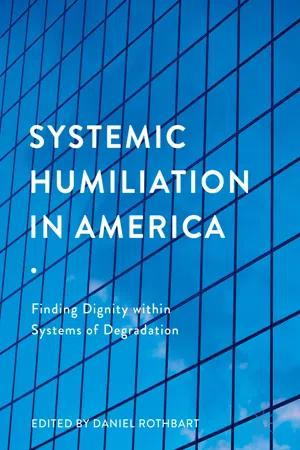
Systemic Humiliation in America
Finding Dignity within Systems of Degradation
- English
- ePUB (mobile friendly)
- Available on iOS & Android
eBook - ePub
About this book
Addresses timely and often overlooked topics (humiliation, shame, and dignity) Takes a broad and interdisciplinary approach, incorporating insights from the fields of sociology, social psychology, criminology, moral philosophy, and conflict analysis Provides many examples and applications of "systemic humiliation" in the United States, examples that hold applications outside of the US as well
Information
© The Author(s) 2018
Daniel Rothbart (ed.)Systemic Humiliation in Americahttps://doi.org/10.1007/978-3-319-70679-5_11. Power and Humiliation
Daniel Rothbart1
(1)
School for Conflict Analysis and Resolution, George Mason University, Arlington, VA, USA
Daniel Rothbart
Why Humiliation?
Almost everyone has been humiliated at some point in life. Sometimes the pain from humiliation is minor and can be shrugged off. Consider, for example, being verbally insulted for sitting during the playing of the national anthem. While the agent of the insult seeks to cast the seated person as unpatriotic, that person may dismiss the insult as silly. The insulted person may even retaliate with a counterinsult, as if to reverse the moral arrow toward the initial accuser. Of course, not all humiliations are innocuous. Bullying is a form of humiliation in which someone seeks to degrade another person, to lord over them, frighten them into submission, and establish dominance over their mind or body. Serious physical or psychological harm can result from such actions.
Not all instances of humiliation involve a person-to-person interaction. Consider the humiliations that many people go through in their experiences with large-scale social-political institutions. For example, employees who receive dismissal notices from their superiors may feel humiliated. Also, one can feel disgraced by receiving an eviction notice for failing to meet financial obligations to a lending institution. In another setting, someone can feel humiliated by being verbally insulted by a police officer in the presence of one’s children. In such cases, the employer, lending official or police officer is typically acting within their professional responsibilities without necessarily attending to the emotional impact of their actions. Unlike bullying, the agents of these social institutions need not harbor malice toward those affected.
But what if the emotional sensitivities of certain groups of people were strategically exploited by a large-scale social-political institution? Is it possible that some institutional practices function in part to disgrace a population group, exploiting their emotional vulnerabilities as a means of population control? If and where such exploitations occur, can measures be crafted to minimize or possibly prevent the pernicious impact of such institutional practices in ways that respect the dignity of those affected?
This volume offers insight into the power of social-political institutions to instill in certain people a sense of inferiority as a strategy for population control. Such power relies on the cunning of getting in the heads of targeted group members, invading their consciousness, distorting the sense of themselves, and diminishing their self-esteem, all for the purpose of rendering the group members compliant and possibly complicit in the prevailing social-political order. Power can be enhanced by making a targeted group feel inferior to society’s “pure,” “chosen,” or “superior” people. These are the controls of political power.
Each chapter in this volume focuses on the power of a social or political institution to undermine a group’s sense of self-worth for the purposes of disciplinary control. I am referring to a power that weaves through a system’s routine operations, rules or decisions. Lacking a fixed point of origin, such power can be crafted in pristine offices, boardrooms, and legislative chambers. Such power is exhibited when directors, officials, agents, operators, or bureaucrats are simply doing their job. This is a power that lies beneath the pronouncements of the system’s administrators’ “reasonable decisions,” “essential directives,” and “common sense policies.” Within the institution’s operations, no one person is solely responsible for the humiliation, so culpability cannot be localized to a single individual. The hidden story situated beneath such power is its strategic function, which is to weaken the will of marginalized people to resist, rebel, and retaliate against the members of the high-power group, rendering them docile to the norms of society. The deployment of such power can be conjoined with conscious acts of denigration when, for example, a government bureaucrat insults members of a marginalized group for being “uppity” by stepping out of line from his or her assigned place. But unlike bullying, such power does not necessitate interpersonal insults. In fact, the system’s operators, agents, or leaders may not be driven by personal malice toward a targeted group.
This volume advances a theme about modern American society that instruments of systemic humiliation deployed by certain social-political institutions are, in effect, politicized as a means for disciplinary control. These are politicized instruments of emotion-controls. It may seem odd to discuss the politics of an emotion. But why not? Many people have examined the politics of hate of propagandists of ethnic-based violence. This is a topic of serious social scientific research since the horrors of World War II. Currently, in the United States, the politics of fear seem to dominate the rhetoric of political candidates from a wide range of political persuasions. From right-wing conservatives we are told to fear Muslim terrorists, Mexican immigrants, urban thugs, and liberal elites, among many other groups. Left-leaning candidates also stoke fear among the electorate, railing against the threats from Wall Street bankers, “home grown” terrorists, Russian hackers, and the Koch Brothers. Just as both right-wing and left-leaning candidates exploit the emotional sentiments of the electorate, certain social-political institutions target population groups for their emotional weaknesses through measures that are buried under the patina of promoting public safety, well-being, or comfort.
In the following chapters, the authors examine the politics of humiliation as practiced by such institutions. Three questions are answered in these chapters: (1) What exactly is a humiliating experience? (2) How exactly do social-political institutions control population groups through instruments of collective humiliation? (3) What are the countermeasures to such instruments that show promise in fostering respect for the dignity of all?
1. According to nineteenth-century psychologists, emotions are inherently irrational, inhibitors of logical thought, and symptoms of fantasy, delusion, and madness. In this view, emotions are vestiges of human evolution from the “lower species,” more like animalistic appetites than “higher” human capacities such as intelligence. Yet, recent experimental studies have revealed that social emotions are effused with cognitive function. With a social emotion one interprets, manages, responds to, and navigates through experience. Consider, for example, a parent’s grief from the death of a child. Such understanding is not reducible to animalistic urges. On the contrary, grief rests upon one’s sense of self, one’s relation to others, and possibly one’s purpose for living. This emotion draws upon the parent’s understanding of their relationship, special bonds with each other, and interdependency. Such an understanding includes a memory of experiences with the child, a sense of protracted interactions, and an anticipation of a future without the child (Nussbaum 2001: 1). Moreover, an experience of grief is not fleeting; it’s not like a pinprick that comes and quickly goes. Grieving is a prolonged process of various degrees of intensity, as if ebbing and flowing with one’s experiences.
Humiliation is an emotion of pain, but it’s not like embarrassment. Where an embarrassment centers on a perceived inappropriate behavior, gesture, or appearance, a humiliation represents a threat to one’s character, a rupture to one’s value, worth or esteem. Some humiliating experiences come with a sense of threat to the sense of oneself as a whole person. For example, I once observed an event that caused a waiter’s embarrassment after he indelicately dropped a large tray of food next to some customers. He apologized profusely to nearby customers. But his embarrassment quickly turned to humiliation when an irate customer hurled the insult, “You stupid klutz!” More than an attack on the waiter’s skills, the insult targeted the whole person, diminishing his character, status, and value. With an experience of humiliation, one feels oneself to be the target of others’ degradation; one is cast as a socially inferior person, typically in the presence of others. This experience also produces a serious reflection of the demerits of the accusation and that the insult is unfair, since “I” do not serve such denigration.
This deeply pernicious sense of humiliation as a rupture to one’s identity is conveyed in riveting testimony by leaders of the civil rights movement of the 1960s. In his Letter from a Birmingham Jail, Martin Luther King wrote about the routine humiliations that invaded the soul, creating a debilitating “sense of nobodiness” among Negros. He wrote:
Such disgraces represent dehumanizing indignities and are experienced routinely by Negros, according to King.[When] your first name becomes “nigger,” your middle name becomes “boy” (however old you are) and your last name becomes “John,” and your wife and mother are never given the respected title “Mrs.”; when you are harried by day and haunted by night by the fact that you are a Negro, living constantly at tiptoe stance, never quite knowing what to expect next, and are plagued with inner fears and outer resentments; when you are forever fighting a degenerating sense of ‘nobodiness’─then you will understand why we find it difficult to wait. (King 1986)
In like measure, James Baldwin wrote of the disgraces he endured at age ten from the abuse of police officers:
Baldwin’s humiliations came with a sense of powerlessness from living precariously at the whim of the police: “I was being spat on and defined and described and limited, and could have been polished off with no effort whatever” (Baldwin 1952). Has American society progressed by overthrowing the destructive forces of racial divisions of the Jim Crow era? Not according to many commentators on racial relations in this country, who, for example, write about systemically embedded racism (West 2014), the vulnerability of blacks’ bodies (Coates 2015), and the extreme pain felt by blacks leading to the “tears we cannot stop” (Dyson 2017).When I was ten, and didn’t look, certainly, any older, two policemen amused themselves with me by frisking me, making comic (and terrifying) speculations concerning my ancestry and probably sexual prowess, and for good measure, leaving me flat on my back in one of Harlem’s empty lots. (Baldwin 1952)
If we delve into the thought patterns associated with humiliation, we find three dominant narratives that spin around in one’s head shifting the stories about oneself, the humiliating acts, and the agents of such acts. (1) Denigration—the humiliated person senses the slings and arrows of an insult through the messages of verbal abuse, bullying, or a threat to one’s social status. This humiliated person assesses the gestures, speeches, or physical actions of others for their symbolic meaning, acts of contempt, belittlement, disgrace, or scorn. (2) Disbelief—with this comprehension of a humiliator’s actions comes a sense of threat to one’s value, rank, status, or power in a social order. This is a threat to one’s relational positioning, that is, to one’s sense of place, as if the pattern of one’s social geography has shifted. Yet, the threat is perceived as unfair in cycles of thought that “I” am not worthy of such debasement since “I” am a person that deserves the esteem of others. (3) Indignation— with such disbelief comes a sense of indignation against the humiliating agent. The pain of being disgraced in the eyes of others is interlinked with anger, possibly indignation, at being such a target. This person may experience anger at the thought that the humiliator is seeking to degrade “me.” The humiliated person reverses the moral...
Table of contents
- Cover
- Front Matter
- 1. Power and Humiliation
- Part I. Social Conflicts and the Politics of Emotions
- Part II. Race, Violence and the Road to Justice
- Part III. Mental Health, Stigma and Dignity
- Back Matter
Trusted by 375,005 students
Access to over 1.5 million titles for a fair monthly price.
Study more efficiently using our study tools.
Frequently asked questions
Yes, you can cancel anytime from the Subscription tab in your account settings on the Perlego website. Your subscription will stay active until the end of your current billing period. Learn how to cancel your subscription
No, books cannot be downloaded as external files, such as PDFs, for use outside of Perlego. However, you can download books within the Perlego app for offline reading on mobile or tablet. Learn how to download books offline
Perlego offers two plans: Essential and Complete
- Essential is ideal for learners and professionals who enjoy exploring a wide range of subjects. Access the Essential Library with 800,000+ trusted titles and best-sellers across business, personal growth, and the humanities. Includes unlimited reading time and Standard Read Aloud voice.
- Complete: Perfect for advanced learners and researchers needing full, unrestricted access. Unlock 1.5M+ books across hundreds of subjects, including academic and specialized titles. The Complete Plan also includes advanced features like Premium Read Aloud and Research Assistant.
We are an online textbook subscription service, where you can get access to an entire online library for less than the price of a single book per month. With over 1.5 million books across 990+ topics, we’ve got you covered! Learn about our mission
Look out for the read-aloud symbol on your next book to see if you can listen to it. The read-aloud tool reads text aloud for you, highlighting the text as it is being read. You can pause it, speed it up and slow it down. Learn more about Read Aloud
Yes! You can use the Perlego app on both iOS and Android devices to read anytime, anywhere — even offline. Perfect for commutes or when you’re on the go.
Please note we cannot support devices running on iOS 13 and Android 7 or earlier. Learn more about using the app
Please note we cannot support devices running on iOS 13 and Android 7 or earlier. Learn more about using the app
Yes, you can access Systemic Humiliation in America by Daniel Rothbart in PDF and/or ePUB format, as well as other popular books in Social Sciences & Mind & Body in Philosophy. We have over 1.5 million books available in our catalogue for you to explore.