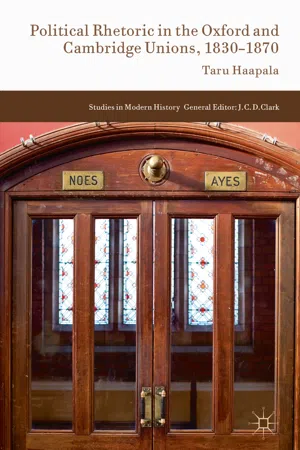
This book offers much-needed insight into the Oxford and Cambridge Unions and the important role they have played in nineteenth-century British political culture. Despite this role, or perhaps for that very reason, the Unions have received very little scholarly attention as to their political activities. This study will focus particularly on debating practices through which their members became knowledgeable of the parliamentary way of doing politics. More significantly, it uses the original Union records as primary research material to show that they also had unique political practices of their own. Presenting a detailed analysis of their debates, the book argues that the Unions should be appreciated as independent political arenas, not mere extensions of Westminster politics.
- English
- ePUB (mobile friendly)
- Available on iOS & Android
eBook - ePub
Political Rhetoric in the Oxford and Cambridge Unions, 1830–1870
About this book
Information
© The Author(s) 2016
Taru HaapalaPolitical Rhetoric in the Oxford and Cambridge Unions, 1830–1870Studies in Modern History10.1007/978-3-319-35128-5_11. Introduction: The Rhetoric of Parliamentary Debate
Taru Haapala1
(1)
Department of Social Sciences and Philosophy, University of Jyväskylä, Jyväskylä, Finland
The connection between debate and parliamentary procedure created an extraordinary affiliation between the Union Societies and the House of Commons in the mid-nineteenth century. The Unions at Oxford and Cambridge Universities are without a doubt the most famous British debating societies. Founded in the early nineteenth century, they have become known as training grounds for statesmen. Similar organisations have existed in other countries providing oratorical and rhetorical training for undergraduates (see e.g. Hollis 1965, 165; Burman 2012, 118–120; van Rijn 2010, 145–148). Many of them offer unique windows to the way political activities in their respective cultures have been perceived and practised during various periods of time.
British debating societies have been closely connected to nineteenth-century parliamentary culture and public life (cf. Bevis 2007; Meisel 2001). However, the transfers of the culture to the actual political practices in debating societies have not been rigorously studied. To address the issue, this study explores the concept of debate related to the training of political activity in the Union Societies.
Sir John Mowbray, a long-serving Conservative MP representing Oxford University from 1868 until 1899, had been a member of the Oxford Union while studying at Christ Church between 1835 and 1847. In his speech at the Union’s fiftieth anniversary in 1873 he reflected on how it had contributed to the learning of politics and debating as a school of ‘the combative element’:
He suggests that, despite the fact that the minute books of the Union Societies never explicitly express the political side of their activities, the members themselves were fully aware that the debates were not merely academic in character: the debates for and against issues were not conducted merely for the sake of argument. The ‘combative element’ was part of the early training in politics that was learnt at Union debates.There are many persons, I know, who regard the Union as merely a debating society, but I think this to be a great mistake (hear, hear). There are imperial politics, and there are Union politics. Regarded on the side of imperial politics, it may be called a deliberative society; but regarded on the side of Union politics, I look upon it as a great school for the development of the combative element (hear, hear). (Mowbray: Oxford Union Society 1874, 6)
I argue that the Union Societies’ debating practices are an important historical source for understanding political activity in nineteenth-century British parliamentary culture. The training the Unions offer is often referred to in terms of the preservation of a political elite: not everyone can access it as it is only available for students of the two most prestigious English universities. It is, however, questionable whether focusing on elites is helpful in determining the political value and importance of these debating societies in the formation of British parliamentary culture overall.
First, it seems that various elites are ubiquitous in politics. Whenever politics is practised exclusions are bound to happen, which creates small groups in privileged positions. For that reason alone, it seems rather futile to dismiss the Unions as elitist if we want to make sense of their role in a political culture. Second, the rules of debate of the House of Commons have been adopted and used in hundreds of societies and associations. The Westminster model of debate has been readily available for and applied in various deliberative assemblies worldwide. Handbooks on how to form debating societies have been written and circulated in Britain and overseas since the late nineteenth century. 1
The common idea of debate, as well as one of its most important educative and political aspects, is to consider issues from opposing points of view. 2 A key feature of parliamentary government, in more general terms, is that it functions through resolutions that are made after careful deliberation on both sides of an issue based on established rules of debate. It is characteristic to parliamentary assemblies to deal with motions as potential ‘opinions of the House’ and to treat proposals taken into deliberation as no longer belonging to the individuals behind their formulation but to the ‘house’ itself. That is why the person responsible for the motion has to ask a permission of the house to remove it from the agenda (cf. Hansard 1857, 32). As I shall elaborate in this study, these features became part of the overall practice adopted in the Cambridge and Oxford Unions as well, which made them, formally, a part of British parliamentary culture and, therefore, an important source for understanding the politics involved.
Challenging the view that the procedural formalisation of debate is only a tool for the political management of a state, 3 this study focuses on examining the ways in which the Union Societies at Cambridge and Oxford adopted and used parliamentary procedure for political purposes of their own. It interprets the Unions as being part of nineteenth-century parliamentary political culture by drawing from their original minute books and rule compilations. Further, the aim of this study is to explore the phenomenon of the politicisation of debate in Britain that occurred through the interchange of parliamentary ideas between Parliament and the debating societies, especially the Unions. 4
The approach applied here accentuates political activity based on procedures and rules of debate. The connection between parliamentary procedure and debate is essential in order to better understand political activity in parliaments. First of all, a parliamentary bill takes shape through a series of motions. The motions are proposed and debated according to a certain procedure. Political activity in a parliamentary assembly centres, firstly, on influencing what kinds of motions are put on the political agenda and, secondly, on taking part in debates on those motions that have reached the agenda. In the British constitutional literature the role of debate is accentuated as the control of state finances was originally considered the main function of Parliament, especially since 1689. It has even been said that, in the British context, a ‘parliamentary body’ is an assembly of which the primary function is not to legislate, but to debate according to certain rules (see e.g. Redlich 1908, vol. 2, 215). 5 ‘Parliamentary bodies’ are commonly perceived as representative institutions in the context of a state. Redlich’s definition, however, encourages us to theorise on the idea of a deliberative assembly without the constraints and burdens of representation on a national scale. In fact, debating procedure—the backbone of British parliamentary politics—was already established at a time before democratic representation had even been conceptualised. 6
The British House of Commons is well known for its ancient traditions and rules which for centuries remained unwritten. John Hatsell’s Precedents of Proceedings in the House of Commons (1779–1796) was the first attempt to provide a comprehensive account of parliamentary procedure. Previously there had been a few compilations 7 of established rules, but they did not attempt to cover the proceedings as a whole. Hatsell’s (1733–1820) volume remained the authority on parliamentary procedure well into the 1800s. He was followed by Thomas Erskine May (1815–1886) with the first treatise on parliamentary procedure, A Treatise upon the Law, Privileges, Proceedings and Usage of Parliament, in 1844. May’s work was reworked and reprinted eight times during his lifetime, and after his death it continued to be considered the most authoritative work on parliamentary procedure. Jeremy Bentham (1748–1832) and Josef Redlich (1869–1936) also contributed to the genre of procedural tracts. Bentham’s Essay on Political Tactics (1791), which addressed the question of the proper workings of a legislative assembly and was to be a guide for the establishment of the French National Assembly, is considered a classic. He had a more theoretical approach to the procedure of a deliberative assembly, whereas Redlich’s work provides a historical reading of British parliamentary procedure.
The traditions and precedents of British parliamentary procedure have remained largely unchanged for centuries. Lord Campion’s (1929) manual for members of Parliament starts with an excursion into the history of the procedure, which offers invaluable information about the contexts in which the procedure was formed and revised. Campion (1929/1958, 3) described procedure as a settled parliamentary practice that is only modified over time. It is adjusted according to constitutional arrangements. Revision of procedure also implies a redefinition of the power relations between the constitutive parts of Parliament (i.e. the House of Commons, the House of Lords and the Crown) (ibid., 1). Awareness of the traditions, learning what is permitted, prohibited or addressed by the rules, opens up new horizons for how to act in the way that is most beneficial for one’s own political ends. For example, the idea of protection of the minority had for centuries been the main purpose of parliamentary procedure (Redlich 1908, vol. 1, 56). As Erskine May noted, it had a long-lasting effect on the debates in the House of Commons. According to him, debate is the only way to ensure that ‘a minority can hope to compete with a majority’ as the procedure can be used to its protection (May 1851, 221). May argued that the forms of proceedings do not favour any party as such, as they are available equally for all who are involved in a debate. Also, he implies that the procedure is a tool to be used for political purposes; that is, the rules of debate do not specify to what end they should be used. What May seems to be suggesting is that debate is the occasion where procedure could be freely used for one’s own benefit. In other words, the rules of debate have a rhetorical dimension as well (cf. Gronbeck 1982). It is the skilful use of the rules that creates the rhetorical space for acting politically.
In a majority of studies on British parliamentary politics, the role of procedure has been largely overlooked. Only a few scholarly studies have emphasised its importance. Gronbeck (1982) has paid particular attention to British parliamentary procedure of the eighteenth century. He has contributed to Foord’s (1964) work on the tactics and techniques that the opposition members used in the period. Lord Norton’s (2001) treatment of parliamentary procedure, in turn, concentrates on procedure as a constraining force on government policies. In the field of policy studies, procedure has also been considered in connection with the agenda-setting of governments, and it is perceived as a set of rules instrumental for the formation of political agendas (Schwartz ...
Table of contents
- Cover
- Frontmatter
- 1. Introduction: The Rhetoric of Parliamentary Debate
- 2. The Union Societies’ Role in the Formation of a Parliamentary Culture of Debate
- 3. Procedure and Debate in the British Parliamentary Culture
- 4. The Politics of Agenda in the Union Debates
- 5. The Politics of Debate in the Union Societies
- 6. Conclusion: Transfer of the Rhetoric of Procedure to British Debating Societies
- Backmatter
Trusted by 375,005 students
Access to over 1.5 million titles for a fair monthly price.
Study more efficiently using our study tools.
Frequently asked questions
Yes, you can cancel anytime from the Subscription tab in your account settings on the Perlego website. Your subscription will stay active until the end of your current billing period. Learn how to cancel your subscription
No, books cannot be downloaded as external files, such as PDFs, for use outside of Perlego. However, you can download books within the Perlego app for offline reading on mobile or tablet. Learn how to download books offline
Perlego offers two plans: Essential and Complete
- Essential is ideal for learners and professionals who enjoy exploring a wide range of subjects. Access the Essential Library with 800,000+ trusted titles and best-sellers across business, personal growth, and the humanities. Includes unlimited reading time and Standard Read Aloud voice.
- Complete: Perfect for advanced learners and researchers needing full, unrestricted access. Unlock 1.5M+ books across hundreds of subjects, including academic and specialized titles. The Complete Plan also includes advanced features like Premium Read Aloud and Research Assistant.
We are an online textbook subscription service, where you can get access to an entire online library for less than the price of a single book per month. With over 1.5 million books across 990+ topics, we’ve got you covered! Learn about our mission
Look out for the read-aloud symbol on your next book to see if you can listen to it. The read-aloud tool reads text aloud for you, highlighting the text as it is being read. You can pause it, speed it up and slow it down. Learn more about Read Aloud
Yes! You can use the Perlego app on both iOS and Android devices to read anytime, anywhere — even offline. Perfect for commutes or when you’re on the go.
Please note we cannot support devices running on iOS 13 and Android 7 or earlier. Learn more about using the app
Please note we cannot support devices running on iOS 13 and Android 7 or earlier. Learn more about using the app
Yes, you can access Political Rhetoric in the Oxford and Cambridge Unions, 1830–1870 by Taru Haapala in PDF and/or ePUB format, as well as other popular books in History & British History. We have over 1.5 million books available in our catalogue for you to explore.