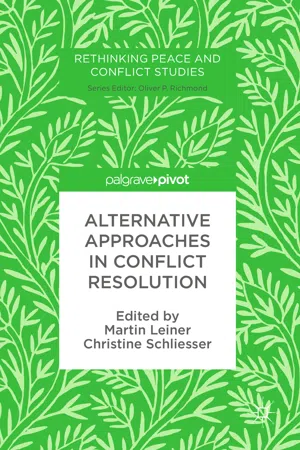
This edited volume brings together alternative and innovative approaches in conflict resolution. With traditional military intervention repeatedly leading to the transformation of entire regions into zones of instability and violence (Afghanistan, Iraq, Libya, Syria), the study of alternative and less violent approaches to conflict resolution has become imperative. Four approaches are presented here: negotiation, religion and gender, reconciliation and forgiveness, and the arts. This volume contains the insights and experiences of fourteen internationally renowned scholars and practitioners from different contexts. Can forgiveness help heal relationships in post-apartheid South Africa? How can art assist dealing with 'unrememberable' events such as the genocide in Rwanda? What transformational resources do women offer in contexts of massive human rights violations? The aim here is twofold: to provide and encourage critical reflection of the approaches presented here and to explore concrete improvements in conflict resolution strategies. In its interdisciplinary and international outlook, this work combines the tried-and-tested approaches from conflict resolution experts in academia, NGOs and civil society, making it an invaluable tool for academics and practitioners alike.
eBook - ePub
Alternative Approaches in Conflict Resolution
- English
- ePUB (mobile friendly)
- Available on iOS & Android
eBook - ePub
Alternative Approaches in Conflict Resolution
About this book
Information
Table of contents
- Cover
- Frontmatter
- 1. Introduction
- 1. Alternative Approaches—Negotiation
- 2. Alternative Approaches—Gender and Religion
- 3. Alternative Approaches—Reconciliation and Forgiveness
- 4. Alternative Approaches—The Arts
- 5. Alternative Approaches—Conclusion
- Backmatter
Trusted by 375,005 students
Access to over 1.5 million titles for a fair monthly price.
Study more efficiently using our study tools.
Frequently asked questions
Yes, you can cancel anytime from the Subscription tab in your account settings on the Perlego website. Your subscription will stay active until the end of your current billing period. Learn how to cancel your subscription
No, books cannot be downloaded as external files, such as PDFs, for use outside of Perlego. However, you can download books within the Perlego app for offline reading on mobile or tablet. Learn how to download books offline
Perlego offers two plans: Essential and Complete
- Essential is ideal for learners and professionals who enjoy exploring a wide range of subjects. Access the Essential Library with 800,000+ trusted titles and best-sellers across business, personal growth, and the humanities. Includes unlimited reading time and Standard Read Aloud voice.
- Complete: Perfect for advanced learners and researchers needing full, unrestricted access. Unlock 1.5M+ books across hundreds of subjects, including academic and specialized titles. The Complete Plan also includes advanced features like Premium Read Aloud and Research Assistant.
We are an online textbook subscription service, where you can get access to an entire online library for less than the price of a single book per month. With over 1.5 million books across 990+ topics, we’ve got you covered! Learn about our mission
Look out for the read-aloud symbol on your next book to see if you can listen to it. The read-aloud tool reads text aloud for you, highlighting the text as it is being read. You can pause it, speed it up and slow it down. Learn more about Read Aloud
Yes! You can use the Perlego app on both iOS and Android devices to read anytime, anywhere — even offline. Perfect for commutes or when you’re on the go.
Please note we cannot support devices running on iOS 13 and Android 7 or earlier. Learn more about using the app
Please note we cannot support devices running on iOS 13 and Android 7 or earlier. Learn more about using the app
Yes, you can access Alternative Approaches in Conflict Resolution by Martin Leiner, Christine Schliesser, Martin Leiner,Christine Schliesser in PDF and/or ePUB format, as well as other popular books in Politik & Internationale Beziehungen & Frieden & globale Entwicklung. We have over 1.5 million books available in our catalogue for you to explore.