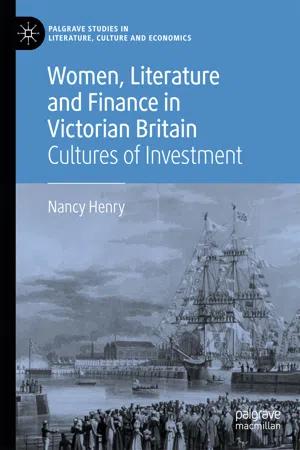
Women, Literature and Finance in Victorian Britain: Cultures of Investment defines the cultures that emerged in response to the democratization of the stock market in nineteenth-century Britain when investing provided access to financial independence for women. Victorian novels represent those economic networks in realistic detail and are preoccupied with the intertwined economic and affective lives of characters. Analyzing evidence about the lives of real investors together with fictional examples, including case studies of four authors who were also investors, Nancy Henry argues that investing was not just something women did in Victorian Britain; it was a distinctly modern way of thinking about independence, risk, global communities and the future in general.
- English
- ePUB (mobile friendly)
- Available on iOS & Android
eBook - ePub
About this book
Information
© The Author(s) 2018
Nancy HenryWomen, Literature and Finance in Victorian BritainPalgrave Studies in Literature, Culture and Economicshttps://doi.org/10.1007/978-3-319-94331-2_11. Introduction
[A] woman can take part in the government of a great empire by buying East India Stock.
—Barbara Leigh Smith Bodichon, A brief summary, in plain language of the most important laws concerning women: Together with a few observations thereon
Keywords
WomenFinanceEconomicsCapitalismInvestmentsBiographyRealist fictionIn 2016, eight years after the start of the 2008 financial crisis , with stock market values climbing into record territory, two contributions to the early twenty-first-century American culture of investing marked the place of women in that culture. First, former Wall Street CEO Sallie Krawcheck founded an investment company, Ellevest , which promised to transform the investing experience of women and took as its motto: “Invest Like a Woman: Because Money is Power.” 1 Second, the film Equity (2016) focused on women as traders on Wall Street; it was also written, produced, directed, and largely financed by women 2 (see also Ryzik 2016). Neither of these developments should be remarkable, but in fact both were. While women are more active than ever as investors, they are still relatively scarce as major players on Wall Street. Ellevest’s bold claims to usher in a new financial era by targeting women’s investment needs and Equity’s exploration of the complex problems faced by women in the high-stakes financial arena seem surprising and new. Together, they offer a glimpse of the ways women are investing and how women investors are being represented in the twentieth-first century.
How did we get here? What is the history of women’s role in financial markets? Why is gender a relevant category for thinking about investing today and in the past? These questions are among those that this book seeks to address through an exploration of how nineteenth-century British women authors invested and how investing women were represented, particularly in realist fiction.
In addition to the visibility of women investors in popular culture, scholars have taken an interest in the history of women’s investment practices. Two groundbreaking works look at the role of women as investors in eighteenth-century Britain and nineteenth-century and twentieth-century America . Historian Amy Froide (2017) argues that “the financial independence of unmarried women, as well as married women’s rights to separate property, allowed women to participate in and further England’s Financial Revolution” (2). She shows that “Englishwomen’s participation in early modern capitalism fits into, as much as it challenges, the economic history of women” (2). Historian George Robb (2017) argues that “Victorian women were active investors and shareholders, that contemporaries were well aware of this, and that there was much comment about the phenomenon, most of it negative” (2017, 1). What is missing from the portrait emerging in these works is an account of women investors in the nineteenth-century British economy and broader culture.
Women, Literature and Finance in Victorian Britain: Cultures of Investment takes a historical perspective on the role of women investors in the literature and culture of Victorian Britain, a role that, though appearing in plain sight in histories, biographies, and fiction, has nonetheless remained invisible to literary critics, possibly because, like the women behind the film Equity , Victorian women did not always make the condemnations of capitalism that literary critics especially seem to value. Novels by Elizabeth Gaskell, Charlotte Brontë, George Eliot, Charlotte Riddell and Margaret Oliphant raise the question: Is it possible to like money without liking greed? In their writing, and in their lives, these women pursued investing as a unique means of empowerment that increased their inherited or earned wealth. The women in this alternative history of capitalism were not traders on the London Stock Exchange (that would not be possible until 1973). Rather, they were either passive or active investors and, in rare cases, speculators. They confronted a set of cultural prejudices against their participation in the market, but took advantage of their legal right to invest, whether on the stock exchange or in private companies. Like today’s more liberated women, they faced sexual entanglements with spouses, lovers, and advisors, as well as domestic obstacles in the forms of fathers, brothers, and children. In this respect, the decisions Victorian women made about how to invest their capital were simultaneously public and private, and novels in particular explore in detail the complex ways in which public and private spheres overlapped.
This book argues, first, that female investors were ubiquitous in Victorian fiction, reflecting a reality that has only recently attracted the attention of historians and critics. The fact that investing was open to women, as other avenues to wealth and power were not, meant that female authors’ treatment of investing and capitalism in their writing was not characterized by the same types of critique that appear in William Makepeace Thackeray’s The Newcomes (1853–1855), Charles Dickens’s Little Dorrit (1855–1857) and Our Mutual Friend (1864–1865), Anthony Trollope’s The Way We Live Now (1875) and The Prime Minister (1876) and George Gissing’s The Whirlpool (1897), among many others. It argues, second, that paying attention to the lived experiences of women investors , including the lives of authors who contributed to financial fiction in the Victorian period, reorients our perspective both on the lives of women and on the history of capitalism .
Inheritance, investment, speculation , prosperity, and failure were hallmarks of the British middle-class experience during the late eighteenth and nineteenth centuries, and it is no wonder that these are all common features of nineteenth-century novels. Such mixed consequences of the volatile economy during the financial and industrial “revolutions” are at the heart of this book: Wealth was created and dramatically lost, and the domestic and economic spheres of society were inseparable. Many nineteenth-century novels introduce scenarios involving the inheritance of wealth, often amassed through global economic networks. Novels also present ethical questions arising from past and present commercial and financial practices. While novelists were uniformly critical of greed and the commodification of human life, which capitalism seemed to encourage, if not demand, many male and female authors were also investors who profited from expanded investment opportunities at home and abroad. Their experiences as local and global investors who represented investment cultures to their readers are crucially relevant to this study.
Women, Literature and Finance in Victorian Britain contributes to literary criticism, the cultural history of finance , and biographical or life writing studies. It revises how we think about financial history by focusing on women and by recasting the trajectories of women’s lives as a set of financial events, conditions, and decisions, which are at least as important as the parallel domestic landmarks of marriage and childbirth. Like other forms of financial transactions, such as buying property, investing capital in private companies or government securities was (and is) simultaneously a public and a private act. The cultures of investment permeated familial relationships; at the same time, family dynamics influenced investing behaviors. Domestic and more broadly social concerns were interwoven with economic and financial concerns, a reality reflected in Victorian literature generally and emphasized particularly in ...
Table of contents
- Cover
- Front Matter
- 1. Introduction
- 2. Women Investors in Fact
- 3. Investment Cultures in Dickens, Trollope, and Gissing
- 4. Elizabeth Gaskell: Investment Cultures and Global Contexts
- 5. George Eliot: Money’s Past and Money’s Future
- 6. Charlotte Riddell’s Financial Life and Fiction
- 7. Margaret Oliphant, Women and Money
- 8. Conclusion
- Back Matter
Trusted by 375,005 students
Access to over 1.5 million titles for a fair monthly price.
Study more efficiently using our study tools.
Frequently asked questions
Yes, you can cancel anytime from the Subscription tab in your account settings on the Perlego website. Your subscription will stay active until the end of your current billing period. Learn how to cancel your subscription
No, books cannot be downloaded as external files, such as PDFs, for use outside of Perlego. However, you can download books within the Perlego app for offline reading on mobile or tablet. Learn how to download books offline
Perlego offers two plans: Essential and Complete
- Essential is ideal for learners and professionals who enjoy exploring a wide range of subjects. Access the Essential Library with 800,000+ trusted titles and best-sellers across business, personal growth, and the humanities. Includes unlimited reading time and Standard Read Aloud voice.
- Complete: Perfect for advanced learners and researchers needing full, unrestricted access. Unlock 1.5M+ books across hundreds of subjects, including academic and specialized titles. The Complete Plan also includes advanced features like Premium Read Aloud and Research Assistant.
We are an online textbook subscription service, where you can get access to an entire online library for less than the price of a single book per month. With over 1.5 million books across 990+ topics, we’ve got you covered! Learn about our mission
Look out for the read-aloud symbol on your next book to see if you can listen to it. The read-aloud tool reads text aloud for you, highlighting the text as it is being read. You can pause it, speed it up and slow it down. Learn more about Read Aloud
Yes! You can use the Perlego app on both iOS and Android devices to read anytime, anywhere — even offline. Perfect for commutes or when you’re on the go.
Please note we cannot support devices running on iOS 13 and Android 7 or earlier. Learn more about using the app
Please note we cannot support devices running on iOS 13 and Android 7 or earlier. Learn more about using the app
Yes, you can access Women, Literature and Finance in Victorian Britain by Nancy Henry in PDF and/or ePUB format, as well as other popular books in Literature & Economic History. We have over 1.5 million books available in our catalogue for you to explore.