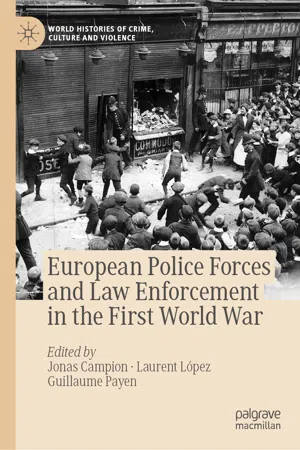
This book offers a global history of civilian, military and gendarmerie-style policing around the First World War. Whilst many aspects of the Great War have been revisited in light of the centenary, and in spite of the recent growth of modern policing history, the role and fate of police forces in the conflict has been largely forgotten. Yet the war affected all European and extra-European police forces. Despite their diversity, all were confronted with transnational factors and forms of disorder, and suffered generally from mass-conscription. During the conflict, societies and states were faced with a crisis situation of unprecedented magnitude with mass mechanised killing on the battle field, and starvation, occupation, destruction, and in some cases even revolution, on the home front. Based on a wide geographical and chronological scope – from the late nineteenth century to the interwar years – this collection of essays explores the policing of European belligerent countries, alongside their empires, and neutral countries. The book's approach crosses traditional boundaries between neutral and belligerent nations, centres and peripheries, and frontline and rear areas. It focuses on the involvement and wartime transformations of these law-enforcement forces, thus highlighting underlying changes in police organisation, identity and practices across this period.
eBook - ePub
European Police Forces and Law Enforcement in the First World War
- English
- ePUB (mobile friendly)
- Available on iOS & Android
eBook - ePub
European Police Forces and Law Enforcement in the First World War
About this book
Information
© The Author(s) 2019
J. Campion et al. (eds.)European Police Forces and Law Enforcement in the First World WarWorld Histories of Crime, Culture and Violencehttps://doi.org/10.1007/978-3-030-26102-3_11. Policing in Wartime: Without Any Disruption? General Introduction
Jonas Campion1 , Laurent López2 and Guillaume Payen3
(1)
Institute of Historical Research of Septentrion (UMR CNRS 8529), Lille University, Villeneuve-d’Ascq, France
(2)
Defense Historical Service, Vincennes, France
(3)
Centre d’histoire du XIXe siècle (EA 3550)/Department of History, Sorbonne University, Paris, France
“This war, in fact, made no sense at all. It couldn’t go on”.1 Inspired by his own experience as a cuirassier in the 12th armoured cavalry regiment, Louis-Ferdinand Céline gave those words to Ferdinand Bardamu, the antihero of his Journey to the End of the Night (Voyage au bout de la Nuit) and his mouthpiece to convey the feelings of confusion and dismay overwhelming a conscript drafted into a war of which the meaning utterly escaped him. Though historians have endeavoured for a century not only to retrieve every detailed event of this first worldwide conflagration but also to make sense of them, a significant aspect remains widely unexplored: the involvement in the war of law enforcement forces—police officers and gendarmes. More or less understood to be mere “keepers of the public peace”—as Parisian officers were legally defined from 7 September 1870—these men hardly seemed destined to take part in this paroxysm of violence, perceived as inadequate or obsolete to cope with tragedy. Yet they did take part.
The present collective work is mainly drawn from the proceedings of an international conference co-organised by the Research Centre of the French Gendarmerie Officers Academy (CREOGN), Paris-Sorbonne University and the Centre for Law and Justice History (CHDJ) of the UCLouvain (Belgium), that took place in February 2016 at the Gendarmerie Nationale Museum in Melun (France).2 The conference was intended to offer studies focused on European policing agencies and protagonists, with simultaneously national, transnational and comparative perspectives—not only for their intrinsic interest but also for their contribution to the overall understanding of the First World War. This book therefore stands at the crossroads between two burgeoning historiographical trends having so far failed to meet, namely the genuine renewal in research writing on the history of policing3 and the massive publishing effort—both in the recent past and on-going, nurtured by centenary commemorations—aimed at providing readers with a global history of societies at war.4
While the argument of “constraint” is often put forward to account for the compliant behaviour of soldiers, thereby hinting at the de facto presence of strong police and judicial repression, general historians of WWI seldom include research material on law enforcement forces—somewhat paradoxically, since such forces, be they civilian or military (as in the case of gendarmes), operated at the forefront of socio-political regulation, all the more so in times of crisis. Although police archives are sometimes used with a positivist outlook, that is, for the sake of the reliable “hard facts” such sources are supposed to provide, little attention is paid to the logic of their creation or to the modes of circulation and exploitation of the information they collect. Our work cannot ambition to fill every similar gap in historiography, yet it intends at least to demonstrate the relevance of studying the war through the prism of law enforcement forces. Bridging divides between rear and front line contexts, between civilian and military worlds, its purpose is to enrich the overall understanding of societies in times of collective hardship by building on the spectacular growth of European historiography focused on law enforcement forces during the last quarter of a century.5
Inspired by police sociology and criminology and also by political science,6 the historiography of law enforcement forces is no longer limited to describing the various institutions and their theoretical frameworks; it now includes officers themselves, together with their image and position in society, their professional culture and daily practice. Aiming for a broader picture while remaining firmly anchored in what Jacques Revel promoted as “ground-level” history, it questions—in local to transnational perspectives—the reality of hypothetical “policing systems” and their interplay,7 also widening its geographical scope to include the various worlds of European colonies.8 In this renewal, the co-directors of this volume rely on the productions of the seminar on the history of the Gendarmerie and other security bodies, opened at the Sorbonne by Jean-Noël Luc in 2000. This work has allowed consideration of the total history—political, military, social and cultural—of these forces, and has made it possible to organize 10 conferences and publish 45 books,9 including 5 on the action of the French gendarmes during the Great War10 and an international history of the armed forces in charge of public security, which proposes a detailed synthesis, 20 case studies and a table of 122 institutions.11
Despite such an abundance of new research, the First World War, as the absolute break between the nineteenth and twentieth centuries, has so far remained a fundamentally unexplored moment in policing history. In France, histories of the Gendarmerie or police forces tend to concentrate on the nineteenth century and most often end their narratives in 1914.12 Likewise, nearly all works focused on the first half of the twentieth century give prominence to WWII and tend to ignore the importance of both WWI and the interwar period. It is only some 15 years ago that pioneering books—those of Olivier Buchbinder on the Gendarmerie acting as a military police force13; Soazig Delebecque on the Republican Guard14; Isabelle Roy on the Macedonian Expedition15; and most importantly the extensive survey written by Louis-Napoléon Panel16—began to show specific interest in this period of, at least apparent, discontinuity. Without further inspection, this short and intense moment may indeed seem fundamentally different from any previous or subsequent period. While the involvement of French gendarmes in the Great War is better known in this perspective, that of civilian police forces has hitherto failed to elicit any equivalent study—the exact reverse of what is noticeable regarding WWII, for which the number of studies on police forces17 is much greater and works investigating Gendarmerie involvement are few. This reveals, yet again, the obviously political nature of policing and its past, with narrated memories mainly focusing on the most controversial or exceptional components of repressive action in times of war (ruthless hounding of deserters during the First World War and participation in roundups under Nazi occupation during the Second World War).
Though sometimes partial in its judgments, research remains mostly partial in terms of scope, that is, usually limiting its inquiry to a single law enforcement force and thereby failing to investigate the general framework and the interactive dynamics at work in the public order system (equally to be understood as a co-building process involving the population).18 A comparative approach is also lacking, that really should be mandatory—given how much the conflict entailed similar operational conditions for the various belligerents and how law enforcement forces more or less tended to copy one another. A broad, continent-wide comparative study should nonetheless be fully aware of distinctive features that similarities cannot erase; military police, for instance, were drawn from the ranks of the Gendarmerie in France, Belgium and Germany whereas the United Kingdom used an autonomous force with the Royal Military Police. While France already evidenced a relatively strong centralization of the civilian police apparatus under state authority by the early years of the twentieth century, local dimensions remained prominent in Belgium19 and Switzerland20—the issue of centralisation itself being highly controversial in the Netherlands since the mid-nineteenth century.21 Within the same individual state, distinctive features should also lead to a differentiation between institutions looking similar at first sight; France, for example, experienced wholly different conditions for its wartime use of the various Gendarmerie corps: territorial (at département level), MP or maritime—not to mention the Republican Guard (the Garde Républicaine, in Paris, is a subdivision of the Gendarmerie). Furthermore, studies of the European police and Gendarmerie forces must not be confined to Europe: the on-going conflict was a world war involving world powers, some of them in control of colonial empires where consequences echoed in one way or another.
An equally extended timeframe must correspond to this widened geographical scope, designed to encompass the whole dimension of the First World War. This conflict did not abruptly come to an end with the 1918 armistice on the western front, and preparation for the war as well as its aftermath must be included. Crucially, the conflict must also be seen in the long-term perspectives of policing history—with a chronology only partially matching that of standard political or military history. As societies were militarising, war blurred the identities of law enforcement forces, previously defined in the nineteenth century through progressive centralisation and professionalisation of policing trades; transfers between institutions took place, hybrid profiles emerged, “improvised” recruitment and “temporary” personnel came to serve. While the overall function remained unchanged, namely maintaining law and order and protecting citizens and property, new...
Table of contents
- Cover
- Front Matter
- 1. Policing in Wartime: Without Any Disruption? General Introduction
- Part I. Police Forces at the Front
- Part II. Police Forces on the Home Front
- Part III. Policing Far from the War? The Empires and the Neutrals
- Part IV. The Aftermath of the War: Back to Peace-Time Policing
- Back Matter
Trusted by 375,005 students
Access to over 1.5 million titles for a fair monthly price.
Study more efficiently using our study tools.
Frequently asked questions
Yes, you can cancel anytime from the Subscription tab in your account settings on the Perlego website. Your subscription will stay active until the end of your current billing period. Learn how to cancel your subscription
No, books cannot be downloaded as external files, such as PDFs, for use outside of Perlego. However, you can download books within the Perlego app for offline reading on mobile or tablet. Learn how to download books offline
Perlego offers two plans: Essential and Complete
- Essential is ideal for learners and professionals who enjoy exploring a wide range of subjects. Access the Essential Library with 800,000+ trusted titles and best-sellers across business, personal growth, and the humanities. Includes unlimited reading time and Standard Read Aloud voice.
- Complete: Perfect for advanced learners and researchers needing full, unrestricted access. Unlock 1.5M+ books across hundreds of subjects, including academic and specialized titles. The Complete Plan also includes advanced features like Premium Read Aloud and Research Assistant.
We are an online textbook subscription service, where you can get access to an entire online library for less than the price of a single book per month. With over 1.5 million books across 990+ topics, we’ve got you covered! Learn about our mission
Look out for the read-aloud symbol on your next book to see if you can listen to it. The read-aloud tool reads text aloud for you, highlighting the text as it is being read. You can pause it, speed it up and slow it down. Learn more about Read Aloud
Yes! You can use the Perlego app on both iOS and Android devices to read anytime, anywhere — even offline. Perfect for commutes or when you’re on the go.
Please note we cannot support devices running on iOS 13 and Android 7 or earlier. Learn more about using the app
Please note we cannot support devices running on iOS 13 and Android 7 or earlier. Learn more about using the app
Yes, you can access European Police Forces and Law Enforcement in the First World War by Jonas Campion, Laurent López, Guillaume Payen, Jonas Campion,Laurent López,Guillaume Payen in PDF and/or ePUB format, as well as other popular books in History & European History. We have over 1.5 million books available in our catalogue for you to explore.