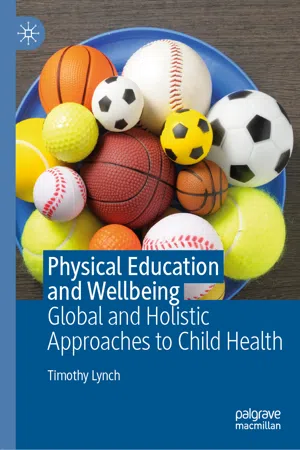
eBook - ePub
Physical Education and Wellbeing
Global and Holistic Approaches to Child Health
- English
- ePUB (mobile friendly)
- Available on iOS & Android
eBook - ePub
About this book
This book explores how physical education (PE) can be best enacted in primary schools in order to optimise children's wellbeing. Drawing together extensive data from school communities around the globe, the author examines multiple dimensions of child health in practice. Ultimately, the findings suggest that PE is imperative within the wider landscape of children's holistic learning, offering a powerful platform for meaningful connections across learning areas. While quantitative research has long evidenced the benefits of physical activity, this book contributes to the complex and global issue of what effective health and wellbeing approaches look like in practice. It is natural for children to enjoy movement for the purposes of play, exploration, learning and development: this book is essential reading for educators looking to enhance children's wellbeing and general health.
Information
Topic
EducationSubtopic
Comparative Education© The Author(s) 2019
Timothy LynchPhysical Education and Wellbeinghttps://doi.org/10.1007/978-3-030-22266-6_11. Introduction
Timothy Lynch1, 2
(1)
Hornbill School, Seria, Brunei
(2)
Sultan Hassanal Bolkiah Institute of Education (SHBIE), Universiti Brunei Darussalam, Bandar Seri Begawan, Brunei
This research book offers insight into enacting “physical education” (PE) to optimise children’s wellbeing. The educational question is no longer whether or not physical activity enhances children’s wellbeing, this is axiomatic, rather it is “how” regular quality PE classes can act as a platform for wellbeing in all schools, for all children. PE is defined as “education through movement” (Pangrazi, 2001, p. 5), and as the book’s title suggests, global and holistic approaches relating to the physical dimension in education are investigated. Hence, “education through movement” is adopted as a lens to explore a holistic approach towards child health and wellbeing.
PE has been advocated for many years within schools as an essential curriculum area, as have the holistic benefits of learning through the physical dimension . However, the education problem that continues to exist, the gap in practice that modern research illustrates, is that PE implementation is not progressing (unlike educational policies). Cale and Harris (2019) recognise gaps in children’s knowledge and understanding of health and the physical dimension in the UK . Also, literature implies to some degree that the holistic HPE ideal has failed in practice (Lynch, 2017; Tinning, 2009). However, we are reminded by Kirk the necessity to continue on the journey of improvement (2014).
The book uses research gathered from around the world and adopts “didactical questions” borrowed from France , Germany and Scandinavian countries—specifically, Swedish didactics of PE research. Didactical in this context refers “to an interest in the relations between teaching, learning and socialisation” (Quennerstedt & Larsson, 2015, p. 1) and “in many European countries, the concept stands for a research tradition with an interest in theories and practices of teaching and learning” (p. 2). Hence, the term’s meaning is different to that of the English language.
Sometimes research in didactics ask slightly different questions regarding educational practice , where didactical questions traditionally are addressed by the questions what, how, and why, in terms of what and how teachers teach, what and how students learn and why this content or teaching is taught or learned. Questions such as who is teaching, who is learning, when and with whom are also relevant. (Quennerstedt & Larsson, 2015, p. 3)
Subsequently, this book’s purpose is: to identify the “what” of “physically educating” children; “how” literature and research suggest this should be done; to identify “why” this is not happening as effectively as it should be; and to offer global direction for our journey of improvement. Through research, problems with implementing the PE curriculum in primary/elementary schools are identified and recommendations are made for advancing the physical dimension in children’s learning, enabling subsequent lifelong wellbeing benefits.
Purpose of the Book
Physical education provides a platform for wellbeing. Specifically, quality physical education (QPE) enhances children’s lifelong wellbeing and holistic health (Lynch, 2016; UNESCO, 2015) . This is a simple statement, given within the realm of education and validated by quantitative research relating to the benefits of physical activities (detailed in Chapters 11, 12, 13, and 14). However, understanding the implementation of QPE to enable holistic health is complex (Kirk, 2014; MacDonald, 2012). The concept of QPE implementation is multidimensional, containing many layers which contribute to this book’s global significance and timeliness, as it investigates how educators, schools and community leaders can optimise children’s wellbeing through the enhancement of PE .
The global definition of PE offered by United Nations Educational, Scientific Cultural Organisation (UNESCO) illustrates the holistic benefits of PE:
the planned, progressive, inclusive learning experience that forms part of the curriculum in early years , primary and secondary education. In this respect, QPE acts as the foundation for a lifelong engagement in physical activity and sport . The learning experience offered to children and young people through physical education lessons should be developmentally appropriate to help them acquire the psychomotor skills, cognitive understanding, and social and emotional skills they need to lead a physically active life. (2015, p. 9)
While many books advocate wellbeing through the physical dimension , this book uses evidence-based research to authenticate the power of QPE and subsequently offers direction in developing whole child wellbeing. The book sits within what Greenfield refers to as “deep thinking ”, “content” or “meaning” derived from research (2012), also referred to as “ideas, thinking, and constructing” (Hattie, 2009, p. 26). That is, the book is a culmination of years of evidence-based research, practical experience and internal insight, carefully constructed to make meaning. Therefore, different aspects of research have been embedded “into a whole nested hierarchy of associations that have accumulated” (Greenfield, 2012) in building knowledge.
The “meaning” clarified relates to QPE and how it can be best achieved within the school community. Cook and Odom (2013) define “evidence-based ” practice in connection with “meaning”; “practices and programmes shown by high quality research to have meaningful effects on student outcome” (p. 136). The meaningful objective evidence in this research book has been gathered from: qualitative in-depth data from case study primary sch...
Table of contents
- Cover
- Front Matter
- 1. Introduction
- 2. Theories, Models and Approaches: Physical Education and Wellbeing
- 3. Approaches to Health and Wellbeing
- 4. Global Policy: Holistic Health, Wellbeing and Physical Education Evolution
- 5. The Meaning of “Education” in “Physical Education”
- 6. “Physically” Educated for Student Wellbeing
- 7. History of the Physical Dimension
- 8. Contemporary Problems: Exploring the Power of Educational Approaches in Health, Wellbeing and Physical Education
- 9. The Socio-Cultural Approach and Implementation in Schools
- 10. Methodology: Research Design and Analysis of Data
- 11. Spiritual Dimension
- 12. Mental Health: Social and Emotional Dimensions
- 13. Physical Dimension
- 14. Cognitive Dimension
- 15. Conclusion and Recommendations
- Back Matter
Trusted by 375,005 students
Access to over 1.5 million titles for a fair monthly price.
Study more efficiently using our study tools.
Frequently asked questions
Yes, you can cancel anytime from the Subscription tab in your account settings on the Perlego website. Your subscription will stay active until the end of your current billing period. Learn how to cancel your subscription
No, books cannot be downloaded as external files, such as PDFs, for use outside of Perlego. However, you can download books within the Perlego app for offline reading on mobile or tablet. Learn how to download books offline
Perlego offers two plans: Essential and Complete
- Essential is ideal for learners and professionals who enjoy exploring a wide range of subjects. Access the Essential Library with 800,000+ trusted titles and best-sellers across business, personal growth, and the humanities. Includes unlimited reading time and Standard Read Aloud voice.
- Complete: Perfect for advanced learners and researchers needing full, unrestricted access. Unlock 1.5M+ books across hundreds of subjects, including academic and specialized titles. The Complete Plan also includes advanced features like Premium Read Aloud and Research Assistant.
We are an online textbook subscription service, where you can get access to an entire online library for less than the price of a single book per month. With over 1.5 million books across 990+ topics, we’ve got you covered! Learn about our mission
Look out for the read-aloud symbol on your next book to see if you can listen to it. The read-aloud tool reads text aloud for you, highlighting the text as it is being read. You can pause it, speed it up and slow it down. Learn more about Read Aloud
Yes! You can use the Perlego app on both iOS and Android devices to read anytime, anywhere — even offline. Perfect for commutes or when you’re on the go.
Please note we cannot support devices running on iOS 13 and Android 7 or earlier. Learn more about using the app
Please note we cannot support devices running on iOS 13 and Android 7 or earlier. Learn more about using the app
Yes, you can access Physical Education and Wellbeing by Timothy Lynch in PDF and/or ePUB format, as well as other popular books in Education & Comparative Education. We have over 1.5 million books available in our catalogue for you to explore.