eBook - ePub
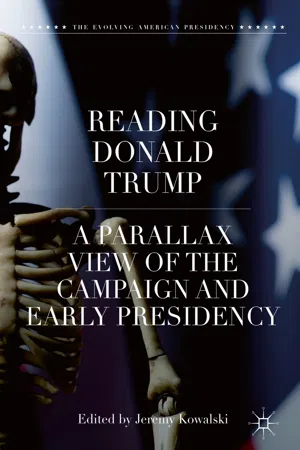
Reading Donald Trump
A Parallax View of the Campaign and Early Presidency
- English
- ePUB (mobile friendly)
- Available on iOS & Android
eBook - ePub
About this book
This book provides a scholarly assessment and analysis of the Trump campaign and early presidency. This assessment and analysis is important not only to help provide some coherence to the turbulent and unpredictable character of "Trumpism," but to contribute to establishing a scholarly foundation for future works that will provide assessments of the Trump presidency in its mid and later stages. Given the divisive and destructive capacity of "Trumpism" and its political and social implications both domestically and internationally, understanding the distinctive political phenomenon of "Trumpism" is necessary if resistance to this transformative moment in American political history is to be successful. This book collects a series of short scholarly contributions on various themes related to "Trumpism" by scholars from disciplines in both the Humanities and Social Sciences.
Information
© The Author(s) 2019
Jeremy Kowalski (ed.)Reading Donald TrumpThe Evolving American Presidencyhttps://doi.org/10.1007/978-3-319-93179-1_11. Introduction: The Emergence of America’s Trump and Trumpism
Jeremy Kowalski1
(1)
Wilfrid Laurier University, Waterloo, ON, Canada
Jeremy Kowalski
Throughout the 2016 US presidential campaign, the vast majority of political pundits and media personalities trivialized or dismissed Donald Trump as a serious political force and presidential candidate. However, on 9 November 2016, the American nation awoke to newspaper headlines reading the following: “Trump triumphs” (New York Times, Washington Post), “Stunning Trump Win” (LA Times), “Shocker” (Santa Fe New Mexican), “America’s New Reality” (Juneau Empire), and “House of Horrors: Trump Seizes Divided States of America” (New York Daily News). Shortly after the unanticipated election and ascendancy of the political figure of Donald Trump to the US presidency, many astonished and bewildered journalists and other political commentators began asking the question, “How did this happen?”
Although the election of Donald Trump as the 45th president of the United States has mystified a multitude of informed and knowledgeable people, his successful campaign for the White House should not be perceived or treated as a political anomaly or aberration. On the contrary, when one situates the election of Donald Trump in a global context, his emergence in the United States reflects the crystallization and increasing normalization of right-wing nationalist movements and populist figures in various jurisdictions around the world following the events of 11 September 2001 and the ensuing so-called war on terror. This constellation of movements and figures includes, but is not limited to, the following: Franke Petry and Jorg Meuthen of the AfD in Germany, Victor Orban of Fidesz and Gabor Voma of Jobbik in Hungary, Marine Le Pen of Front National in France, Heinz-Christian Strache of the FVO in Austria, Nikolaos Michael Oliakos of the Gold Dawn in Greece, Jimmie Akeson of the Sweden Democrats in Sweden, Geert Wilders of the PVV in the Netherlands, Matteo Salvini of LeNord in Italy, Jaroslaw Kaczynski of the PiS in Poland, Jair Bolsonaro of the Social Liberal Party in Brazil, President Rodrigo Duterte of the Philippines, and President Recep Tayyip Erdogan of Turkey. What this particular constellation of political figures and parties reveals and brings into focus is a globalized condition of political emergency or crisis where many democratically elected officials and state institutions have abandoned their respective populations in favor of a system that maintains the interests of elites over the needs of the citizenry. As Antonio Gramsci explains, the result is that “the great masses have abandoned their traditional ideologies, and no longer believe what they used to believe previously, etc. The crisis consists precisely in the fact that the old is dying and the new cannot be born; in this interregnum a great variety of morbid symptoms appear” (2005, 276). Indeed, right-wing populist figures like Donald Trump and those listed earlier are the embodiment of these “morbid symptoms.” Unfortunately, at the risk of the appearance of hyperbole, in the current time-space conjuncture, we are now “Living in the Time of Monsters” (Zizek 2012, 32).
To date, the explanations for Donald Trump’s presidential victory have focused on a variety of variables that when taken in totality secured the Trump Whitehouse. Generally, these variables include the celebrity status of Donald Trump, James Comey’s letter to Congress indicating that he was re-opening the investigation into Hillary Clinton’s e-mail practices while she was Secretary of State, the publishing of hacked Democratic National Committee (DNC) e-mails by WikiLeaks, the legion of support for Donald Trump by “deplorable” American citizens, the anti-establishment posture of Donald Trump and his appeal to disenfranchised voters, the use of social media and fake news to propagate the Trump narrative and influence the decision-making calculus of the American voter, and, of course, the supposed sinister and conniving interference of Russian boogeymen in the democratic process of the United States. Although these explanations provide an account of the appeal of the political figure of Donald Trump and reveal the political processes and forces that helped to shape the mood of American voters, these explanations do not adequately address the actual political and social conditions that facilitated the ascendancy of a right-wing populist figure and demagogue like Donald Trump to the presidency in the United States.
The political accession of Donald Trump can be explained through the crisis of hegemony in the United States leading up to the 2016 presidential election. This crisis was precipitated by the narrow spectrum of ideological manoeuver available to traditional political elites in both the Republican and Democratic parties because of their collective pathological commitment to a neoliberal form of capitalism and related system of governance.1 As a result of this pathology, a crisis in the dominant ideology (neoliberalism) was triggered causing the cement (elite and ruling system of ideas) of the social formation of the United States to erode and disintegrate. This ideological crisis then served a catalytic function in generating a crisis of hegemony where the traditional political elites of the Republican and Democratic parties were unable to impose their leadership on, or receive the consent to govern from, the American electorate (Poulantzas 1979, 72, 76–77). This crisis of hegemony experienced in the United States manifested in two distinct forms.
The first form of the crisis occurred within each of the dominant political parties of the United States. As a result of the fracturing of the Republican Party between the Republican Study Committee, the Freedom Caucus, the Tea Party movement, neoconservatives, libertarians, traditional conservatives, the Christian right, and so on, the Republican Party not only lacked a coherence in traditional leadership that addressed the real concerns of American citizens but also did not offer a vision of America that represented a departure from its support of traditional political and financial elites (Mann and Ornstein 2016, 206). The failures of the Republican Party are exemplified by the polling data gathered from Republican supporters. As Thomas Mann and Norman Ornstein note, “In every poll taken of Republican primary voters in October, November, and December 2015, including likely voters, outsider candidates garnered nearly 70 percent support, while establishment candidates captured under 20 percent” (2016, 210).2 Similarly, in the Democratic Party, there was a fracture between support for Hillary Clinton and Bernie Sanders. However, rather than support a candidate that offered an alternative vision of America that would have benefited the average American citizen, the DNC chose to support Hillary Clinton and traditional elite interests. As T. J. Coles states, “The ruling body of the Democratic Party, the Democratic National Committee, played many dirty tricks to make sure that the corporate-backed Hillary Clinton did better than the union and single-donor backed Bernie Sanders” (2017, 102). As Coles continues, “In other words, the elites within the Democratic Party would rather see a Republican victory than a Democrat victory led by a socialist” (102). As a consequence of the fractures within both the Republican and Democratic parties and their pathological commitment to traditional elite interests, each Party lacked the credibility and legitimacy to exercise what Nicos Poulantzas refers to as “political domination” (1979, 72) with the consent of the majority of their respective supporters. It is precisely through these conditions of political crisis that enable figures like Donald Trump to emerge and assume political power. As Jan-Werner observes, “Today, many indicators suggest that neither parties nor party systems fulfill their respective functions any longer. Scholars have shown that populism is strong in places with weak party systems. Where previously coherent and entrenched party systems broke down, changes for populists clearly increased” (Muller 2016, 79). Therefore, in effect, it was the traditional political elites of both the Republican and Democratic parties and their commitment to unrepresentative politics that helped to create America’s Trump.
The second form of the crisis of hegemony experienced in the United States occurred in civil society among the working classes. To help contextualize this particular form of the crisis, it is important to consider the Occupy movement that began on 24 September 2011 in New York City and quickly spread to dozens of other cities around the United States. The significance of the Occupy movement is that it articulated the material social and economic grievances of society and was an expression of the real conditions of existence of growing segments of the American population. Noam Chomsky described the Occupy movement in the following terms:
Chomsky goes on to state, “At the same time, concentration of wealth leads almost reflexively to concentration of political power, which in turn translates into legislation, naturally in the interest of those implementing it; and that accelerates what has been a vicious cycle leading to, as I said, bitterness, anger, frustration and a very atomized society” (55). T. J. Coles illustrates the growing inequality and stratification of society in the United States through identifying various economic trends following the adoption of neoliberalism from the 1970s onward. For instance, according to a study conducted by the Economic Policy Institute, “in 1965 the CEOs of America’s 350 biggest companies made 20 times more than the average worker. By 2012 they were making nearly 300 times more. The wealth did not trickle down. It went into three pockets: the banks (as savings), the speculative economy (as investments), and the luxury goods economy of yachts, jewelry, jet-setting, etc. (the ‘plutonomy’ economy)” (2017, 43). Furthermore, as Coles identifies, “The biggest financial institutions, as well as energy companies, posted record profits after the Financial Crisis of 2008. By 2015, there was a record 10.4 million individuals worth over a million dollars in the US. Their wealth totals $11.6 trillion. By 2016, there were 540 billionaires in America. Their wealth totals nearly $2.4 trillion” (43). This grotesque accumulation of capital and wealth over approximately the last four decades by a small coterie of the population has coincided with the significant reduction in the qua...Primarily I think this should be regarded as a response, the first major public response, in fact, to about thirty years of a really quite bitter class war that has led to social, economic, and political arrangements in which the system of democracy has been shredded. Congress, for example, has its lowest ever approval level in history—practically invisible—and other institutions’ ratings are not much higher. The population is angry, frustrated, bitter—and for good reasons. For the past generation, policies have been initiated that have led to an extremely sharp concentration of wealth in a tiny sector of the population. In fact, the wealth distribution is very heavily weighted by, literally, the top tenth of one percent of the population, a fraction so small that they’re not even picked up on in the census. You have to do statistical analysis just to detect them. And they have benefited enormously. (2012, 54)
Table of contents
- Cover
- Front Matter
- 1. Introduction: The Emergence of America’s Trump and Trumpism
- 2. Gender and Identity in the Jigsaw Puzzle of Trump’s Zero Sum Politics
- 3. Trumpolect: Donald Trump’s Distinctive Discourse and Its Functions
- 4. Donald Trump’s Wall of Whiteness
- 5. Immigration Courts, Judicial Acceleration, and the Intensification of Immigration Enforcement in the First Year of the Trump Administration
- 6. The Political Economy of Donald J. Trump
- 7. The Discourse on Terrorism of Donald Trump
- 8. Inside the Trumpian Geopolitical Imagination
- 9. Trump and Nuclear Weapons
- 10. Coda: Political Crisis and the Reimagining of America
- Back Matter
Trusted by 375,005 students
Access to over 1.5 million titles for a fair monthly price.
Study more efficiently using our study tools.
Frequently asked questions
Yes, you can cancel anytime from the Subscription tab in your account settings on the Perlego website. Your subscription will stay active until the end of your current billing period. Learn how to cancel your subscription
No, books cannot be downloaded as external files, such as PDFs, for use outside of Perlego. However, you can download books within the Perlego app for offline reading on mobile or tablet. Learn how to download books offline
Perlego offers two plans: Essential and Complete
- Essential is ideal for learners and professionals who enjoy exploring a wide range of subjects. Access the Essential Library with 800,000+ trusted titles and best-sellers across business, personal growth, and the humanities. Includes unlimited reading time and Standard Read Aloud voice.
- Complete: Perfect for advanced learners and researchers needing full, unrestricted access. Unlock 1.5M+ books across hundreds of subjects, including academic and specialized titles. The Complete Plan also includes advanced features like Premium Read Aloud and Research Assistant.
We are an online textbook subscription service, where you can get access to an entire online library for less than the price of a single book per month. With over 1.5 million books across 990+ topics, we’ve got you covered! Learn about our mission
Look out for the read-aloud symbol on your next book to see if you can listen to it. The read-aloud tool reads text aloud for you, highlighting the text as it is being read. You can pause it, speed it up and slow it down. Learn more about Read Aloud
Yes! You can use the Perlego app on both iOS and Android devices to read anytime, anywhere — even offline. Perfect for commutes or when you’re on the go.
Please note we cannot support devices running on iOS 13 and Android 7 or earlier. Learn more about using the app
Please note we cannot support devices running on iOS 13 and Android 7 or earlier. Learn more about using the app
Yes, you can access Reading Donald Trump by Jeremy Kowalski in PDF and/or ePUB format, as well as other popular books in Politics & International Relations & American Government. We have over 1.5 million books available in our catalogue for you to explore.