eBook - ePub
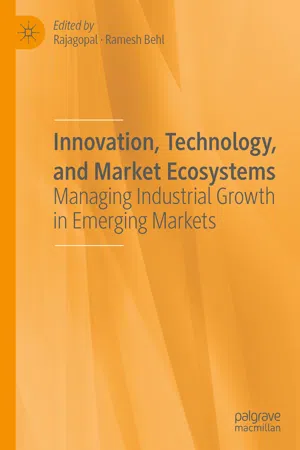
Innovation, Technology, and Market Ecosystems
Managing Industrial Growth in Emerging Markets
- English
- ePUB (mobile friendly)
- Available on iOS & Android
eBook - ePub
Innovation, Technology, and Market Ecosystems
Managing Industrial Growth in Emerging Markets
About this book
This edited book brings together international insights for raising rich discussion on industrial growth in the twenty-first century with a focus on the Industry 4.0 drive in the global marketplace, which is driven by innovations, technology, and digital drives. It delineates multiple impacts on business-to-business, business-to-consumers, the global-local business imperatives, and on the national economy. The chapters critically analyze the convergence of technology, business practices, public policies, political ideologies, and consumer values for improving business performance in the context of Industry 4.0 developments. This contribution will enrich knowledge on contemporary business strategies towards automation and digitization process in manufacturing, services, and marketing organizations. The discussions across the chapters contemplate developing new visions and business perspectives to match with the changing priorities of industries in the emerging markets.
Information
© The Author(s) 2020
Rajagopal, R. Behl (eds.)Innovation, Technology, and Market Ecosystemshttps://doi.org/10.1007/978-3-030-23010-4_11. Convergence of Local Enterprises with Large Corporations: Bridging Industry 4.0 Functions on Broader Business Canvass
Introduction
Local enterprises , along with large industries, play a significant role in social and economic development of the region by providing backward linkages. However, due to resource limitations and lack of adaptation to appropriate technology, they often contribute marginally to the growth of local developmental economics. Several studies have highlighted the effects of convergence of local companies with large companies within the industry, which serves as feeder source of industrial input to large business establishments. The network of local enterprises including start-up enterprises commonly serves as digital assistant to the large manufacturing and marketing companies striking a balance between socio-economic and business growth (Proikaki et al., 2018).
The emphasis on co-creation of innovation and managing innovation business projects in partnership with the local companies is gradually generating technological breakthroughs, allowing emerging companies to reduce the time to bring innovative products and services to the market. The recent trend of carrying out innovation in the business-to-consumer and business-to-business segments by companies exhibits different ways of deploying price and volume advantages in global competition. Large companies practice outsourcing innovation, collaborating with start-up enterprises, investing in open innovation, and engaging in driving public-private partnerships. For example, large companies from emerging markets such as Lenovo Group Ltd. (China) and Godrej Consumer Products (India) and Internet players such as Tencent Inc. (China) are pioneering new ways of industrializing innovation. These companies are engaged in simultaneous engineering by leveraging quick launch, test, and improve (LTI) cycles combining vertical hierarchy for effective control of manufacturing systems with horizontal flexibility. These companies allow autonomy among the innovation teams to steer the new insights and experiments within peer groups (Rajagopal, 2016).
Penetration of multinational enterprises (MNEs) in local markets reduces the survival rate of local firms and drives the local companies to serve as ancillaries or merge with the multinational enterprises. However, this effect diminishes over time as the local firms receive political patronage to support their technology-led growth. Local firms are better able to confront the negative impact of MNEs’ entry with a broader knowledge search over time (Wu, Lao, Wan, & Li, 2019). Most companies grow as learning organizations with openness to new ideas for driving differentiation in order to match innovation and market dynamics. Learning organizations accelerate continuous innovation across a wide range of industries reaching economies of scale at relatively low costs and acceptable quality to ensure value for money to the consumers. Innovative business projects catering to the emerging market demand and consumer needs are often risky and might not ensure breakthroughs in the market. However, successful implementation of innovative business projects has potential to powerfully disrupt the profit models of competitors and make space in the market for the innovation to grow over the period. Industry 4.0 revolution is enforced automation of operations and use of radical innovation to gain strategic competitive advantage. In this process, reducing transaction costs to facilitate innovation has appeared to be a major challenge. Hence, entrepreneurs and investors seek to develop alliance with larger business organizations to build a safer market and reduce their transaction cost. Distributed, decentralized, and diversified open innovation-based local enterprises grow faster in a competitive marketplace (Dey, Gupta, & Singh, 2019).
Top quartile organizations are more mature in enterprise architecture (EA), while small and medium enterprises in emerging countries use more EA designs in IT investment decision-making within the niche markets. However, enterprise architecture adds value to emerging enterprises toward making investment decisions on adapting to new technologies (van den Berg, Slot, van Steenbergen, Faasse, & van Vliet, 2019). For managing innovative business projects efficiently, companies need to reengineer their internal innovation processes based on the principles of vertical and horizontal management approaches, by focusing on time-bound projects involving local partners or workforce (Williamson & Yin, 2014). Many structural and organizational features reduce perceived innovation barriers of firms in developing economies. Interactions between enterprise resources and decision-making among entrepreneurs in small emerging economies are generally characterized by financial and market limitations, weak institutional framework, and low innovation performance. Firms face more obstacles across all the different levels of innovation activity as the size of the company decreases. While considering small firms, relationship between size of the firm and engagement in innovation activities reveals continuous learning dynamics based on one’s own innovation effort and experience, which contributes to overcoming difficulties in the long term (de-Oliveira & Rodil-Marzábal, 2019).
Continuous growth in innovation and technologies is the principal stimulant for companies to gain competitive differentiation and leadership in the global markets and gain high brand equity to drive consumers toward new buying preferences and explore new market segments. However, it is often hard for consumers to adopt innovations, gain confidence in deriving values appropriately, and derive competitive advantages from the innovative offerings over the existing and predetermined products and services. Companies growing in a competitive marketplace monitor both new and incremental innovations to explore their influence on firms’ survival and growth. In addition, the market orientation, firm’s size, its international dimension, and age of the business leader at entry are the control variables most influential on survival (Ortiz-Villajos & Sotoca, 2018).
Consumer perceptions on the innovative products and technologies are largely influenced by social and informal networks. Such interconnections among consumers and companies are so strong that a new product’s adoption by one player often depends on its systematic adoption by other players. Traditionally, companies launch innovative products by targeting unique customer segments or developing compelling value propositions. However, companies engaged in continuous innovations orchestrate a change of behavior among consumers across market segments in order to expand its market outreach. Companies engaged in innovation and competitive gains in the marketplace should explore new market segments, develop and implement strategies that maximize the chances of getting competitive advantage, complement power players, and position the innovation as an enhancement to products or services.
Small companies exploit user innovation for crowdsourcing-based marketing initiatives. The three key activities, by which companies facilitate the outcomes from the crowdsourcing initiative, include the development of opportunities for user innovation, the planning of user innovation activities, and the implementation and assessment of the outcomes. The importance of technical features that support innovation marketing enables socializing of innovation and derives support of active consumers. Such innovation marketing process not only attracts large industries toward innovations at niche level but also creates social consumption experience (Pacauskas, Rajala, Westerlund, & Mäntymäki, 2018). The innovation and technology companies tend to offer coordinated switching incentives to the players (social media, retailer, and salespeople) who add to the innovation’s benefits the players that act as channels to ensure the value of the products and services (Chakravorti, 2004). The elements of business scenario in a destination market are intertwined around various macro-economic factors comprising political, social, economic, technological, and legal factors besides the micro-economic factors within the company.
Developing Entrepreneurial Projects
Innovation is a continuous process, and it helps organizations grow. Growth is often measured in terms of business performance, turnover, and profit contributed by the products and services. Performance of innovative products is measured in reference to the generated competitive differentiation in marketplace, consumer experience, quality of products, and values and marketing efficiency. Innovation is the process of making changes to something established by introducing something new. Innovation can be radical or incremental that can be applied to products, processes, or services, and in any organization. Nurturing innovation projects is a complex process for the small, medium, and start-up organizations. Most innovative projects suffer from internal and external financial constraints that affect the commercialization of innovations during the concept stage (García-Quevedo, Segarra-Blasco, & Teruel, 2018).
Innovation in small and micro enterprises is explored at all levels in the marketplace by generating consumer involvement in the projects of new product or services development. In view of the fast-growing market competition, more and more companies are recognizing innovation as the business opportunity is visualized in sustainability and environmental management sector. Such shift in thinking in many companies and industries, where learning-organization principles are being applied to create sustainable business models, has evidenced change in organizational culture and improvement in the core competencies (Rajagopal, 2016). Small firms differ in assessing the cost, benefit, and risk (CBR) effects during the manufacturing to marketing process as compared to large partnering firms engaged in innovation across destinations. However, strategic alliances between small and large companies toward innovation sharing, and coopetition in building marketing strategies can provide these firms an appropriate CBR measure. In this process, small and large firms evaluate benefits and risks associated in developing strategic alliances for acquisition and commercialization of innovations of small firms. It has been observed in previous research studies that small firms are less reluctant on alliance project than large firms, especially if the cooperation for managing competition (coopetition) allows them to reduce their costs and optimize long-term benefits. The innovation alliances between small and large companies help in developing design-to-market and time-to-market strategies (Chiambaretto, Bengtsson, Fernandez, & Näsholm, 2019).
Small innovation-led firms grow as learning organizations. They become inspirational, energetic places to work, where even relationships with customers and suppliers improve. However, a more integrated view will enable companies to innovate for long-term profitability and sustainability. There are three core competencies that learning organizations must master to profit from sustainability: encourage systemic thinking; convene strategic market players and customers toward changing conventional thinking; and take the lead in reshaping economic, political, and societal forces that baffle change (Senge & Carstedt, 2001).
Often companies select innovative business projects considering their potential for commercialization and gaining high market share in the competitive marketplace. A single company is seldom capable of generating successful diffusion for commercialization of an innovation. Success of innovative products and services often requires cooperation between market players, organizations, and stakeholders in marketing through conventional and digital platforms. Thus, the networking aspect of commercialization is crucial for any innovation, especially in the mass and bottom-of-the-pyramid market segments. Broadly, customers and users, distributors, investors, asso...
Table of contents
- Cover
- Front Matter
- 1. Convergence of Local Enterprises with Large Corporations: Bridging Industry 4.0 Functions on Broader Business Canvass
- Part I. Industry and Technology Management
- Part II. Corporate Financial Management
- Part III. Human Resources Management
- Part IV. Macro-Economic and Social Factors
- Part V. Marketing Management and Enterprise Effectiveness
- Back Matter
Trusted by 375,005 students
Access to over 1.5 million titles for a fair monthly price.
Study more efficiently using our study tools.
Frequently asked questions
Yes, you can cancel anytime from the Subscription tab in your account settings on the Perlego website. Your subscription will stay active until the end of your current billing period. Learn how to cancel your subscription
No, books cannot be downloaded as external files, such as PDFs, for use outside of Perlego. However, you can download books within the Perlego app for offline reading on mobile or tablet. Learn how to download books offline
We are an online textbook subscription service, where you can get access to an entire online library for less than the price of a single book per month. With over 1.5 million books across 990+ topics, we’ve got you covered! Learn about our mission
Look out for the read-aloud symbol on your next book to see if you can listen to it. The read-aloud tool reads text aloud for you, highlighting the text as it is being read. You can pause it, speed it up and slow it down. Learn more about Read Aloud
Yes! You can use the Perlego app on both iOS and Android devices to read anytime, anywhere — even offline. Perfect for commutes or when you’re on the go.
Please note we cannot support devices running on iOS 13 and Android 7 or earlier. Learn more about using the app
Please note we cannot support devices running on iOS 13 and Android 7 or earlier. Learn more about using the app
Yes, you can access Innovation, Technology, and Market Ecosystems by Rajagopal, Ramesh Behl, Rajagopal,Ramesh Behl in PDF and/or ePUB format, as well as other popular books in Business & Business General. We have over 1.5 million books available in our catalogue for you to explore.