- English
- ePUB (mobile friendly)
- Available on iOS & Android
eBook - ePub
About this book
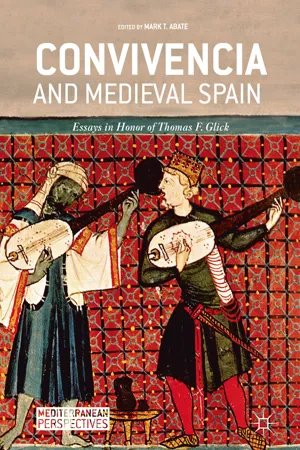
This volume is a collection of essays on medieval Spain, written by leading scholars on three continents, that celebrates the career of Thomas F. Glick. Using a wide array of innovative methodological approaches, these essays offer insights on areas of medieval Iberian history that have been of particular interest to Glick: irrigation, the history of science, and cross-cultural interactions between Jews, Christians, and Muslims. By bringing together original research on topics ranging from water management and timekeeping to poetry and women's history, this volume crosses disciplinary boundaries and reflects the wide-ranging, gap-bridging work of Glick himself, a pivotal figure in the historiography of medieval Spain.
Information
© The Author(s) 2019
Mark T. Abate (ed.)Convivencia and Medieval SpainMediterranean Perspectiveshttps://doi.org/10.1007/978-3-319-96481-2_11. “Ever Since Castro: Thomas F. Glick, Medieval Spain, and Convivencia”
Mark T. Abate1
(1)
Westfield State University, Westfield, MA, USA
For all of my scholarly career I have traveled the interface between two cultures, Islamic and Spanish, able to identify strongly with both, but still feeling not quite at home with either. I was trained as an Islamist; my research has largely fallen on the Spanish side. For these reasons, possibly, my notion about what is distinctive or even normative about medieval society may differ considerably from those of either the Islamist or the Hispanist. Only by identifying with both cultures, and with one no more than the other, can the historian entertain any reasonable hopes of filtering out some of the more flagrant biases that have so persistently plagued this area of investigation.1 (Thomas F. Glick)
Father Burns once wrote that “If history is at bottom biographies , so also is historiography.”2 This point very much informs the following examination of two interrelated subjects: Thomas F. Glick’s development as a historian and his place in the “convivencia debate.” Sadly, though necessarily, both are treated here with much more brevity than they deserve. No chapter-length study could provide more than a basic sketch. Glick’s publications currently tally at 10 monographs, 319 edited volumes, 197 articles, 257 encyclopedia entries, and 187 book reviews. These are roughly distributed among the fields of medieval history and the history of modern science, and these could in turn be subdivided into works on technology, science , archeology, Spain, Latin America, and so on. He has held appointments as a Professor of History, in the History of Science, the History of Technology, Professor of Geography, and even as a Professor of Gastronomy. He is seen as an Arabist by some, a Hispanist by others, and a geographer by still others. A junior colleague that he met at a conference once thought that Thomas Glick, the author of Einstein in Spain, was the son of the medievalist Thomas Glick who wrote Islamic and Christian Spain in the Early Middle Ages. They were, of course, the same Thomas Glick though the initial confusion is perfectly understandable. Planning a collection of chapters in honor of such a scholar was difficult from the beginning. What would be the theme? Taking the easy way out, I kicked the can to Don Tomas himself and made him decide. The decision did not take long. It was medieval Spain, with an emphasis on cross-cultural contacts, what has been generally referred to, at least up until now, as convivencia. He has always self-identified as a medievalist, even during periods when he was working almost exclusively on modern subjects.
Tough decisions had to be made regarding what to include and what to pass over in trying to summarize Glick’s career and work. After a lot of second-guessing, I decided to focus on Glick’s development as a historian up until about 1980 and to mention only a few examples of his works after that time. Much more was to come after 1980, of course, as at this point he had not even reached mid-career. His controversial work on archeology, for example, was still a long way off. Most but not all of his work on modern science, sadly, has been omitted. But his main interests and distinctive methodological approach had already crystallized by 1980. Most of his work has pursued, through an ever-widening array of vistas over the years, a small set of interests that had already emerged by the time he received his doctorate. Most of them—possibly all of them—in one way or another are connected to the issue of diffusion. Methodologically, his approach to these interests gestated throughout his graduate career and reached maturity during his years at the University of Texas at Austin in the late 1960s and early 1970s (at least for his medieval interests). He continued experimenting with and revising models but the basic structure and rationale of his approach remained essentially the same. By 1980 he had already encountered, either personally or through their writings, most of the scholars who came to exert the greatest impact on his development and thought. It was also around 1980 that the majority of his attention became focused on the history of modern science and continued to be until the turn of the decade. The year 1980 was also a sabbatical year for Glick: his magnum opus in medieval history, Islamic and Christian Spain in the Early Middle Ages: Comparative Perspectives on Social and Cultural Formation, had just been released and he left for Valencia to continue research on Freudian theory in Spain (but as it turned out, he began his Einstein project instead). For all these reasons 1980 seemed a logical, manageable, necessary if imperfect terminus. Despite the fact that medieval history is the subject of all the essays collected in this volume, and hence my focus here, something had to be said about his work in the history of modern science. I have discussed a few aspects of it—again with regretful brevity—which I think will be of interest to those who appreciate Glick’s unique approach to history even if it is outside the field.
Cleveland to Harvard: Sartonism
Thomas F. Glick was born in Cleveland Heights Ohio and his early education was at the Hawken School and Western Reserve Academy. His interests both in history and in science emerged early: in grammar school he read, cover to cover, the World Book encyclopedia during leisure time and in high school his love of reptiles and amphibians led him to start a Herpetology Club. Studying Latin for six years, rare for students outside Catholic schools, was the most important part of his early education, an experience he credits not only with the obvious advantages for later learning Romance languages but with habituating logical thought through its declensions and conjugations. Glick’s initial interest in Spain began with a love of the language itself, instilled in him by a gifted high school Spanish teacher. Two European tours with his parents in 1954 and 1956 clinched his fascination with Spain. The land itself, its landscapes and cityscapes, stood out in particular: the mixed urban architecture of the south, rural agrarian communities with the feel of a lost age, and of course the meseta . When in a humorous mood he might joke, tongue in cheek, that a crush on Sophia Loren in the film El Cid might have played some small role in the development of his love for all things Spanish.
In 1956 Glick began the B.A. program at Harvard as a sophomore focusing on Medieval Europe. After an underwhelming experience in his medieval sophomore tutorial, he decided to explore biology, taking courses and spending his spare time in the basement of the Museum of Comparative Zoology identifying or “keying out” specimens from its uncatalogued collection of Cuban lizards. Harvard’s biology curriculum was not yet fully organized along the lines of evolutionary thinking; it was heavily descriptive in approach and insufficiently theorized for Glick’s liking. If the department then was what it became a decade later, during the days of George Simpson and Stephen Jay Gould, he quite likely would have become a biologist rather than a historian. Interested in history and in biology, but not inclined to commit fully to either, Glick heard of the new “History and Science” program. Modeled partly on Harvard’s “History and Literature” concentration, its course credits were divided evenly between history and science, with students focusing on a particular field in history and a discipline in the sciences. As an honors program it required an undergraduate thesis and granted the widest of access to the stacks. Widest of access to the stacks was needed for the History and Science program: even George Sarton’s works back then were locked up in a remote cage in the bowels of the stacks and required special permission to use. The program was a perfect fit: it combined his main interests in a synergistic way and, in practical terms, all his course credits would transfer into the concentration seamlessly.3
Admission into the “History and Science” program required a preliminary interview with its director I. Bernard Cohen. Cohen was a brilliant and colorful character. After briefly studying veterinary medicine and doing a short stint as a prohibition rum-runner, he enrolled at Harvard to study chemistry and then switched to a concentration in mathematics and physics. After a seminar with George Sarton in his senior year, he decided to pursue graduate work in the history of science and became Sarton’s chief disciple. After the war Cohen became the first American to receive a Ph.D. in the history of science and eventually Sarton’s successor at Harvard. Cohen was a Newton scholar who had a deep passion for Spanish culture that ranged from a love of flamenco to an affinity for its leftist revolutionary politics. Before Glick’s interview concluded, Cohen was excitedly pulling Spanish and Latin American science titles from his shelves and handing them to Glick. Hispanism at the time was not an overly appreciated field: their shared love for Spain created a bond and from then on Cohen always encouraged him to pursue subjects on the history of science in Spain. Glick recruited his roommate Michael McVaugh, who was studying chemistry, to join the program with him. Cohen was an energetic lecturer with a comical flair: he concluded lectures on Newton, for example, by deploying a fire extinguisher while standing on a red wagon to demonstrate Newton’s third law as he flew out of the classroom. Glick and McVaugh had never heard anything like the lectures in the history of science course and they discussed the material endlessly. Both became medievalists focusing on the history of science in Spain and lifelong friends.
The “History and Science” program at Harvard was the first of its kind. It was founded by George Sarton, the “father” of the history of science, who more than anyone else transformed the history of science from the personal pursuits of a handful of interested scholars into a formal and institutionalized discipline. Sarton was a pioneer and, like most pioneers, spent much of his life on the margins looking for terra firma to call home. Born in Ghent in 1884, he loved the sciences, was devoted to the humanities, and was a committed liberal. He studied philosophy at the University of Ghent but dropped out “in disgust” to spend a year in private study. When he returned it was to study chemistry and mathematics. After receiving his doctorate in 1911, with a dissertation on Newtonian mechanics, he bought a home in Wondelgem outside Ghent where he began the process of promoting his vision of the history of science. Three years later the property was commandeered by German troops. Sarton buried his books and notes in the garden and fled Belgium. In the USA, Sarton initially got by on a patchwork of lectureships and temporary positions until he received a two-year appointment at Harvard lecturing on the history of science (though technically serving as a lecturer in philosophy) that eventually became permanent, if anomalous, through financial support from the Carnegie Institution.4
The Sartonian vision was foundational for Glick’s intellectual development. He was a Sartonian from the time he completed his B.A. and he still is today. He never met Sarton (who died the year before Glick arrived at Harvard) but he was thoroughly initiated into his views on science and culture through Cohen , through reading Sarton’s entire Introduction to the History of Science as an undergraduate (five massive tomes which stacked up stretch from the floor to the bottom of my knee), and then again through studying with José Millás Vallicrosa and Juan Vernet in Barcelona.5 Sarton’s approach, which he called the “New Humanism,” stressed the need to include the history of science among the traditionally studied “humanities” such as art, literature, philosophy, and music. Science was a crucial aspect of the human experience, the “human task par excellence” if measured objectively as it is the only human activity that is truly cumulative and has progressed over time. Historically the pursuit of science illustrated, more than any other endeavor, the fundamental unity of humanity across cultural, civilizational, and even temporal lines. Despite the sometimes vast differences among peoples from various regions and periods, there have always been among them groups of scholars committed to studying the natural world. The regularities of natural phenomena provided a constant for scientists of all backgrounds: as they faced the same problems posed by nature they often formulated similar questions, devised comparable explanations, and made common discoveries—sometimes simultaneously—by methods that could be similar but were often quite different. Central to Sarton’s position wa...
Table of contents
- Cover
- Front Matter
- 1. “Ever Since Castro: Thomas F. Glick, Medieval Spain, and Convivencia”
- Part I. Irrigation
- Part II. Contacts
- Part III. Perceptions
- Part IV. Science
- Part V. Epilogue
- Correction to: Reading Averroes
- Back Matter
Trusted by 375,005 students
Access to over 1.5 million titles for a fair monthly price.
Study more efficiently using our study tools.
Frequently asked questions
Yes, you can cancel anytime from the Subscription tab in your account settings on the Perlego website. Your subscription will stay active until the end of your current billing period. Learn how to cancel your subscription
No, books cannot be downloaded as external files, such as PDFs, for use outside of Perlego. However, you can download books within the Perlego app for offline reading on mobile or tablet. Learn how to download books offline
Perlego offers two plans: Essential and Complete
- Essential is ideal for learners and professionals who enjoy exploring a wide range of subjects. Access the Essential Library with 800,000+ trusted titles and best-sellers across business, personal growth, and the humanities. Includes unlimited reading time and Standard Read Aloud voice.
- Complete: Perfect for advanced learners and researchers needing full, unrestricted access. Unlock 1.5M+ books across hundreds of subjects, including academic and specialized titles. The Complete Plan also includes advanced features like Premium Read Aloud and Research Assistant.
We are an online textbook subscription service, where you can get access to an entire online library for less than the price of a single book per month. With over 1.5 million books across 990+ topics, we’ve got you covered! Learn about our mission
Look out for the read-aloud symbol on your next book to see if you can listen to it. The read-aloud tool reads text aloud for you, highlighting the text as it is being read. You can pause it, speed it up and slow it down. Learn more about Read Aloud
Yes! You can use the Perlego app on both iOS and Android devices to read anytime, anywhere — even offline. Perfect for commutes or when you’re on the go.
Please note we cannot support devices running on iOS 13 and Android 7 or earlier. Learn more about using the app
Please note we cannot support devices running on iOS 13 and Android 7 or earlier. Learn more about using the app
Yes, you can access Convivencia and Medieval Spain by Mark T. Abate in PDF and/or ePUB format, as well as other popular books in History & European Medieval History. We have over 1.5 million books available in our catalogue for you to explore.