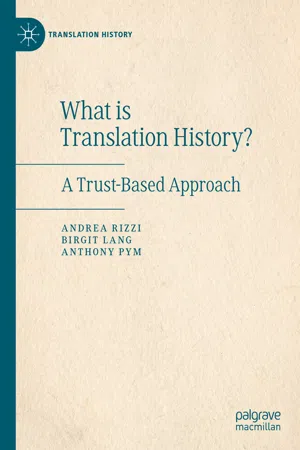
This book presents a dynamic history of the ways in which translators are trusted and distrusted. Working from this premise, the authors develop an approach to translation that speaks to historians of literature, language, culture, society, science, translation and interpreting. By examining theories of trust from sociological, philosophical, and historical studies, and with reference to interdisciplinarity, the authors outline a methodology for approaching translation history and intercultural mediation from three discrete, concurrent perspectives on trust and translation: the interpersonal, the institutional and the regime-enacted. This book will be of particular interest to students and scholars of translation studies, as well as historians working on mediation and cultural transfer.
- English
- ePUB (mobile friendly)
- Available on iOS & Android
eBook - ePub
About this book
Information
Topic
FilologíaSubtopic
Historia social© The Author(s) 2019
Andrea Rizzi, Birgit Lang and Anthony PymWhat is Translation History?Translation Historyhttps://doi.org/10.1007/978-3-030-20099-2_11. Introduction: Towards a New Translation History
Andrea Rizzi1 , Birgit Lang1 and Anthony Pym1
(1)
School of Languages and Linguistics, University of Melbourne, Melbourne, VIC, Australia
Abstract
In asking what translation history is and how it might be written, we explore some of the leading concepts and approaches that historians (of literature, language, culture, society, science, translation, and interpreting) engage with when they encounter translation. We consider the conceptual foundations of translation history in order to propose a way forward.
Keywords
Translation historyTrustMethodologySignallingIntercultural mediationThis book is about translation history and how it might be written. In addressing these questions, we explore some of the leading concepts and approaches that historians (of literature, language, culture, society, science, translation, and interpreting) engage with when they encounter translation. We have written this book with historians in mind, as well as scholars and students of translation studies. In the present chapter we draw a long bow by considering the conceptual foundations of translation history in order to propose a way forward.
Before discussing what translation history can be, let us propose what we think it could best do: namely, address issues of complex social causation that enable or hinder intercultural communication.1 We submit that translation—by which we mean a spoken or written text-based interlingual transfer—is not possible without trust. By studying translation with reference to trust we can reach a clearer understanding of why translations were produced in the first place, and what challenges they appear to have ‘solved’.
In broad terms, we contend that rather than fine-tuning or even challenging key concepts from translation studies (for instance the resemblance and relationality between start and target texts), translation history as a field of inquiry needs to hone its own conceptual tools and methodologies. These more flexible resources, in turn, can build a stronger bridge between discrete disciplines, and foster a greater awareness of translation among historians, as well as greater methodological confidence among scholars of translation.
Our contribution to honing methodology and concepts is to place the concept of trust at the centre of translation history. Including trust in our purview complements and expands the value of approaches that have been recommended and studied for years: researching translators as people in addition to translations as texts; examining translation norms—since norm-adherence can be one of the bases of trust—and investigating translator-client relations, collaborative translation, and translation cultures. All of these matters have been studied before, so what does this book do that is new?
By examining theories and practices of trust from sociological, philosophical, and historical studies, and with reference to interdisciplinarity, we outline a methodology that enables us to approach translation history and intercultural mediation from three discrete, concurrent perspectives on trust and translation: the interpersonal, the institutional, and the regime-enacted.2 Further, we suggest the use of trust as both an object of study and an analytical tool for understanding intercultural mediation. This involves recognising that trust is not the ‘innocent’ concept it is often taken to be, but one requiring closer empirical and theoretical attention than it has so far received in translation studies. Trust describes social practices (including translation) and also constructs them.3
What might a translation history that includes trust look like? To canvass a reply, we address the following array of related questions: first and foremost, as we have already anticipated, what is translation history? Why is the trust aspect of translation history important, and what problems can it address? Who and what is trusted in translation and interpreting? What kinds of trust exist in translation? And, following from these questions, how might we write interdisciplinary translation history that is trustworthy in its claims to represent a genuine, localised encounter between two or more disciplines?
Each chapter offers a response to these questions in a manner that began with self-reflexive enquiry. The authors of this volume work on translation from different and complementary perspectives: Andrea Rizzi is a literary historian, Anthony Pym is a translation scholar, and Birgit Lang is a cultural historian. In writing this volume we have each been brought to examine more openly our different perspectives on translation from these formative vantage points, appreciating ways in which our backgrounds have also conditioned our respective styles of writing. We have chosen to use the plural ‘we’ as the speaking subject of all chapters as a mark of our collaborative ethos, and to underscore our unity in diversity. We discuss and refine our positions and arguments not to find essentialist common ground, but to hone our ideas for the near future of translation history as a robust and incisive field of empirical research and dialogue.
We have not wished to write a book that insists on a narrow suite of norms or methodologies for the study of translation history. Our wish is to propose a new area for attention that can inspire historians and translation scholars to explore more closely the role of translators, interpreters, translations, and their clients in the history of intercultural exchange. As the first volume of the Translation History series published by Palgrave Macmillan, we hope that this contribution will mark the beginning of an enriching conversation about the role that translation history can play in enhancing our understanding of cultural mediation in the past, and in the present.
What is Translation History?
Since at least 1992, scholars have lamented a ‘lack of history in translation history’.4 At the same time, literary historians have engaged with philosophical and social theories to explain practices and theories of translation. For instance, literary historians Rita Copeland, Lawrence Venuti, and Marie-Alice Belle have adopted the Foucauldian concept of genealogy to identify and explain historical attitudes and to understandings of translation—fluency, transparency, progress, imitation, and assimilation, among others.5 The social turn within translation studies has brought key concepts from the work of French sociologists Pierre Bourdieu and Bruno Latour: social capital, habitus, and network are some of the most significant ideas to have influenced studies of translation and translators over the past twenty years. In the last seven years, UK and North-American-based literary historians have contributed to more nuanced approaches to the study of early modern translation in Europe in the context of social and commercial changes. This scholarship calls for closer collaboration between literary and book historians by ‘situating translators at the interface’ between the production and consumption of texts.6
Meanwhile, trust—as a key socio-cultural aim and ambition for intercultural mediation—has remained underexplored in translation.7 Fundamentally, we propose, translators and interpreters exchange their trustworthiness.8 Over the past thirty years, scholars of literature, translation, and science have produced substantial histories of translation and interpreting in English.9 Historians have only comparatively recently engaged with interlingual and textual translation as the centrepiece of their research.10 In the literature on history and translation that has been published in the last fifty years or so, very few studies have offered what Julio-César Santoyo has called ‘a global or globalising vision of what the translation activity has been throughout its approximately four thousand, five hundred years of history’.11 Here we understand Santoyo to be referring to histories focussing on practices of translation rather than theories, because there is no shortage of anthologies of ancient, early modern, modern, and contemporary statements on theories of translation. In these edited collections, excerpts from Marcus Tullius Cicero, Jerome (Eusebius Hieronymus), Martin Luther, Friedrich Schleiermacher, and twentieth-century intellectuals tend to be anthologised chronologically, and according to the generally positivist understanding that changes in approach become progressively more sophisticated.12 Most of these anthologies focus on Euro-American theories, but 2006 saw the publication of a trailblazing anthology of early modern Chinese texts presenting concepts and practices relating to translation.13
To date, most contributions to translation history can be described as collections of essays or monographs on translation theories and practices from a particular region, language, or period.14 Fortunately, research during the past three decades has produced studies that seek to chart the history of translation in the east and west beyond specific nations or regions, and across centuries.15 Now there are also available edited collections and dedicated journal issues that foreground specific aspects of translation and interpreting: methodologies (Pym, Lépinette, and Alcalá), travel and translation (De Bi...
Table of contents
- Cover
- Front Matter
- 1. Introduction: Towards a New Translation History
- 2. On Relationality: Trusting Translators
- 3. On Relativity: Trusting Historians
- 4. On Interdisciplinarity: Trusting Translation History
- 5. Conclusion
- Back Matter
Trusted by 375,005 students
Access to over 1.5 million titles for a fair monthly price.
Study more efficiently using our study tools.
Frequently asked questions
Yes, you can cancel anytime from the Subscription tab in your account settings on the Perlego website. Your subscription will stay active until the end of your current billing period. Learn how to cancel your subscription
No, books cannot be downloaded as external files, such as PDFs, for use outside of Perlego. However, you can download books within the Perlego app for offline reading on mobile or tablet. Learn how to download books offline
Perlego offers two plans: Essential and Complete
- Essential is ideal for learners and professionals who enjoy exploring a wide range of subjects. Access the Essential Library with 800,000+ trusted titles and best-sellers across business, personal growth, and the humanities. Includes unlimited reading time and Standard Read Aloud voice.
- Complete: Perfect for advanced learners and researchers needing full, unrestricted access. Unlock 1.5M+ books across hundreds of subjects, including academic and specialized titles. The Complete Plan also includes advanced features like Premium Read Aloud and Research Assistant.
We are an online textbook subscription service, where you can get access to an entire online library for less than the price of a single book per month. With over 1.5 million books across 990+ topics, we’ve got you covered! Learn about our mission
Look out for the read-aloud symbol on your next book to see if you can listen to it. The read-aloud tool reads text aloud for you, highlighting the text as it is being read. You can pause it, speed it up and slow it down. Learn more about Read Aloud
Yes! You can use the Perlego app on both iOS and Android devices to read anytime, anywhere — even offline. Perfect for commutes or when you’re on the go.
Please note we cannot support devices running on iOS 13 and Android 7 or earlier. Learn more about using the app
Please note we cannot support devices running on iOS 13 and Android 7 or earlier. Learn more about using the app
Yes, you can access What is Translation History? by Andrea Rizzi,Birgit Lang,Anthony Pym in PDF and/or ePUB format, as well as other popular books in Filología & Historia social. We have over 1.5 million books available in our catalogue for you to explore.