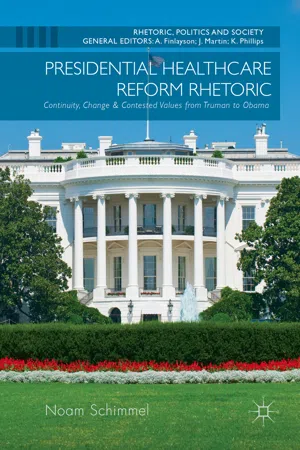
This book analyzes the rhetorical strategies employed by the four Democratic presidents, Truman, Johnson, Clinton and Obama, who tried to expand access to and affordability of healthcare in the United States. It considers how they made such arguments, the ethics they advanced, and the vision of America they espoused. The author combines rhetoric analysis, policy analysis, and policy history to illuminate the dynamic nature of the way American presidents have imagined the moral and social bonds of the American people and their exhortations for governance and policy to reflect and honor these bonds and obligations. Schimmel illustrates how Democratic presidents invoke positive liberty and communitarian values in direct challenge to opposing conservative ideologies of limited government and prioritization of negative liberty and their increasing prominence in the post-Reagan era. He also draws attention to the ethical and policy compromises entailed by the usage of specific rhetoricalstrategies and their resulting discursive effects.
eBook - ePub
Presidential Healthcare Reform Rhetoric
Continuity, Change & Contested Values from Truman to Obama
- English
- ePUB (mobile friendly)
- Available on iOS & Android
eBook - ePub
Presidential Healthcare Reform Rhetoric
Continuity, Change & Contested Values from Truman to Obama
About this book
Information
© The Author(s) 2016
Noam SchimmelPresidential Healthcare Reform RhetoricRhetoric, Politics and Societyhttps://doi.org/10.1007/978-3-319-32960-4_11. Introduction
Noam Schimmel1
(1)
Kellogg College, University of Oxford, Oxford, UK
1.1 The Significance of Healthcare in Contestation of the American Moral Order and Social Imaginary
This book employs rhetoric analysis to illuminate the moral order and social imaginary 1 that Democrats, specifically Presidents Harry Truman, Lyndon Baines Johnson, Bill Clinton, and Barack Obama, have offered as justification for their healthcare reform plans to expand access to healthcare 2 in the US irrespective of income. It is a temporal study of Democratic presidential healthcare reform rhetoric between 1945 and 2013. It analyzes the rhetoric of these four presidents comparatively and examines how Democratic presidential healthcare reform rhetoric has evolved. In so doing, it also explores how it responds to opposing Republican social imaginaries which have emphasized limited government and reject the principle of universal or near-universal healthcare insurance to be guaranteed to American citizens by the government.
This change in the American moral order and social imaginary advanced by Democratic presidents affirms the traditional liberal American values of equality and liberty associated with the Constitution and Declaration of Independence, but also seeks to expand the concept of liberty from a primarily negative one restricting the government’s role in the lives of citizens—reflected in the Constitution and the Declaration of Independence—toward a positive one, in which the government actively enables the welfare of citizens by providing a guarantee of health insurance to the economically disadvantaged and to all American citizens. In this way it seeks to recognize vulnerable members of American society, to mitigate their suffering and the injustice they face, and to address their needs through a practical expression of communitarian social solidarity that guarantees them access to quality healthcare and in so doing creates greater equality of opportunity in American society.
In analyzing this Democratic presidential rhetoric I also consider how these four presidents respond to Republican conservative discourse around the issue of the size of the government and its corresponding characteristics and responsibilities. 3 In Republican rhetoric 4 the phrases “limited government” and “small government” focus at their most basic and obvious level on matters of size. But the size of government is often a coded way of referring to a range of implicit assumptions about which social issues and sectors of the population deserve the attention and resources of the government. Size entails much more than a quantitative measurement—it is also a word loaded with qualitative ethical, ideological, and social meanings which merit examination. As David Shipler writes: “The liberal-conservative divide is not only about how big government should be; it is also about what government should do. Liberalism is the use of the state for some purposes; conservatism is the use of the state for other purposes.” 5
A study of presidential rhetoric covers a wide range of fields of enquiry. 6 These include efforts in the literature on politics and communication to assess the persuasive power of rhetoric, often in relation to practical consequences in the form of voting trends and social attitudes as measured by empirical surveys and statistical analysis. 7 Scholars of speech and rhetoric have examined presidential rhetoric thematically, 8 stylistically, 9 historically, 10 as transmitted by the media, 11 symbolically, 12 discursively, 13 culturally, 14 ethically, 15 and in relation to specific subjects such as war, 16 new policy initiatives, 17 presidential campaigning, 18 current events and commemorative events, 19 and particular genres, 20 such as presidential inaugural addresses 21 and State of the Union addresses. 22 This book addresses a cross-section of these concerns, incorporating discursive, ethical, historical, thematic, and cultural components of rhetoric analysis within the context of political science and public policy.
Thematically, healthcare is significant because it represents one of the most fundamental human needs, along with shelter, access to food and clothing, and education. The lack of universal healthcare for Americans has been one of the great social injustices that tens of millions of Americans have suffered for almost a century; its impacts on life expectancy, quality of life, individual freedom, family stability, economic productivity, and social cohesion are substantial. 23 Lack of health insurance has severe detrimental health impacts that can cause serious physiological and psychological damage. 24 Almost 45,000 Americans die of treatable medical problems every year because they lack health insurance according to a 2009 research study at Harvard Medical School. 25 During the first half of the twentieth century, as Harry Truman noted in one of his campaign speeches, that number was substantially larger. 26 As Jill Quadagno explains:
The consequences are often devastating as illnesses and injuries that do not receive regular medical attention increase in gravity and often become more difficult and expensive to treat, as well as causing the deterioration of an individual’s health.Many uninsured people do not have a regular family doctor and thus do not receive preventive health services … As a result, their health problems are often diagnosed at more advanced stages, resulting in higher mortality rates. Frequently the care they do receive is in an emergency room where there is no primary care and no follow-up care. 27
I choose healthcare as a case study with which to analyze American political discourse because it is one of the major policy areas that Democrats and Republicans have fiercely contested for decades—indeed, in its most comprehensive form since the 1940s and Harry Truman’s presidency and his efforts to advance universal health insurance. As of 2013, over 45 million Americans lacked health insurance and over 20 million were underinsured, 28 although by 2016, Obama’s Affordable Care Act substantially lowered these figures and improved access to health insurance. 29
The US is a highly unusual outlier in not providing universal or near-universal health insurance coverage (until the implementation of the Affordable Care Act) among wealthy industrialized nations. Almost all EU Member States, Canada, Australia, New Zealand, Japan, Taiwan, and some Latin American countries provide universal health insurance to all citizens. 30 While the US under the leadership of Franklin Delano Roosevelt adopted certain social insurance programs such as Social Security, and later under Lyndon Baines Johnson the social insurance program of Medicare and the social welfare program of Medicaid, a government guarantee of universal access to health insurance has remained a key area of political contention in the US since Theodore Roosevelt’s failed efforts to establish such a program in 1912. These failed in part because Roosevelt was not re-elected and consequently did not have the opportunity to develop and advance his reforms, but also because there was little precedent in American policy, politics, and culture for such an effort to provide citizens with a comprehensive entitlement to a fundamental social provision. After Truman’s failed efforts, several presidents made sustained efforts to create such a program, with Richard Nixon proposing expanding health insurance, 31 Bill Clinton universalizing it, and finally Barack Obama near-universalizing it. All of these presidents failed except for Obama. Given that Obama faced a Congress and nation at its partisan apex, following three decades of increasingly hegemonic conservative power, his success is noteworthy.
Healthcare provision has a huge impact on the well-being of US citizens, and given the central place of healthcare reform in political conflicts between Democrats and Republicans, it is appropriate to consider how the debate over healthcare reflects the larger discursive struggle over the moral and social obligations of the US government to its citizens. Enabling healthcare reform or disabling it has profound implications on how Americans imagine themselves, the moral and social bonds that tie them, and the obligations of the government to US citizens. As Robert Asen writes: “Implicated in struggles over meaning, policies express a nation’s values, principles and priorities, hopes and ideals, and beliefs about citizens’ responsibilities and obligations to each other.” 32 This book applies healthcare reform as a case study of wider American political and moral values and their rhetorical contestation, revisions, and, ultimately, policy expression.
1.2 Democratic and Republican Conceptualizations of the American Social Imaginary
The empirical assumption of my research is that the contemporary American social imaginary, the ways in which people imagine their co-existence in a national space, and the moral values, relationships, and responsibilities entailed are discursively constituted through the use of key signifiers. These signifiers relate to the role of government in American...
Table of contents
- Cover
- Frontmatter
- 1. Introduction
- 2. History of American Liberal and Conservative Healthcare Rhetoric and Public Policy
- 3. Methodology and Theory: The Social Imaginary and its Moral Order
- 4. Harry Truman’s November 19, 1945 Address to Congress on Healthcare Reform
- 5. Lyndon Baines Johnson’s Remarks at the Signing of the Medicare Bill, July 30, 1965 and Related Speeches
- 6. Bill Clinton’s September 22, 1993 Address on Healthcare Reform to Congress
- 7. Barack Obama’s September 9, 2009 Healthcare Speech to Congress
- 8. Conclusion
- Erratum to: Presidential Healthcare Reform Rhetoric: Continuity, Change & Contested Values from Truman to Obama
- Backmatter
Trusted by 375,005 students
Access to over 1.5 million titles for a fair monthly price.
Study more efficiently using our study tools.
Frequently asked questions
Yes, you can cancel anytime from the Subscription tab in your account settings on the Perlego website. Your subscription will stay active until the end of your current billing period. Learn how to cancel your subscription
No, books cannot be downloaded as external files, such as PDFs, for use outside of Perlego. However, you can download books within the Perlego app for offline reading on mobile or tablet. Learn how to download books offline
Perlego offers two plans: Essential and Complete
- Essential is ideal for learners and professionals who enjoy exploring a wide range of subjects. Access the Essential Library with 800,000+ trusted titles and best-sellers across business, personal growth, and the humanities. Includes unlimited reading time and Standard Read Aloud voice.
- Complete: Perfect for advanced learners and researchers needing full, unrestricted access. Unlock 1.5M+ books across hundreds of subjects, including academic and specialized titles. The Complete Plan also includes advanced features like Premium Read Aloud and Research Assistant.
We are an online textbook subscription service, where you can get access to an entire online library for less than the price of a single book per month. With over 1.5 million books across 990+ topics, we’ve got you covered! Learn about our mission
Look out for the read-aloud symbol on your next book to see if you can listen to it. The read-aloud tool reads text aloud for you, highlighting the text as it is being read. You can pause it, speed it up and slow it down. Learn more about Read Aloud
Yes! You can use the Perlego app on both iOS and Android devices to read anytime, anywhere — even offline. Perfect for commutes or when you’re on the go.
Please note we cannot support devices running on iOS 13 and Android 7 or earlier. Learn more about using the app
Please note we cannot support devices running on iOS 13 and Android 7 or earlier. Learn more about using the app
Yes, you can access Presidential Healthcare Reform Rhetoric by Noam Schimmel in PDF and/or ePUB format, as well as other popular books in Politics & International Relations & American Government. We have over 1.5 million books available in our catalogue for you to explore.