- English
- ePUB (mobile friendly)
- Available on iOS & Android
eBook - ePub
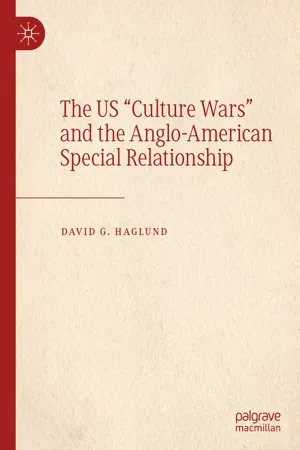
The US "Culture Wars" and the Anglo-American Special Relationship
About this book
This book discusses "culture" and the origins of the Anglo-American special relationship (the AASR). The bitter dispute between ethnic groups in the US from 1914–17—a period of time characterized as the "culture wars"—laid the groundwork both for US intervention in the European balance of power in 1917 and for the creation of what would eventually become a lasting Anglo-American alliance. Specifically, the vigorous assault on English "civilization" launched by two large ethnic groups in America (the Irish-Americans and the German-Americans) had the unintended effect of causing America's demographic majority at the time (the English-descended Americans) to regard the prospect of an Anglo-American alliance in an entirely new manner. The author contemplates why the Anglo-American "great rapprochement" of 1898 failed to generate the desired "Anglo-Saxon" alliance in Britain, and in so doing features theoretically informed inquiries into debates surrounding both the origins of the war in 1914 and the origins of the American intervention decision nearly three years later.
Information
© The Author(s) 2019
David G. HaglundThe US "Culture Wars" and the Anglo-American Special Relationshiphttps://doi.org/10.1007/978-3-030-18549-7_11. Identity, Culture Wars, and the Origins of the Anglo-American Special Relationship: A Huntingtonian Prelude
David G. Haglund1
(1)
Department of Political Studies, Queen’s University, Kingston, ON, Canada
Keywords
Anglo-American special relationship (AASR)Samuel P. HuntingtonIdentityEthnic conflictEthnic lobbyingKin-country syndromeWhite nationalismEuro-AmericanThe Second American Revolution
This book is about culture and the origins of the Anglo-American special relationship (the AASR)—origins that I believe to be located, temporally, in the period between the outbreak of the First World War in August 1914 and the American entry thereinto in April 1917. I am not claiming that the AASR as an ongoing geopolitical institution can be dated from those war years; such a statement would be absurd in light of the drastic downturn in the quality of Anglo-American relations that set in following the First World War. Instead, I believe that the AASR is of more recent vintage, dating from the events of the Second World War. Its deeper origins, however, are to be discerned in that earlier period, when America struggled to remain aloof from the fighting.
The “culture wars” of the 32 months of America’s neutrality during that global conflagration played a seminal, if dimly understood, part in revolutionizing the country’s grand strategy, with far-reaching consequences for later in the twentieth century. This second “American revolution” saw the United States abandoning its prior, and long-standing, attachment to the merits of isolation from the European balance of power and moving toward the acceptance of the hitherto unpalatable idea that alliances, even permanent and “entangling” ones, might become an unavoidable feature of its geopolitical future.1 Discarding the tradition of isolation, in turn, was accompanied by a recognition that America’s newly discovered “internationalism,” halting as it was at first, must entail a radical adjustment in the manner in which it conducted relations with Great Britain, the country that would eventually become its single most obvious and important security partner, from 1940 down to the present time.2 But for that adjustment in strategic outlook to occur, it would need to be preceded by a different sort of adjustment, one directed at the very meaning of the American national identity. And it is upon the adjustment in identity that this book is focused.
Specifically, the adjustment would entail majority opinion swinging from its earlier and proudly maintained opposition to anything smacking of political “union” (i.e., alliance) with Great Britain,3 to an acknowledgment that, henceforth, America’s world-order interests might not only benefit from such union (reunion, in fact, to those who took the long view) but would require it. For this to happen, however, Americans would first have to rid themselves of the ontological “chip” that had for so long been perched conspicuously upon their collective shoulder, and give up for good the strategic conceit that held closer cooperation with Britain in matters of security and defense to constitute the very embodiment of an “un-American activity,” therefore tantamount to betrayal of the Revolution of 1776.
More than this, of course, would be needed before the United States could develop into a permanent fixture on the transatlantic and European stage. But the great American identity shift of the Great War, although obviously not a sufficient condition for ongoing alliance with the former mother country, would turn out to be a necessary one on the path to the AASR. What the culture wars of the neutrality period did was to remove for good the chip, eliminating the one superordinate social-psychological impediment that had hitherto rendered visions of future Anglo-American alliance so constantly illusory, no matter how much legions of policy intellectuals in the United Kingdom (as well as a few in the United States) sought, at the dawn of the twentieth century, to replace the promise of alliance with the reality of one.4 That obstacle to Anglo-American alliance was the “anglophobic” mindset that had so stamped itself upon American national identity for generations, to such an extent that to be a “good” American demanded the promotion of an antagonistic perspective on the political meaning of Britain.5 Crucially, this was a mindset characteristic not only of many of America’s politically active European ethnic minorities (though it was certainly that); it was an attitudinal disposition defiantly maintained through generations by America’s majority population, descendants themselves of earlier arrivals from Great Britain.6 Those descendants will be referred to in this book, for reasons that will become clear in Chap. 4, as the “Hawthornian majority”; I will also employ, synonymously and interchangeably, the expressions, the “EDAs” (for English-descended Americans) and the “Brito-Americans,” this latter originating with Horace Kallen.7
Culture Wars and Identity Shifts
In telling the story of the Hawthornians’ identity shift, I find myself again and again returning to the work of Samuel P. Huntington, sometimes in agreement with him, sometimes in disagreement, but always in recognition of just how seminal have been his contributions to so many important debates about American foreign policy. Huntington was widely and correctly reputed to be one of the foremost analysts of that policy from a “realist” perspective, but in the last book he ever wrote, he gave some sign of defecting to the opposition camp among theorists of international relations (IR). That camp comprises adherents of a paradigm known as “social constructivism,”8 with whom Huntington was showing himself to be in complete agreement on the centrality of “identity” to America’s, or any other country’s, foreign policy. For constructivists, identity is accorded the same pride of causal place as that given to “power” by a certain category of realists (most notably, the “structural” realists to be encountered in subsequent chapters). Thus, it was with some surprise that readers of his 2004 book, Who Are We?, should stumble across Huntington unabashedly declaring that “[n]ational interests derive from national identity. We have to know who we are before we can know what our interests are.”9 Appearances aside, Huntington was not actually defecting from the ranks of realists, for as his comment about “national interests” makes clear, he continued to take his theoretical bearings from the conceptual compass of greatest utility to non-structural realists (these latter usually being referred to as “classical realists” or, sometimes of late, “neoclassical realists”)—a compass upon whose face the arrow always points in the same direction, the true north of the national interest.10 This variant of realism, as many have remarked, is not necessarily antithetical to certain strains of constructivist epistemology, hence Huntington was not so much departing from familiar paradigmatic confines as expanding them.11
There was another matter upon which the Harvard professor was running true to form with the publication of Who Are We? He was continuing to stir up controversy,12 even if not on the scale engendered by an earlier book on civilizational struggle, to be discussed shortly. Provocative though his more recent book was, because of its thesis that immigrants from Latin America were posing a potentially existential threat to America’s “creedal” identity, there really was little adverse reaction to his acknowledgment of the centrality of identity in political life. To the contrary, it has become a home truth of contemporary commentary about public affairs that identity ranks as a (some say, the) paramount feature of political contestation, domestically as well as internationally.13 It is the unavoidable conceptual elephant in the room for legions of political analysts and activists alike. All by itself, this ambiguous psychological construct14 promises to provide the important answers to the implied question conveyed in the title of one of the most famous books ever written about the political process, Harold D. Lasswell’s Depression-era treatise on Politics: Who Gets What, When, How.15 We are constantly being told that politics turns, more and more, on the heartfelt need of groups to assert and defend their “collective identity.” These groups of identity bearers (the Who of Lasswell’s title) have as their uppermost goal the bolstering of their collective self-esteem (the What), and while there are innumerable instances where this goal can be and is accomplished peaceably, there are far too many cases where the unfolding of the How turns violent.
Even the United States no longer seems as immune to the violent side of identity disputation as had been the case in recent decades, with the disturbances of mid-August 2017 that shook Charlottesville, Virginia, shining a spotlight on the collectivity styling itself as the “alt-right.” This entity is widely construed as a congeries of white-supremacist organizations, though they prefer to call themselves “white nationalists.”16 Whether or not they resort to bullets—and sometimes they do, witness the murderous attacks on Charleston’s Emanuel African Methodist Episcopal Church in June 2015 and on Pittsburgh’s Tree of Life Synagogue in October 201817—these various white nationalists do represent the most worrisome and least palatable manifestation of a dynamic that, in the United States, has for more than a quarter century been usefully captured in the expression, culture wars.18 Although culture is such an omnibus vessel as to permit the carriage of any number of referent objects (what T. S. Eliot would have called “objective correlatives,” and which could include religion, gender, and sexual orientation), frequently the kind of identity strife that figures in the culture wars has concerned, and continues to concern, ethnic identity,19 with ethnicity often conflated, especially in America, with the even more contentious category of “race,” as the example of the alt-right demonstrates so well.20 It is the specifically ethnic content of identity that will feature so centrally in the argument advanced in this book, for reasons explained below.
To be clear, it is neither only nor even principally in the United States that culture clashes have been said to constitute the major “fault lines” of a series of struggles pitting collective ethnic identities against each other; these have been occurring on a regular enough basis worldwide to dissuade anyone from pretending they are unimportant. Just the opposite: ever since the ending of the Cold War, it has been commonplace to encounter, both empirically and theoretically, claims that a series of global culture wars has come to dominate international politics, in a manner that replaces the power ...
Table of contents
- Cover
- Front Matter
- Part I
- Part II
- Back Matter
Trusted by 375,005 students
Access to over 1.5 million titles for a fair monthly price.
Study more efficiently using our study tools.
Frequently asked questions
Yes, you can cancel anytime from the Subscription tab in your account settings on the Perlego website. Your subscription will stay active until the end of your current billing period. Learn how to cancel your subscription
No, books cannot be downloaded as external files, such as PDFs, for use outside of Perlego. However, you can download books within the Perlego app for offline reading on mobile or tablet. Learn how to download books offline
We are an online textbook subscription service, where you can get access to an entire online library for less than the price of a single book per month. With over 1.5 million books across 990+ topics, we’ve got you covered! Learn about our mission
Look out for the read-aloud symbol on your next book to see if you can listen to it. The read-aloud tool reads text aloud for you, highlighting the text as it is being read. You can pause it, speed it up and slow it down. Learn more about Read Aloud
Yes! You can use the Perlego app on both iOS and Android devices to read anytime, anywhere — even offline. Perfect for commutes or when you’re on the go.
Please note we cannot support devices running on iOS 13 and Android 7 or earlier. Learn more about using the app
Please note we cannot support devices running on iOS 13 and Android 7 or earlier. Learn more about using the app
Yes, you can access The US "Culture Wars" and the Anglo-American Special Relationship by David G. Haglund in PDF and/or ePUB format, as well as other popular books in Politics & International Relations & North American History. We have over 1.5 million books available in our catalogue for you to explore.