- English
- ePUB (mobile friendly)
- Available on iOS & Android
eBook - ePub
About this book
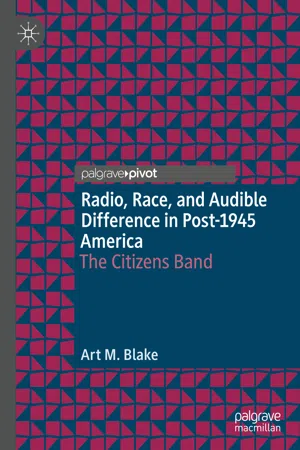
In the second half of the twentieth century, new sounds began to reverberate across the United States. The voices of African-Americans as well as of women, Latinx, queer, and trans people broke through in social movements, street protests, and in media stories of political and social disruption. Postwar America literally sounded different. This book argues that new technologies and new mobilities sharpened American attention to these audibly coded identities, on the radio, on the streets and highways, in new music, and on television. Covering the Puerto Rican migration to New York in the 1950s, the varying uses of CB radio by white and African American citizens in the 1970s, and the emergence of audible queerness, Art M. Blake attunes us to the sounds of race, mobility, and audible difference. As he argues, marginalized groups disrupted the postwar machine age by using new media technologies to make themselves heard.
Information
© The Author(s) 2019
A. M. BlakeRadio, Race, and Audible Difference in Post-1945 Americahttps://doi.org/10.1007/978-3-030-31841-3_11. America in Color: The Postwar Audible Spectrum
Art M. Blake1
(1)
Ryerson University, Toronto, ON, Canada
Art M. Blake
Abstract
Listening to the Puerto Rican migration in the late 1940s and the 1950s, I provide in this chapter an example of the larger context in which audible difference operated in the era preceding CB radio’s mass popularity. The first major postwar migration from outside the mainland United States began in 1948, when many thousands of Puerto Ricans left home for New York City in search of economic mobility and better opportunities than their island territory could offer. New York had not experienced a mass migration of this sort since the turn of the twentieth century. So when Puerto Ricans came to New York in large numbers from 1948 to 1958, their presence represented certainly an audible, if not always a visible, sea change in many working-class neighborhoods—places already under increasing pressure in that same decade from urban planning initiatives to rid the city of “blight” by demolishing vital, if poor, tenement neighborhoods.
Keywords
MigrationPuerto RicanAudible differenceUrban1950sIf you see or hear an actual citizens band (CB) radio, via mass media or in real life depending on your age (mostly), you may not know what it is or your mind may jump to an association with the United States in the 1970s, the movie or song “Convoy” and the question “I wonder what happened to ….” CB radio holds a place in some of our minds as a sort of one-hit wonder of communications technology or an awkward phase between the omnipresence of old terrestrial media and the emergence of new digital media . But in this book I argue that CB radio is worthy of more lasting attention from scholars and students of media and communications history. In fact, as I will show, CB radio, as deployed in the United States, was both representative of, and a player in, urban race relations, gendered and racialized uses of technology, a changing image and national role for the American South, the dwindling power of major post-1945 social movements, and American citizens’ responses to forms of mobility and immobility in the closing decades of the twentieth century.
Big claims for a simple mobile communications technology! But as other scholars in the history of technology and media have shown us, the cultural work performed by devices (from many eras but particularly those in the electronic age) goes far beyond their intended function.1 Scholars can frame urban history and the history of popular culture around histories of technology and invention just as much as they can frame such research around histories of migration, race, economics or gender. As a cultural historian I am interested in the resonances among time-place-people-things; in how a building or a pervasive idea or a change in perspective can reshape other stories far beyond that original starting point. For example, I have written about how the development of New York City’s skyscraper “landscape” at the turn of the twentieth century helped “Americanize” the city in the eyes of Americans who had thought the city too “foreign” both by sensibility and due to its large population of immigrants. So, similarly, I dug into the history of CB radio as part of a larger research project on sound in cities. What I learned from archival research in films, television shows, advertisements, and magazine and newspaper articles led me to understand CB radio as a catalyst for my own questions about histories of listening, aural perceptions of different voices and the role of nonmusical sound in shaping senses of belonging or marginalization especially in urban settings undergoing demographic change.
When, why and to whom might the audibility of race and other forms of difference matter? As scholars of visual culture have argued, questions of the visual legibility of “identity” have mattered most at times of social-political change when the previously stable visual markers of, say, gender, class, sexuality or race became blurred; so too with questions of audible identification and its uncertainties. Mark Smith extensively documents in his book How Race Is Made: Slavery, Segregation, and the Senses the significance of all senses in the construction of race and the practice of racism in the southern United States from the antebellum period through the immediate postsegregation years after the 1954 U.S. Supreme Court Brown vs. Board of Education decision mandating the desegregation of public schools. Smith argues that examining the history of the southern racial sensorium shows that “it was no accident that the most vicious sensory stereotypes whites applied to blacks occurred when certainty in the identification of race was evaporating.” Smith’s skillful examination of the interplay of the histories of the senses and of race and racism buttresses my own arguments here that the racialization of CB radio technology requires us to consider the history of the audibility of race.2
The audibility of race, and other forms of difference rendered in relation to white Anglo supremacy and heteronormativity, resonated with particular sharpness in the post-1945 social movement efforts to reorder America’s racial and other hierarchies. The voices of women, Latinx, queer and trans people in addition to those of African Americans began to reverberate through both reformist and liberation movements, in mainstream media attuned to stories of political and social disruption, through residential urban neighborhoods, and in street protests and marches. Post-World War II America sounded quite different than the preceding pre-war version.
As this book will demonstrate, mobility—geographic, physical, social, economic, intellectual, cultural—produced audible difference by moving bodies, voices and ideas with a rapidity as well as a reach not seen (or heard) before the war, moving them into spaces, territories and ears not previously entered. The uses of citizens band radio provide stark examples of the interaction among mobility, audibility and difference, in particular with reference to the racial construction of “white” and “black” in mid- to late twentieth-century America. But that interaction exemplified through CB radio is better understood, and also complicated, by considering a larger context for audible difference and an expanded idea of “technology.” In this chapter I provide a first example of that larger context of the operation of audible difference preceding the era of CB radio’s mass popularity by listening to the Puerto Rican migration in the late 1940s and the 1950s; in the last chapter of the book my example again extends the audibility of difference to include queer Americans and expands the idea of “technology” to encompass the queer sensory intuition known colloquially as “gaydar.”
The first major postwar migration from outside the mainland United States began in 1948, when many thousands of Puerto Ricans left home for New York City, in search of economic mobility and better opportunities than their island territory could offer. New York had not experienced a mass migration of this sort since the turn of the twentieth century. Immigration restriction legislation passed against Chinese immigrants in 1882, and subsequent laws targeting southern and eastern Europeans in the 1910s, and culminating in the 1924 National Origins Act had closed America’s doors to most sources of immigration other than western and northern Europe. So when Puerto Ricans came to New York in large numbers from 1948 to 1958, their presence represented certainly an audible, if not always a visible, sea change in many working-class neighborhoods—places already under increasing pressure in that same decade from urban planning initiatives to rid the city of “blight” by demolishing vital, if poor, tenement neighborhoods.
In one of those neighborhoods, on Manhattan’s west side, beginning in 1948, commercial sound recordist Tony Schwartz undertook a series of personal recording projects. One of these local sound portraits ultimately resulted in a 1955 record album Schwartz entitled “Nueva York,” a project that emerged from Schwartz’s listening to his own changing neighborhood. Around 1948–1949, Schwartz had noticed a particular change in the cadences of his neighborhood—Spanish-language conversations on the street, merengue tunes and Puerto Rican folk ballads on the candy-store juke boxes, and the shrill complaints from his Euro-American neighbors about “those Puerto Ricans.” Recalling his father’s stories of his grandparents’ immigrations from Europe to New York at the turn of the century, especially the hardships they faced from discrimination, the confusion of a new language and the hostility of so-called native New Yorkers, Schwartz realized, he said, that he “had a chance to document a migration of a people to New York.” Recorded in a mixture of Spanish and English, Schwartz’s “Nueva York” album, distilling eight years of recording into a set of distinct tracks, was released on the Folkways Records label during the peak years of the Puerto Rican migration and New Yorkers’ varied responses to it.3
Listening to “Nueva York,” it becomes clear that the public spaces of the neighborhood cafes and candy stores offered some of Schwartz’s rich...
Table of contents
- Cover
- Front Matter
- 1. America in Color: The Postwar Audible Spectrum
- 2. The Sounds of White Vulnerability
- 3. Mobilizing Black Technoculture
- 4. Queering the Spectrum from Radio to Local TV
- Back Matter
Trusted by 375,005 students
Access to over 1.5 million titles for a fair monthly price.
Study more efficiently using our study tools.
Frequently asked questions
Yes, you can cancel anytime from the Subscription tab in your account settings on the Perlego website. Your subscription will stay active until the end of your current billing period. Learn how to cancel your subscription
No, books cannot be downloaded as external files, such as PDFs, for use outside of Perlego. However, you can download books within the Perlego app for offline reading on mobile or tablet. Learn how to download books offline
Perlego offers two plans: Essential and Complete
- Essential is ideal for learners and professionals who enjoy exploring a wide range of subjects. Access the Essential Library with 800,000+ trusted titles and best-sellers across business, personal growth, and the humanities. Includes unlimited reading time and Standard Read Aloud voice.
- Complete: Perfect for advanced learners and researchers needing full, unrestricted access. Unlock 1.5M+ books across hundreds of subjects, including academic and specialized titles. The Complete Plan also includes advanced features like Premium Read Aloud and Research Assistant.
We are an online textbook subscription service, where you can get access to an entire online library for less than the price of a single book per month. With over 1.5 million books across 990+ topics, we’ve got you covered! Learn about our mission
Look out for the read-aloud symbol on your next book to see if you can listen to it. The read-aloud tool reads text aloud for you, highlighting the text as it is being read. You can pause it, speed it up and slow it down. Learn more about Read Aloud
Yes! You can use the Perlego app on both iOS and Android devices to read anytime, anywhere — even offline. Perfect for commutes or when you’re on the go.
Please note we cannot support devices running on iOS 13 and Android 7 or earlier. Learn more about using the app
Please note we cannot support devices running on iOS 13 and Android 7 or earlier. Learn more about using the app
Yes, you can access Radio, Race, and Audible Difference in Post-1945 America by Art M. Blake in PDF and/or ePUB format, as well as other popular books in History & North American History. We have over 1.5 million books available in our catalogue for you to explore.