eBook - ePub
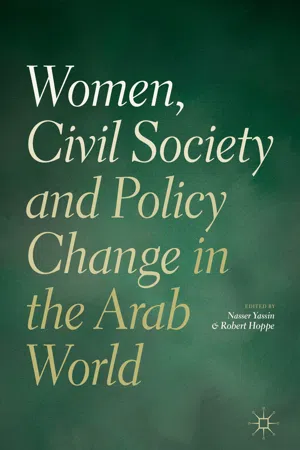
Women, Civil Society and Policy Change in the Arab World
- English
- ePUB (mobile friendly)
- Available on iOS & Android
eBook - ePub
Women, Civil Society and Policy Change in the Arab World
About this book
This book examines the ways in which Arab civil society actors have attempted to influence public policies. In particular, the book studies the drive towards a change of policies that affect women and their well-being. It does so through the lens of women civil society activism and through analysis of cases of policy reform in three Arab countries namely: Lebanon, Morocco and Yemen. The book addresses the tension between policy change and state repression; between Islamic traditional/religious values and civil/secular ones; between the formal and the informal channels for policy-making. One of the first books to reflect on the capability of Arab civil society actors to influence change, it traces recent policy evolution from before the Arab Uprisings in 2011 until the present day, and describes the limited ability of civil society actors to induce change and substantiate it over recent decades. The book explores the use of policy theories in the analysis of cases, and reflects on the possibility of applying and "adapting" those concepts, largely applied in the Western world, to encompass policymaking in the Arab world without conceptual 'overstretch'.
Information
© The Author(s) 2019
Nasser Yassin and Robert Hoppe (eds.)Women, Civil Society and Policy Change in the Arab Worldhttps://doi.org/10.1007/978-3-030-02089-7_11. Introduction
Nasser Yassin1
(1)
American University of Beirut, Beirut, Lebanon
Keywords
ArabCivil societyPolicymakingUprisingsTransitionChange“The people want to topple the regime” was by and large the most famous and quoted slogan during the Arab uprisings in 2011 and 2012. Dubbed by some observers as the Arab Spring, the Uprisings shock the world when the masses broke decades of fear occupying public squares in a score of Arab cities demanding freedom, democracy and justice. Equally striking slogans, albeit not as famous, were those of the “Arab Women Intifada” invigorating women to rise up against oppressions. Arab women were not reluctant to take it to the streets, from Tunis to Taez. The revolutionary moment, which some may argue was short-lived, created an opportunity for Arab women to step up their fight and battle with the tyranny of authoritarian state as well as the repression of patriarchal society.
The uprisings that started with a wave of protest in Tunisia in December 2011, and soon after in Egypt in January 2012, created a domino effect into Yemen, Bahrain, Libya, Syria and later albeit at a smaller scale Morocco and Jordan. Lebanon that was spared that moment, had its own uprising in 2005 upon the assassination of former prime minister Rafic Hariri against the security regime installed by the Syrian army and its intelligence since 1991. Though holding similar demands and themes with universal call for justice and reforms, each Arab uprising had its own dynamics within the socio-political context of each country. All had their ideals propagated and mobilization facilitated by networked individuals and activists. The use of social network mediums, which contributed to quickly dubbing these uprisings the Twitter or Facebook revolutions, had helped in spreading the call to rise, organising of demonstrators and voicing demands. Despite that, the most noticeably common factor across the uprisings was the youth element that was not necessarily experienced revolutionaries but shared the need to break-up with authority, as Nasser Abourahme (2013) calls it. The activists’ tactics to collocate the crowd were unprecedented to the modern Arab world: grass-root, savvy, peaceful and inclusive of all segments of society.
The mere fact that masses decided to stand up to demand the fall of the regimes in those Arab countries constitutes a rupture from the established social contract installed for decades with the establishment of the post-colonial modern nation states. Thus, the most apparent demand of the uprisings, at the time, was the need to transform the notion of governance, and the perceived relationship between the people and their rulers. The uprisings vividly signified the destruction of the fear barrier, and a rise of people power and self-determination. They presented a revolutionary moment, although short-lived, of the will of the masses to take responsibility of their future. One of the infamous slogans during the protests read: “yasqut al-rais al qadem” (Down with the next president). As Abourahme observed, this seemed “to capture something of a revolutionary subjectivity—a certain fractured relation to authority; what mattered was resisting the system itself no matter who took office” (Abourahme 2013: 429).
Indeed, the revolutionary moment did not last long. Periods of transition, with varying durations, ensued in countries going through the uprisings. Except for Tunisia, transitions failed to bring up democratic practices and build reformed institutions. The relative success of Tunisia can be attributed to the ways the main political parties, including the powerful Islamist Ennahda, dealt with the transition and outcomes of elections. The role of trade unions, in particular, was significant in mediating between competing parties and in maintaining dialogue on the future of democracy in Tunisia, as we will see in the next chapter of this book. The fate of other uprisings was more perilous. Countries like Libya, Syria and Yemen fell into full-scale civil wars melding local identity politics with geopolitical ambitions of regional and global powers, turning their conflicts into global crises. Others like Egypt saw an orchestrated comeback of the military and its strongmen in a camouflaged counter-revolution. In Bahrain, the government suppressed the uprisings, while Morocco and Jordan managed to weather the storm with series of reforms.
Part of the failure to enact significant change at level of polity and in rebuilding state institutions could be attributed to the inability to uproot the old regimes and the consequence of incomplete revolutions. The “infrastructure of authoritarianism remained in place” as Brown (2013: 53) puts it. And counter-revolutions aiming at reinstating Arab regime ancien became the norm. Bayat (2017) argues that instead of completing a full-scale revolution with seizing state power for creating or setting a new political order, the uprisings appeared to be satisfied by just pressing for reforms for more democracy and social justice. Thus, the Arab uprisings were not a revolution in the sense of rupturing the old political structures, but a ‘refolution’. With lack of solid vision for ‘new’ state institutions and ways of governance, uprisings were satisfied with negotiating change and reform rather than uprooting old structures of the despotic regimes.
Where Were the Civil Society Actors During the Uprisings?
Despite a history of presence in the Arab world, the ability of civil society actors to induce change and substantiate it prior to the uprisings has been limited. Among the serious obstacles that they faced were the unfavourable set of social, political and economic conditions, and chiefly state repression and fervent resistance to change. State tactics included controlled liberalization, co-optation of civil society groups and the establishment of parallel government-operated NGOs as well as strict monitoring and intrusive legal regulations.
Along with states’ restrictive measures and heavy-handed approach, another factor to take into account when dwelling with the role of civil society in the Arab world is the complex framing of what makes it civil in the first place. This can be best described by the existence of two forms of Arab civil society: ‘al-mujtama’ al-ahli’, or civil society in the traditional sense—as organized forms that are based on communal, kin or religious belonging, and ‘al-mujtama’ al-madani’— i.e. the ‘civil’, which is more literally ‘society of the city’—indicating an organized civil society that answers to the shift from rural/tribal to urbanized society (Rishmawi and Morris 2007), and corresponding to the more modern notion of NGOs and human rights organizations (Centre on Conflict, Development and Peace-building 2012). While the latter has secular and liberal leanings, the former is more communitarian in nature and maintains the intricacies of the Muslim-Arab societies and defined as ‘local community actors and parochial or primordial links’ (Bonnefoy and Poirier 2010) taking on the shape of local community-based organizations (CBOs), tribal-based organizations and religious-based organizations, which have existed for a long time in the Arab world.
Enter the uprisings; some argue that there was a limited role by civil society actors in igniting and organizing the 2011 uprisings, at least during their initiation. Civil society groups did, however, prepare the grounds for the uprisings through years of underground struggles. It can also be said that civil society actors, and notably trade unions, did not directly orchestrate the uprisings, rather they acted as “vessels through which previous socialization had taken place” and participated in spreading a message of unity against abusive regimes (Challand 2011: 276). On the other hand, Halaseh (2012) argued that the crippled and in many instances coerced civil society organizations were forced to exclude the youth and many potential activists prior to 2011. Those marginalized youth and, as Samir Amin (2011) called them the “re-politicized” youth, were later the core element of the uprisings, followed by the radical left and the democratic middle classes.
How Arab Civil Society Actors Manauvered During Times of Transition and Uncertainty?
Arab civil society actors were able to navigate the periods of uncertainty created by the uprisings. This is especially the case during the collective mobilizations and in the early phase after the uprisings where civil society actors were successful in playing the role of “buffer” between conflicting and various political parties. It was a moment of competing political agendas, which allowed civil society actors to participate, and where a space was carved out for civil society participation as a balancing force. Civil society actors acted as mediators between “revolutionary” groups. In Egypt, civil society played such mediating role during the process of drafting the post uprising constitution bridging the gaps between the Muslim Brotherhood and other revolutionary elements.
The uncertainty has given the opportunity for civil society to grow in number. In Libya prior to the uprising, the ousted regime of Gaddafi was not in favour of any civil association that did not fall under the governance of the state and its apparatus. The number of civil society organisations was close to null aside from trade and peasant unions. The latter have been viewed as being an extension of the state (Vallianatos 2013). With the uprising, the number of civil society organizations has increased from 22 to around 3000 nationwide where the majority established in the urban areas of Benghazi and Tripoli. Tunisia, the first Arab country to witness a popular uprising, witnessed an increase in number of civil society organisations from a little less than 10,000 to almost 15,000 by 2012. Furthermore, the geographic distribution of these organizations has expanded greatly. Whereas prior to the revolution they were mostly centred in the capital Tunis or the coastal cities of Sfax and Sousse where they could remain within the easy grasp of the state security apparatus, civil society organisations have now rapidly expanded in all districts of the country. In Yemen, the World Bank reported the registration of around 8300 civil so...
Table of contents
- Cover
- Front Matter
- 1. Introduction
- 2. ‘Civil Societies’ and the Arab Uprisings-Prospects for Socio-political Change: A Comparative Analysis of the On-going Tunisian and Egyptian Plight
- 3. The Political Participation of Women in the Arab World: Mapping the Movement, Experiences and Challenges Facing Arab Women from the Beginning of the Twentieth Century Until the Post-Arab Uprisings Era: Expectations, Paths and Outcomes
- 4. Civil Society Advocacy and Policy Entrepreneurship: Examining the Making of the Law 293 to Criminalize Domestic Violence in Lebanon
- 5. Empowering Women Through Land Policy Change: The “Soulaliyate” Movement in Morocco
- 6. Minimum Marriage Age Legislation in Yemen, 2008–2014: Exploring Some Limits to Portability of the ACF
- 7. Is Sisyphus a Muslim Woman? Policymaking on Women Issues in Three Arab Countries
- Back Matter
Trusted by 375,005 students
Access to over 1.5 million titles for a fair monthly price.
Study more efficiently using our study tools.
Frequently asked questions
Yes, you can cancel anytime from the Subscription tab in your account settings on the Perlego website. Your subscription will stay active until the end of your current billing period. Learn how to cancel your subscription
No, books cannot be downloaded as external files, such as PDFs, for use outside of Perlego. However, you can download books within the Perlego app for offline reading on mobile or tablet. Learn how to download books offline
Perlego offers two plans: Essential and Complete
- Essential is ideal for learners and professionals who enjoy exploring a wide range of subjects. Access the Essential Library with 800,000+ trusted titles and best-sellers across business, personal growth, and the humanities. Includes unlimited reading time and Standard Read Aloud voice.
- Complete: Perfect for advanced learners and researchers needing full, unrestricted access. Unlock 1.5M+ books across hundreds of subjects, including academic and specialized titles. The Complete Plan also includes advanced features like Premium Read Aloud and Research Assistant.
We are an online textbook subscription service, where you can get access to an entire online library for less than the price of a single book per month. With over 1.5 million books across 990+ topics, we’ve got you covered! Learn about our mission
Look out for the read-aloud symbol on your next book to see if you can listen to it. The read-aloud tool reads text aloud for you, highlighting the text as it is being read. You can pause it, speed it up and slow it down. Learn more about Read Aloud
Yes! You can use the Perlego app on both iOS and Android devices to read anytime, anywhere — even offline. Perfect for commutes or when you’re on the go.
Please note we cannot support devices running on iOS 13 and Android 7 or earlier. Learn more about using the app
Please note we cannot support devices running on iOS 13 and Android 7 or earlier. Learn more about using the app
Yes, you can access Women, Civil Society and Policy Change in the Arab World by Nasser Yassin, Robert Hoppe, Nasser Yassin,Robert Hoppe in PDF and/or ePUB format, as well as other popular books in Politics & International Relations & Middle Eastern Politics. We have over 1.5 million books available in our catalogue for you to explore.