This edited collection is an interdisciplinary study of gems in the early modern world. It examines the relations between the art, science, and technology of gems, and it does so against the backdrop of an expanding global trade in gems. The eleven chapters are organised into three parts. The first part sets the scene by describing how gems moved around the early modern world, how they were set in motion, and how they were pulled together in the course of their travels. The second part is about value. It asks why people valued gems, how they determined the value of a given gem, and how the value of a gem was connected to its perceived place of origin. The third part deals with the skills involved in cutting, polishing, and mounting gems, and how these skills were transmitted and articulated by artisans. The common themes of all these chapters are materials, knowledge and global trade. The contributors to this volume focus on the material properties of gems such as their weight and hardness, on the knowledge involved in exchanging them and valuing them, and on the cultural consequences of the expanding trade in gems in Eurasia and the Americas.
Michael Bycroft and Sven Dupré (eds.)Gems in the Early Modern WorldEurope's Asian Centurieshttps://doi.org/10.1007/978-3-319-96379-2_1
Begin Abstract
1. Introduction: Gems in the Early Modern World
Michael Bycroft1 and Sven Dupré2
(1)
History Department, University of Warwick, Coventry, UK
(2)
History of Art, Science and Technology, Utrecht University, Utrecht, The Netherlands
Michael Bycroft (Corresponding author)
Sven Dupré
Keywords
Global tradeInterdisciplinaryMaterialityKnowledgeGemstones
This project has received funding from the European Research Council (ERC) under the European Union’s Horizon 2020 research and innovation programme (grant agreement No. 648718).
End Abstract
Are there diamonds in Brazil? There was no straightforward answer to this question in the eighteenth century, despite the fact that, as we now know, diamonds were discovered in the mountainous region of Serro do Frio in the 1720s. The discovery is usually associated with a man named Bernardo Fonseca Lobo, who claimed credit for the discovery in a petition to the Portuguese crown.1 But Lobo claimed to have made the discovery in 1723, five years before he showed the diamonds to the Portuguese Governor of Brazil. A plausible explanation for the delay is that Lobo had taken five years to identify the stones as diamonds. At any rate, that was the view of Sylvestre Garcia do Amaral, a lapidary from Lisbon who claimed to have made this identification before anyone else, in 1727. Amaral may have identified the stones by sight or, more reliably, by attempting to cut them on a rotating iron wheel sprinkled with powdered emery. As early modern lapidaries knew from daily experience, emery cuts ruby, sapphire, and rock crystal but not diamond.
Amaral was probably not (as he claimed) the first to identify the stones as diamonds, but he was right to stress his expertise as a lapidary. Raw diamonds are rough and cloudy, like pieces of translucent gravel, easily confused with the rock crystal that was being dug up and traded in Serro do Frio in this period. Even experienced traders took their precautions: a Huguenot merchant in Lisbon received stones from Brazil in the late 1720s, sent to him by a former servant who wanted “to know what they were”; the merchant sent the specimen to a London firm and learned that they were “good and handsome diamonds.” Expert judgements such as this one ensured that Brazil supplied most of the world’s diamonds for the rest of the eighteenth century. Analogous judgements were made on a daily basis throughout the century. One of the earliest illustrations of the diamond mines in Brazil, from the early nineteenth century, shows a line of black slaves bent over a riverbed, each overseen by a white man whose job is to appraise the minerals turned up by the digger at his feet (Fig. 1.1).
Fig. 1.1
“View of Negroes [sic.] washing for diamonds at Mandanga on the River Jigitonhonha in Cerro do Frio Brazil,” from Thomas Mawe, Travels in the Interior of Brazil, 2nd ed. (London, 1822). Image credit: Library of Congress/Internet Archive
By mid-century, Brazilian diamonds were a reality for numerous merchants, slaves, mine owners, and lapidaries. But there remained a great deal of uncertainty about the origin and quality of the new stones. In a book published in 1751, the London jeweller David Jeffries went so far as to say that there was no such thing as Brazilian diamonds and that diamonds labelled as such were in fact from India. He claimed that merchants in Lisbon started selling their Indian diamonds as “Brazilian” ones when the king of Portugal banned the trade in diamonds with India; to lend plausibility to the fake name, these merchants maintained that Brazilian diamonds were inferior to Indian ones. The result of this de-valuation was a surplus of cheap diamonds that had depressed the diamond trade in London and threatened the livelihoods of merchants and gem-cutters in the capital. Jeffries hoped that his treatise would reverse this trend by exposing the ruse of the Portuguese traders and providing clear rules for determining the quality, and hence the price, of raw diamonds. Now, the price of a raw diamond depends on how much material must be removed when it is facetted, which in turn depends on the desired cut. So Jeffries went into great detail about the types of cut that were then in fashion and the procedures for executing these cuts. His book ends with a set of line drawings of diamonds of different sizes and cuts; Jeffries urged his genteel readers to use these drawings as templates for estimating the size and hence the price of their own diamonds.2
Jeffries’ book went through numerous editions and translations, but his conspiracy theory did not convince everyone. “All jewellers agree,” a French naturalist wrote in 1779, “that the Brazilian diamond is somewhat softer, lighter and less perfect than the Oriental one.” Scientists at the Royal Society of London and the Paris Academy of Science weighed in on the dispute, distinguishing Brazilian diamonds from Indian ones on the grounds of density, crystal structure, refractive index, and electrical conductivity. In doing so, they made use of newly discovered properties of gems (such as refractive index) and of new techniques for measuring old properties (such as the hydrostatic balance for measuring density). These scientists found their specimens where they could: an English scientist weighed a set of diamonds obtained from the East India Company; one of his French counterparts weighed diamonds from the crown jewels. The differences these men detected were aesthetic as well as technical. The French naturalist Georges Buffon cited a note from the ambassador of the Holy Roman Empire: “Oriental diamonds have greater hardness, fire and brilliance than those from Brazil…An experienced eye is never mistaken.”3
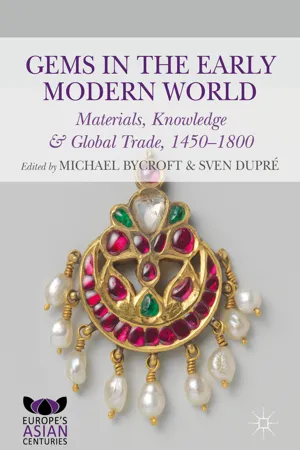
The case of Brazilian diamonds illustrates the main themes of this volume. Firstly, the past can be fruitfully studied from the point of view of materials, in this case precious and semi-precious stones. The material properties of gems—their size, shape, and hardness; their varieties and sub-varieties; and the way they respond to the edge of a file or the light of a candle—made a difference to the way they interacted with humans. Secondly, gems are best studied from several different angles at once. The history of Brazilian diamonds could be written by an art historian, a cultural historian, a history of science, a historian of technology, or an economic historian, and for this reason, the history of precious stones is best written by a team that combines all these specialties. In merging these sub-disciplines, we are especially interested in exploring the role of knowledge in the history of gems, whether the knowledge involved in telling a ruby from a piece of coloured glass, in cutting a diamond into facets, or in explaining why emeralds occur in North Africa and South America but not in France or China. The third theme is the acceleration of the global trade in gems between 1450 and 1800 and in particular the integration of Europe and Europeans into that trade. This integration is nicely symbolised by the jewel shown on the front of this book, an eighteenth-century tika, or forehead ornament, set with green and red stones (possibly emeralds and rubies), and with shivers of diamond and pearls. Made in Surat, the most important port city at the north-west coast of India, the jewel travelled via channels connected to the Dutch East India Company to the stadholderly collection in the Dutch Republic.4 Global trade is the backdrop for the 11 chapters in the volume, each of which sheds light on the connections between the art, science, technology, and trade of these unusually mobile and versatile materials. Though most of the chapters take Europe as their starting point, most of them do not end there; together they range across Eurasia, as did the maps, networks, and commodities they examine. In the rest of this introduction, we summarise existing knowledge about gems in the early modern world before expanding on the three themes outlined in this paragraph.
1 The Global Gem Trade and Europe
What does it mean to say that Europe and Europeans became integrated into the global gem trade in the early modern period? The history of the diamond trade, the most well-documented branch of the gem trade in this period, suggests the following answers.
Firstly, it does not mean that the trade was merely local before 1450 or that it excluded the lands west of the Nile and the Don. On the contrary, a map of diamond trade routes between 100 BC and 300 AD takes in the length, if not the breadth, of Eurasia. From their origins on the Indian subcontinent, diamonds travelled to China via modern-day Sri Lanka and Thailand; they travelled north as far as the Ural mountains; and they travelled west via the Red Sea and the Persian Gulf to the port cities of the Mediterranean.5 The flow of diamonds from India to the Mediterranean slowed after the fall of the Roman Empire, but it never ceased altogether and it thickened from the thirteenth century onwards. As early as the eighth century, Venetian traders were buying gems in Aleppo and Alexandria and bringing them to Pavia, where their buyers included agents sent by Charlemagne. In the tenth century, gems were mentioned in a treaty settled between Greeks and the Muslim rulers of Aleppo. In the thirteenth century Venice set up trade missions in Aleppo and Alexandria, and the importance of gems to these missions is shown by treaties concluded between Venice and the Muslim rules of Egypt and Syria between 1238 and 1353. A merchant’s handbook written in Europe in about 1490 describes the flourishing trade of diamonds out of Venice on the eve of European landfall in India and Brazil. The author refers to diamonds bought by Venetians in the Near East and then sent west from Venice, the cut diamonds going to Lisbon and Paris and uncut diamonds to Antwerp.6
This trade was transformed by the arrival of Europeans in South America in 1492 and by their arrival in the Indian Ocean by sea in 1498. The most obvious consequence of these voyages was the physical proximity of Europeans to diamond mines and to the merchants who frequented them. Europe no longer relied for its diamonds on the Persian and Arab middle-men who had controlled most of the gem trade through the Levant since antiquity.7 They were now able to purchase diamonds at the mines themselves or at trading centres with a direct link to the mines, notably Goa and Madras. At its peak early in the sixteenth century, Goa was the largest market for precious stones in Asia, and although the best of the diamonds sold there probably went to the agents of local rulers, many also found their way to Europe. According to an Italian visitor in this period, it was easy to find “a Portuguese merchant, well skilled in that trade, to make a small purchase in diamonds on one’s behalf, they being cheap at Goa.” The sea route from Goa to Lisbon had the advantages of security, ease of transport, and freedom from taxation and regulation.8 By the second half of the seventeenth century, these ...
Table of contents
Cover
Front Matter
1. Introduction: Gems in the Early Modern World
Part I. Motion
Part II. Value
Part III. Skills
Back Matter
Trusted by 375,005 students
Access to over 1.5 million titles for a fair monthly price.
Study more efficiently using our study tools.
Frequently asked questions
Yes, you can cancel anytime from the Subscription tab in your account settings on the Perlego website. Your subscription will stay active until the end of your current billing period. Learn how to cancel your subscription
No, books cannot be downloaded as external files, such as PDFs, for use outside of Perlego. However, you can download books within the Perlego app for offline reading on mobile or tablet. Learn how to download books offline
Perlego offers two plans: Essential and Complete
Essential is ideal for learners and professionals who enjoy exploring a wide range of subjects. Access the Essential Library with 800,000+ trusted titles and best-sellers across business, personal growth, and the humanities. Includes unlimited reading time and Standard Read Aloud voice.
Complete: Perfect for advanced learners and researchers needing full, unrestricted access. Unlock 1.5M+ books across hundreds of subjects, including academic and specialized titles. The Complete Plan also includes advanced features like Premium Read Aloud and Research Assistant.
Both plans are available with monthly, semester, or annual billing cycles.
We are an online textbook subscription service, where you can get access to an entire online library for less than the price of a single book per month. With over 1.5 million books across 990+ topics, we’ve got you covered! Learn about our mission
Look out for the read-aloud symbol on your next book to see if you can listen to it. The read-aloud tool reads text aloud for you, highlighting the text as it is being read. You can pause it, speed it up and slow it down. Learn more about Read Aloud
Yes! You can use the Perlego app on both iOS and Android devices to read anytime, anywhere — even offline. Perfect for commutes or when you’re on the go. Please note we cannot support devices running on iOS 13 and Android 7 or earlier. Learn more about using the app
Yes, you can access Gems in the Early Modern World by Michael Bycroft, Sven Dupré, Michael Bycroft,Sven Dupré in PDF and/or ePUB format, as well as other popular books in Storia & Storia dell'Asia. We have over 1.5 million books available in our catalogue for you to explore.