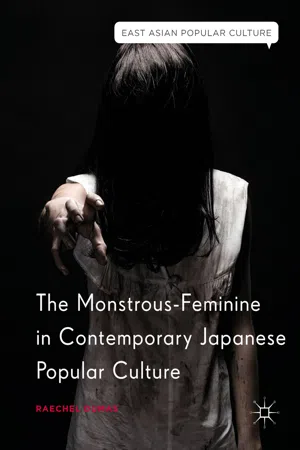
This book explores the monstrous-feminine in Japanese popular culture, produced from the late years of the 1980s through to the new millennium. Raechel Dumas examines the role of female monsters in selected works of fiction, manga, film, and video games, offering a trans-genre, trans-media analysis of this enduring trope. The book focuses on several iterations of the monstrous-feminine in contemporary Japan: the self-replicating sh?jo in horror, monstrous mothers in science fiction, female ghosts and suburban hauntings in cinema, female monsters and public violence in survival horror games, and the rebellious female body in mytho-fiction. Situating the titles examined here amid discourses of crisis that have materialized in contemporary Japan, Dumas illuminates the ambivalent pleasure of the monstrous-feminine as a trope that both articulates anxieties centered on shifting configurations of subjectivity and nationhood, and elaborates novel possibilities for identity negotiation and social formation in a period marked by dramatic change.
- English
- ePUB (mobile friendly)
- Available on iOS & Android
eBook - ePub
The Monstrous-Feminine in Contemporary Japanese Popular Culture
About this book
Information
Print ISBN
9783319924649
Subtopic
Film & Video© The Author(s) 2018
Raechel DumasThe Monstrous-Feminine in Contemporary Japanese Popular CultureEast Asian Popular Culturehttps://doi.org/10.1007/978-3-319-92465-6_11. Open Wounds: Situating the Monstrous-Feminine in Contemporary Japan
Raechel Dumas1
(1)
Department of Classics and Humanities, San Diego State University, San Diego, CA, USA
Since the 1993 publication of Barbara Creed ’s The Monstrous-Feminine: Film, Feminism, Psychoanalysis, the monstrous-feminine has become a subject of increasingly widespread critical interest and inquiry. In the same period, female monsters have continued to assume an ever more imaginative array of shapes within the artistic imagination. If these initial remarks seem detached from considerations of place, it is because the monstrous-feminine is a largely ubiquitous trope, materializing across global borders in myriad localized contexts, often at the nexus of anxiety-ridden discourses centered on shifting paradigms of subjectivity, cultural identity, and nationhood. This is especially true of the female monsters to be found within the vast landscape of popular culture, an arena of representation that has widely mobilized sexual difference as a device for elaborating both the perils and the pleasures that contemporary life entails.
For Creed, the monstrous-feminine is entrenched in enduring apprehensions centered on the female reproductive body as a site located beyond the regulatory purview of paternal law. Central to her discussion of this phenomenon is the work of feminist critic Julia Kristeva , whose 1980 Powers of Horror provides a psychoanalytic account of abjection , which describes a process of radical exclusion that is modeled on the infant’s repudiation of the maternal body as a mechanism for establishing a concrete identity. Kristeva draws a connection between the societal impulse to secure and reinforce the boundaries of culture and the psychosexual repression of the maternal body as a precondition for the formation of a coherent selfhood:
The abject confronts us, on the one hand, with those fragile states where man strays on the territories of animal. Thus, by way of abjection , primitive societies have marked out a precise area of their culture in order to remove it from the threatening world of animals or animalism, which were imagined as representatives of sex and murder. The abject confronts us, on the other hand, and this time within our personal archeology, with our earliest attempts to release the hold of the maternal entity even before existing outside of her, thanks to the autonomy of language. (pp. 12–13)
The work of abjection thus serves to secure subjectivity and social order by foreclosing the feminine as a representative of that which “disturbs identity, system, order. What does not respect borders, positions, rules. The in-between, the ambiguous, the composite” (p. 4). As Kristeva observes, however, the symbolic realm carved out by this process is one riddled with instabilities, and the abject threatens always to return: “Abjection … is a precondition of narcissism. It is coexistent with it and causes it to be permanently brittle. The more or less beautiful image in which I behold or recognize myself rests upon an abjection that sunder it as soon as repression, the constant watchman, is relaxed” (p. 13).
Creed observes that sexual difference in horror cinema routinely conforms to the parameters outlined by Kristeva, identifying an extensive catalog of archetypes that reflect fears surrounding both the physical characteristics of the female body and the psychological dimensions of female desire : primeval mothers, vampires, witches, monstrous and bleeding wombs, possession, castrating mothers, beautiful but deadly killers, aged psychopaths, monstrous girl-boys, women as non-human animals, women as life-in-death, and women as deadly femmes castratrice (1993, p. 1). Continuing, she provides a far-reaching account of how these tropes have been deployed in the contemporary horror film to connote the collapse of boundaries delineating morality and sinfulness, culture and nature, order and chaos, the knowable and the unknowable, Self and Other.
While Creed’s analysis is limited in scope to Western horror films, her observations provide a fruitful point of departure for thinking also about the monstrous-feminine in Japan. Monstrous configurations of femininity have long occupied a place in the Japanese cultural imaginary, routinely emerging as sites for modeling deviant (and reinforcing normative) moral behaviors and social norms. As in the West, this trope originates largely in the archaic mythological consciousness, where the female body is frequently deployed to elaborate both the ritual dimensions of Shintō religious practice and the gendered cultural paradigms that governed much of ancient Japanese life—a notion I will examine more fully in the chapters that follow. As I have explored elsewhere, premodern Buddhist attitudes regarding the female body are especially replete with ambivalence, alternatingly identifying female sexuality and reproductive potential with the divine and the defiled as a means of shaping and reinforcing hegemonic behavioral codes (2013). Some of the most remarkable medieval contemplations of the female body are located in the expansive literary genre of setsuwa and the visual realm of picture scrolls, both of which depict the female body in various states of monstrosity—through images of grotesque metamorphosis, sexual violence , monstrous impregnation, menstrual excess, and decaying corpses—as a means of negatively reinforcing the virtues of female sexual propriety, maternal devotion, and spiritual practice. 1 Buddhism ’s “pragmatic hostility toward women” (Dix, p. 58) is likewise visible across a spectrum of other medieval and early modern Japanese literary, visual, and performing arts, taking the shape of figures such as the madwoman of Nō theater, the ubume (a creature associated with the taboos of menstrual blood and pregnancy ), the kosodate yūrei (child -rearing ghost ), the mountain-dwelling yamanba and yamauba (creatures frequently accompanied by a child ), and the female onryō (vengeful ghost ), among others, to demonstrate the dangers of attachment to, and the illusory quality of, the material world.
While a comprehensive engagement with the monstrous-feminine in the premodern imagination is beyond the scope of this book, these examples are reflective of a longstanding conversation in Japan surrounding the perceived place of women in the domestic, social, and moral organizations. In the modern era, this conversation has endured to yield a broad spectrum of discourses that situate the female body as a site for mapping shifting configurations of Japanese subjectivity and nationhood. As Miri Nakamura explains, the importation of discourses on reproductive science, hygiene, and eugenics into Japan during the Meiji era (1868–1912) had a formative influence on modern conceptualizations of embodiment, producing citizens who for the first time in history came to understand their bodies “as something inseparable from the national body politic.” Moreover, the impulse to produce “new and improved national bodies” during this period engendered also an ever-growing measure of curiosity centered on their anomalous counterparts. In modern Japanese literature, such bodily anxieties came to be widely explored through intimations of female monstrosity, with “pathogenic women,” “evil twins,” and “humanoid automata” (including robot babies), among other tropes, emerging as privileged sites for exploring topics ranging from disease phobia to reproductive fears, colonial tensions to technological paranoia (p. 2).
As Nakamura’s catalog highlights, the female body in early twentieth century Japan came to represent an especially fruitful site for elaborating the “‘abnormal’ bodies of the modern empire” (p. 9). It is also important to note that scientific discourses during this era coalesced with rapidly proliferating psychoanalytic ones to produce a number of other literary tropes—for example, the naturalized maternal entities imagined by writers such as Izumi Kyōka and Jun’ichirō Tanizaki and the sexually perverse and criminally minded dokufu (poison woman) of detective fiction—whose identities are likewise coded as monstrous by virtue of their positioning at the fragile borders separating culture and nature, eroticism and danger, life and death. 2 For Nakamura, this profusion of anomalous bodies manifests the uncanny experience of Japanese modernity, and moreover demonstrates that it was not deviance per se that threatened the national body, but rather the ambiguity of that which could not be classified:
The binary of the normal and the abnormal was constantly being undermined in modern Japan, the categories continually reestablished and rewritten. It is the articulation of this anxiety—the uncertainty about whether or not the normative binary could be sustained—that lies at the crux of the uncanny . (p. 6)
The atomic violence of World War II (WWII) ushered in a new set of anxieties centered on the ambiguous status of modern Japanese subjectivity and nationhood, and especially the relationship between the individual and national bodies. As Douglas Slaymaker observes, in the period following the war the image of the self-sacrificing Japanese soldier as an abstract masculine ideal yielded to widespread perceptions of these men as
marginalized and powerless, heightening anxieties concerning masculine identity and postwar sexual economies. Moreover, Occupation policies actively repressed articulations of “masculinity” with one result being that men (in an occupation replicating colonial relationships) were encoded as effeminate by the occupiers. The sense of postwar emasculation was layered atop a wartime experience that was, for most, as a subordinate soldier whose relationship to power already suggested similarities to the experience of women. (p. 19)
The vulnerability of Japanese bodies to violence was made further apparent by the hibakusha, atomic bombing survivors who (thanks in large part to the government suppression of information about the effects of radiation exposure) became the object of palpable contagion fears and reproductive anxieties in the wake of the war . 3 In the long postwar era, increasing scholarly and media attention to questions of Japanese war responsibility—and especially the mass rape and murder at Nanking, biological weapons testing on colonial subjects at Unit 731, and the imperially sanctioned comfort women project—has served to further center “anomalous” bodies amid discourses on postwar Japanese identity, yielding a supplanting of the meticulously curated image of a healthy imperial body by one of a body politic irrevocably scarred by physical and psychological wounds.
As in prewar Japan, these tensions have found diverse expression in literary and artistic engagements with female embodiment, ranging from representations of the female body as a locus of rebellion to more explicitly monstrous constructions of femininity. The immediate postwar period witnessed a proliferation of fiction and film in which the eroticized female body is positioned as a site for male sexual exploration, reflecting the tendency, popularized by writers of nikutai bungaku (literature of the flesh), to metaphorize freedom from the constraints of the imperial project in terms of “carnal liberation” (Slaymaker, p. 5). 4 As Occupation-era restrictions on artistic representation lifted, shifting configurations of subjectivity and nationhood were also distilled into more obliquely monstrous shapes. Consider, for example, Kaneto Shindō’s influential period films Onibaba (Demon Hag, 1964) and Kuroneko (Black Cat, 1968), both of which transpire against the backdrop of civil war and center on fema...
Table of contents
- Cover
- Front Matter
- 1. Open Wounds: Situating the Monstrous-Feminine in Contemporary Japan
- 2. The Girls That Never End: The Infinite Seduction of Tomie and Ring
- 3. Xenogenesis: Monstrous Mothers and Evolutionary Horrors in Contemporary Japanese Science Fiction
- 4. Faces of Horror, Dances of Death: Female Revenants and Suburban Hauntings in New Millennial Japanese Horror Films
- 5. Corrupted Innocence, Sacred Violence, and Gynoid Becomings: The Monstrous-Feminine on the Gaming Scene
- 6. Disobedient Bodies, Monstrous Affinities: Reframing Female Defilement in Natsuo Kirino’s The Goddess Chronicle
- 7. The End?
- Back Matter
Trusted by 375,005 students
Access to over 1.5 million titles for a fair monthly price.
Study more efficiently using our study tools.
Frequently asked questions
Yes, you can cancel anytime from the Subscription tab in your account settings on the Perlego website. Your subscription will stay active until the end of your current billing period. Learn how to cancel your subscription
No, books cannot be downloaded as external files, such as PDFs, for use outside of Perlego. However, you can download books within the Perlego app for offline reading on mobile or tablet. Learn how to download books offline
Perlego offers two plans: Essential and Complete
- Essential is ideal for learners and professionals who enjoy exploring a wide range of subjects. Access the Essential Library with 800,000+ trusted titles and best-sellers across business, personal growth, and the humanities. Includes unlimited reading time and Standard Read Aloud voice.
- Complete: Perfect for advanced learners and researchers needing full, unrestricted access. Unlock 1.5M+ books across hundreds of subjects, including academic and specialized titles. The Complete Plan also includes advanced features like Premium Read Aloud and Research Assistant.
We are an online textbook subscription service, where you can get access to an entire online library for less than the price of a single book per month. With over 1.5 million books across 990+ topics, we’ve got you covered! Learn about our mission
Look out for the read-aloud symbol on your next book to see if you can listen to it. The read-aloud tool reads text aloud for you, highlighting the text as it is being read. You can pause it, speed it up and slow it down. Learn more about Read Aloud
Yes! You can use the Perlego app on both iOS and Android devices to read anytime, anywhere — even offline. Perfect for commutes or when you’re on the go.
Please note we cannot support devices running on iOS 13 and Android 7 or earlier. Learn more about using the app
Please note we cannot support devices running on iOS 13 and Android 7 or earlier. Learn more about using the app
Yes, you can access The Monstrous-Feminine in Contemporary Japanese Popular Culture by Raechel Dumas in PDF and/or ePUB format. We have over 1.5 million books available in our catalogue for you to explore.