This is the first book-length study to read the "Ancient Mariner" as "poetry," in Coleridge's own particular sense of the word. Coleridge's complicated relationship with the "Mariner" as an experimental poem lies in its origin as a joint project with Wordsworth. J. C. C. Mays traces the changes in the several versions published in Coleridge's lifetime and shows how Wordsworth's troubled reaction to the poem influenced its subsequent interpretation. This is also the first book to situate the "Mariner" in the context of the entirety of Coleridge's prose and verse, now available in the Bollingen Collected edition and Notebooks; that is, not only in relation to other poems like "The Ballad of the Dark Ladiè" and "Alice du Clós," but also to ideas in his literary criticism (especially Biographia Literaria), philosophy, and theology. Using a combination of close reading and broad historical considerations, reception theory, and book history, Mays surveys the poem's continuing lifein illustrated editions and educational textbooks; its passage through the vicissitudes of New Criticism and critical theory; and, in a final chapter, its surprising affinities with some experimental poems of the present time.
- English
- ePUB (mobile friendly)
- Available on iOS & Android
eBook - ePub
Coleridge's Ancient Mariner
About this book
Information
© The Author(s) 2016
J. C. C. MaysColeridge's Ancient MarinerNineteenth-Century Major Lives and Letters10.1057/978-1-349-94907-6_11. Taking Bearings, Setting a Course
J. C. C. Mays1
(1)
Department of English, University College Dublin, Dublin, Ireland
The providence that’s in a watchful state
Knows almost every grain of Pluto’s gold,
Finds bottom in th’ uncomprehensive deep,
Keeps place with thought, and (almost like the gods)
Do thoughts unveil in their dumb cradles.
William Shakespeare 1
1.1 What, When, and Why
Owen Barfield wrote a particularly trenchant, characteristically insightful review-essay on The Friend, edited by Barbara Rooke, when only one volume of the Bollingen edition had appeared. One of the several points he made concerns the way Coleridge hoped his writing would be read and why it is often misread:
Of course, the proportion of “when” and “why” did not grow less as the Bollingen edition advanced. It was applied to throw light on the substance of what Coleridge had to say, with startling results; Barfield would surely have approved the volumes prepared by George Whalley and Carl Woodring, no less than many others. Still, the point he makes is important and it distinguishes the value of his own commentaries. He restates it again in terms borrowed from Coleridge himself:Much of what has been written about the mind of Coleridge in the last forty years is of a very high quality. One recalls, for example, Humphry House’s Clark Lectures (1953). But there is one feature that is common to nearly all of it; and that is its excessive absorption in the two related “problems” of chronology and plagiarism. Did Coleridge change his opinions much in the course of his life—or not? Did he only borrow from everything he read, or did he sometimes think for himself? It began with De Quincey and it was still going on last year in Thomas McFarland’s packed and learned Coleridge and the Pantheist Tradition. The “when” and the “why” seem to take precedence of the “what” so powerfully that one sometimes feels rather uneasy—like a man listening in to a sophisticated argument about different wines and rival vintage years and suddenly afflicted by a qualm of doubt as to whether the disputants had ever actually tasted any of them. (76)
We must have discovered the truth ourselves by other means, before, out of the mass of traditions, assertions, and fables, we can discriminate what really was Coleridgean and that it was Coleridgean. (cf. Lects 1818–1819 1:170)
Such is the ideal. Unusual difficulties nevertheless remain when the task is faced. First, Coleridge often wrote to discover or improve his grasp on what he sought to say—not just to communicate what he had already determined in his mind—and, second, times have changed. Not only must the fog between then and now be dispersed: there are also differences between the same thing seen at different times. The words in the “Ancient Mariner” are simple, the overall story can be appreciated by a child, and all this can come adrift, leaving one lost among the changes of position, shifts of mood, and the way apparently random things happen in the poem. The ingredients are recognisable, but what is being done with them? The logic of a more recent “difficult” poem like T.S. Eliot’s “The Waste Land” can seem easier to follow: at least, if specific details are annotated. By contrast, a serious reader of the “Ancient Mariner” can be brought up short by the recollection that Coleridge began the poem light-heartedly as a mock Gothick parody. The words are the same, but what is the entity we are reading? Are we looking at a picture of a duck or a rabbit? 2
I recall one group of students who found a way to situate themselves when they imagined marking up the poem for a film-shoot (this was a class in Los Angeles, with Hollywood nearby). They fastened on the rapidly changing shifts of scene in the opening stanzas, how the tempo settled and mounting expectations replaced it; how the action was interpreted all the time by changing focal lengths and points of view; and how situations built up only to crest or crumble and go into reverse. The narrative progresses in this way throughout. The hold on cause-and-effect loosens further as episodes follow each other; events happen with neither reason nor justice. Beauty, horror, hope, and incomprehension are sustained by the momentum of a voyage out and back, although that too contains unexplained gaps. The narrative returns to its starting place; but home safe and sound are not the right words because the mixture of emotions at the close is particularly, and most subtly, the most uncomfortable of all. The Mariner is haunted by ineradicable memories and remains in a forever unsettled, somehow compromised position. In what way has he come through, and how can one really say his story is finished?
Working over the poem with greater care, at this stage of the reading process, risks dulling initial impressions that are all important. One might notice, for example, that traces of Part VII appear to be anticipated in Part V (lines 341–61). What to make of this? Is it a deliberate foreshadowing or the trace of a change of plan? The purpose of a poem is—as Coleridge repeatedly emphasised—to give pleasure and in this case it is better to begin with the thought already suggested, that Coleridge’s first casual intentions were overtaken in the course of writing. If the basic story of voyage out and back became less of a parody as it progressed, the pattern of what he discovered may provide the next step in describing the puzzling rationale of the poem. The neutral word describing is important here: an over-anxious wish to understand can destroy the half-grasped mystery of what is there. Coleridge came across deeper themes in the course of composition that troubled him. His attempt to comprehend them better led him to revise and expand the very first (lost or, as likely, never written down) version in 300 or 320 lines (PW 1:365 gives refs), and to continue to make further changes, large and small, following the first published version. Only when this incomplete dimension of the poem is acknowledged—the mystery in the poem confronted—should analysis cross from facing the “what” to begin to discuss the relation of the same to the “why and when.” The transition derives from the same necessity Coleridge faced in Chap. 14 of Biographia Literaria when he argued that it is not enough to understand how a poem works by reading carefully and slowly. To understand how the same may or may not be poetry involves one differently in an argument about intention, which—I emphasise—does not involve the personality of the author. The poem itself is, in Shakespeare’s words at the head of this chapter, a “dumb cradle.” The “gold” contained in its “depths” waits on the assistance of “watchful providence” that has “kept place with thought.” The life of the material poem is infused by an activity almost like that of the gods. So much can be said simply now, and before I elaborate, it will be helpful to set out what each chapter contains.
Several kinds of reader are likely to look into this book. One might look for thoughts on, or help with, a specific aspect of “The Rime of the Ancient Mariner”; another might possess an interest in Coleridge’s writing as a whole and how the poem fits into it; yet another might have no more interest in Coleridge and his poem than in many other poets and poems. The ambition must be to cater to an interest in all three categories equally.
1.2 Peculiar Distractions
Anyone writing seriously about Coleridge’s best-known poem faces peculiar distractions. Coleridge’s personality has been part of the story since his years at school, where he was a star pupil. A formulaic understanding of his career was reached by 1816 by a curious coincidence of judgements between friends and enemies (Wordsworth and Hazlitt), and this has remained essentially unchanged down to the present time. It turns on the argument that the trio of poems of which the “Mariner” is one (the others being “Christabel” 176 and “Kubla Khan” 178) marks the climax of his early years of promise and the beginning of his years of decline. It matters less whether the biographers are hostile or sympathetic—for example, E.K. Chambers or Richard Holmes—than whether they possess a firm grasp of what was going on in Coleridge’s mind. Without that, whatever they write of the earlier years, and however enthusiastically, is likely to be distorted. Coleridge’s later writing is now available in printed editions, and there is nothing to prevent the two phases from being brought into relation with each other.
The importance of the task is perhaps not generally understood. Equally important is the uncommon relation between Coleridge as the subject of biography and Coleridge as the poet. I wrote about this in Experimental Poetics, and the topic will recur in the chapters that follow. It applies to the “Ancient Mariner” very obviously, in that the story is pure invention: outside Coleridge’s time and place on earth. The storyteller enters it by accident, his telling is driven by a particular theme, and in the course of its development, Coleridge clearly discovered that the processes of his own invention drew on feelings he did not know he had. In this way, undercurrents that threatened to usurp it complicated the advancement of the story. In the following chapters, I do my best to describe this process. It is made easier by knowing how the conflicts in his mind—emotional and intellectual together—subsequently advanced towards reconciliation and dynamic coherence; although there is always a danger that the backward explanatory projection will clarify too much the confused seedbed of a life-long project. For the moment, enough to say that although Coleridge is an experimental, not overtly experiential poet, the experiment was rooted in and nourished by experience. It is unimportant to worry about whether he began to take opium or wrote “Kubla Khan” before, during, or after the “Mariner” was substantially complete; or when he decided that what he was writing was too long or too good to publish in the Monthly Review, as was initially intended; or whether his preoccupation with the poem interfered with his obligations as a husband and father.
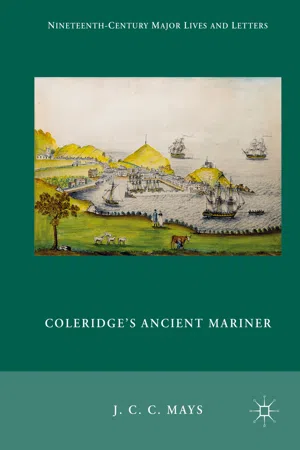
Take another example of what one could call interference deriving from the particular circumstances of the poem. Those who turn off Route A39 to visit the Coleridge Cottage at Nether Stowey, refurbished and extended by the National Trust, often continue afterwards to Watchet because it has been claimed as the port from which the Mariner departed and returned, and where there is now a prominent statue showing him with an albatross hanging from his neck. The modern visitor to Watchet will try hard to find the snug, sheltered village sketched by J.M.W. Turner in 1811 and engraved by George Cooke in 1818, and since reproduced many times down to the present (e.g. PW 1:369), but a further problem remains. Although the village has long possessed a church on a little rise, St. Decuman’s, it lacked the lighthouse twice-over mentioned in the poem: there was no lighthouse at Watchet until 1862, and they were rare constructions indeed along this stretch of coast in 1797–1798. The assiduous biographer, then, must suppose that Coleridge walked to the western end of the Exmoor tourist trail, where the only lighthouse of the time was to be found, prominently situated, at Ilfracombe. This, converted from a chapel dedicated to St. Nicholas at the time of Henry VIII, still stands high above the harbour, with the parish church on a lesser rise behind in the town: the top cover of the present book shows the prominence of these two features at the time the poem was written. It seems to me quite likely that Coleridge’s attention was drawn to the Ilfracombe lighthouse—as it had been to the chapel at Culbone and Ash Farm nearby (and also perhaps Lord King’s strange Kubla-like construction above Porlock Weir)—by Richard Warner whom he met at Bath. 3 Thirty years afterwards, Coleridge associated Ilfracombe with his favourite walk towards Lynton from Porlock (TT 1:205). There is no other reason for him to know and remember the name of Ilfracombe—which Warner makes clear was worth visiting mainly for its lighthouse—although the town came into the news when it was blockaded by four French warships in February 1797 (as Coleridge possibly remembered in the spring of 1798, when he wrote “Fears in Solitude” 175).
Thus, Ilfracombe has as good a claim as Watchet to be the little port Coleridge had in mind, if not a better one. However, the church in the poem is described as a “kirk,” which is appropriate in a poem masquerading as a Border Ballad, but the ports on the Scottish Borders could not have sent ships to the Antarctic or Pacific Oceans any more than any small port other than Ilfracombe on the coast between Bristol and Bideford: note the ocean-going vessel attached to the pilot’s boat on the cover scene. In short, while a biographer like Holmes could make a very good case for Ilfracombe while treading further in Coleridge’s footsteps, and while a tourist might like to drive onwards so far because the lighthouse is indeed picturesque and the museum contains further watercolours by John Walters, the hunt to connect the poem to real-life locations and events is a pleasure utterly separate from the pleasure the poem itself offers. This book is concerned with the latter alone: with the make-up of Coleridge’s poem, its ideas, its complicated interrelation with poems written by Wordsworth, its different versions, the ways it has been read differently during its 200-year history, and its relation to poems of a similar kind in the present day. The lighthouse and the church stand together as emblems of physical warning and spiritual rescue, creating an image of departure and return.
1.3 Almost Like a Subplot
The present chapter stands as introductory to a connected sequence in which Chap. 2 addresses the primary question head-on: how to confront the “Mariner” for what it is, or appears to be; and Chap. 3 enlarges the focus by considering what was in Coleridge’s mind when he wrote it, that is, replaces the emphasis on technique with an examination of its content. Chapter 4 turns to the specific poetical context—the beginning of the poem in a joint venture with Wordsworth—and develops (in Chap. 5) into a consideration of Wordsworth’s response to the result. This was the first criticism the poem received and it remains the most searching. It proceeded by way of a different poetical treatment of the same themes and motifs, as well as by critical redefinitions, by the end of which Coleridge came to modify the text of the “Mariner” several times. It was therefore appropriate to pause and consider the differences between the major versions and Chapter 6 forms a “landing-place” in the argument (Friend 1:148–49), a place to settle this matter of importance before moving on. Chapter 7 returns to the story of ...
Table of contents
- Cover
- Frontmatter
- 1. Taking Bearings, Setting a Course
- 2. What Does the Poem Do?
- 3. As a Poem of the Imagination
- 4. Wordsworth as Collaborator and Contributor
- 5. The Shadow Cast by Wordsworth
- 6. Revision, Gloss, Choice
- 7. A Reputation by Default
- 8. Today and To Do
- Backmatter
Trusted by 375,005 students
Access to over 1.5 million titles for a fair monthly price.
Study more efficiently using our study tools.
Frequently asked questions
Yes, you can cancel anytime from the Subscription tab in your account settings on the Perlego website. Your subscription will stay active until the end of your current billing period. Learn how to cancel your subscription
No, books cannot be downloaded as external files, such as PDFs, for use outside of Perlego. However, you can download books within the Perlego app for offline reading on mobile or tablet. Learn how to download books offline
Perlego offers two plans: Essential and Complete
- Essential is ideal for learners and professionals who enjoy exploring a wide range of subjects. Access the Essential Library with 800,000+ trusted titles and best-sellers across business, personal growth, and the humanities. Includes unlimited reading time and Standard Read Aloud voice.
- Complete: Perfect for advanced learners and researchers needing full, unrestricted access. Unlock 1.5M+ books across hundreds of subjects, including academic and specialized titles. The Complete Plan also includes advanced features like Premium Read Aloud and Research Assistant.
We are an online textbook subscription service, where you can get access to an entire online library for less than the price of a single book per month. With over 1.5 million books across 990+ topics, we’ve got you covered! Learn about our mission
Look out for the read-aloud symbol on your next book to see if you can listen to it. The read-aloud tool reads text aloud for you, highlighting the text as it is being read. You can pause it, speed it up and slow it down. Learn more about Read Aloud
Yes! You can use the Perlego app on both iOS and Android devices to read anytime, anywhere — even offline. Perfect for commutes or when you’re on the go.
Please note we cannot support devices running on iOS 13 and Android 7 or earlier. Learn more about using the app
Please note we cannot support devices running on iOS 13 and Android 7 or earlier. Learn more about using the app
Yes, you can access Coleridge's Ancient Mariner by J. C. C. Mays in PDF and/or ePUB format, as well as other popular books in Literature & European Literary Criticism. We have over 1.5 million books available in our catalogue for you to explore.