Options traders rely on a vast array of information concerning probability, risk, strategy components, calculations, and trading rules. Traders at all levels, as well as portfolio managers, must refer to numerous print and online sources, each source only providing part of the information they need. This is less than ideal, as online sources tend to be basic, simplified, and in some cases incorrect. Print sources, on the other hand, are mostly focused on a very narrow range of strategies or trading systems. Up until now, there has been no single source to provide a comprehensive reference for the serious trader.
The Complete Options Trader is that much-need comprehensive reference, a compilation of the many attributes options traders need.
Thomsett lays out a rich and complete guide to 100 strategies, including profit and loss calculations, illustrations, examples, and much more. A thorough evaluation of these strategies (and the rewards and risk involved) demonstrates how a broad approach to analytically using options can and does enhance portfolio profits with lower levels of risk.
The book also features a complete glossary of terms used in the options industry, the most comprehensive glossary of this nature currently available.
All too often, the attributes of options trading are poorly understood; risk is ignored or over-simplified; hedging is not folded into a strategic evaluation; and options traders shun the value of holding equity positions. No longer—if options traders rely on this comprehensive guide as the reference for the industry.
Michael C. ThomsettThe Complete Options Traderhttps://doi.org/10.1007/978-3-319-76505-1_4
Begin Abstract
Option Strategies
Michael C. Thomsett1
(1)
Spring Hill, TN, USA
Michael C. Thomsett
URL: https://thomsettsguide.com/
End Abstract
The sheer number of options strategies, when arranged alphabetically, presents ease of access but does not fully describe the varying levels of risk they entail. For that, it is necessary to track the payoff diagrams, examples, and amounts of capital required to put a strategy into place. In the following examples, actual stock prices and options premiums have been used. However, identification of a company or date of the options expirations is not necessary; the observations presented in this chapter apply in all cases, and examples are only a starting point for understanding the attributes of each strategy: long or short positions, risk levels, profit potential, and a range of possible actions that can be taken before expiration—rolling, closing, or exercising positions.
Examples exclude trading costs. Given the widespread use of online discount brokerage services in which fees are quite low, this is a minor factor. Assuming the average fee is $5 per contract, the net effect of transaction fees is not substantial. However, costs of entering and exiting positions should be taken into account in calculating potential profit. Examples generally are limited to single options. In practice, the use of multiple option contracts further reduces the transaction cost, another point to be factored in to the calculation of net outcome. Of much greater concern is the bid and ask prices and the bid/ask spread between the two values. The bid is what will be received upon the sale of an option (whether selling to open or to close), and the ask price is the price a trader pays when purchasing an option.
Tables for several of the following strategies are provided to demonstrate outcomes at various underlying price levels, assuming the full position is left open until the day of expiration for each option contract. To link to each table, go to the website at https://www.thomsettpublishing.com/option-strategies (for the first half of the alphabet) or https://www.thomsettpublishing.com/option-strategies-n-z (for the first half of the alphabet), and from there, link to the strategy to find its table.
In practice, however, stock movement is far more likely to provide opportunities to close out part or all of a position at a profit, well before expiration date. The short side of a multiple-option strategy can be closed when time value evaporates, leaving only the long side. However, if a long side is closed due to substantial change in the price of the underlying, that may leave short positions open in uncovered status, greatly increasing risk; and also setting up a greater requirement for posting collateral in the margin account.
The majority of examples employ the least number of contracts possible. However, the use of multiple contracts may enhance profits as well as add greater risks. For example, in rolling forward to avoid exercise, replacing a single short option with two, three, or more later-expiring short contracts may produce a net credit while improving future profit potential. This is a practical consideration for writing covered calls if and when enough underlying stock is owned to provide coverage for a flexible rolling strategy. This point should be kept in mind for all strategies. The number of open contracts as well as ratio levels in combinations can be varied based on risk levels, the amount of underlying stock held, and available margin credit.
Alligator spread – any spread involving complex combinations of offsetting options, to the extent that the trading costs will potentially “eat up” any profits. It is possible to design a strategy to provide virtually no loss exposure with limited profit potential, as in thebutterfly spread. However, if the number of offsetting positions is too great, the potential profits will not materialize on a net basis. Trading costs and broker commissions make the position impractical in many cases. Option traders also have to consider the possibility that in overly complex option spreads and combinations, they may face (a) collateral requirements, which tie up capital, and (b) unexpected tax consequences due to theanti-straddle rules that penalize traders entering two-sided transactions and realizing losses and profits in different years.
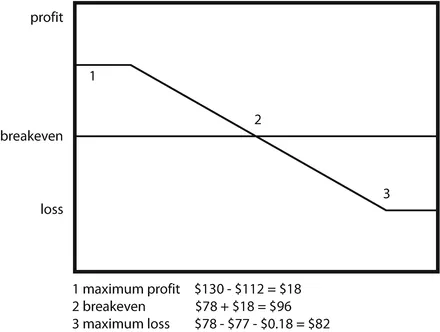
Bear call spread – a variation of the bear spread employing only calls and creating a net credit. The profit is maximized when the market value of the underlying stocks declines; however, risk is limited to the difference between long and short positions. The spread creates a limited maximum profit potential in exchange for a limited maximum loss. A loss occurs when the stock’s price rises above both call strikes, and is limited to the point spread, minus the original credit received when the position was opened.
The breakeven on this position resides in between the two strike prices. Profit is equal to the amount of the net credit received (the bear call spread always creates a credit because current value of the lower short call will always exceed the value of the higher long call). The outcomes are illustrated in Fig. 1.
Fig. 1
Bear call spread
Example: The current underlying price is $78.14. A bear call spread is set up with the following trades:
Buy 13-day 79 call, ask 1.12
Sell 13-day 78 call, bid 1.30
Net credit 0.18
Outcomes:
Maximum profit
$130 − $112 = $18
Breakeven
$78 + $18 = $96
Maximum loss
$78 − $77 − $0.18 = $82
To see a table showing outcomes at various price levels, link onbear call spread at the website https://thomsettsguide.com/options-strategies/
Bear put ladder – a strategy employing a long put spread and, in addition, a short put at a strike below the spread strikes. For example, a bear put ladder is set up by buying a 110 put at an ask price of 108.10 and selling a 105 put at a bid of 100. Maximum profit will be earned when the stock closes between the two short strikes by expiration. Profit would be the net of (a) the credit gained when the position was opened or, if a net debit, a negative; and (b) the point spread between the higher...
Table of contents
Cover
Front Matter
Introduction
Market Overview
Market Risks
Option Strategies
Option Glossary
Elements of Value
Return Calculations
Options and Stock Selection
Option Taxation
Back Matter
Trusted by 375,005 students
Access to over 1.5 million titles for a fair monthly price.
Study more efficiently using our study tools.
Frequently asked questions
Yes, you can cancel anytime from the Subscription tab in your account settings on the Perlego website. Your subscription will stay active until the end of your current billing period. Learn how to cancel your subscription
No, books cannot be downloaded as external files, such as PDFs, for use outside of Perlego. However, you can download books within the Perlego app for offline reading on mobile or tablet. Learn how to download books offline
We are an online textbook subscription service, where you can get access to an entire online library for less than the price of a single book per month. With over 1.5 million books across 990+ topics, we’ve got you covered! Learn about our mission
Look out for the read-aloud symbol on your next book to see if you can listen to it. The read-aloud tool reads text aloud for you, highlighting the text as it is being read. You can pause it, speed it up and slow it down. Learn more about Read Aloud
Yes! You can use the Perlego app on both iOS and Android devices to read anytime, anywhere — even offline. Perfect for commutes or when you’re on the go. Please note we cannot support devices running on iOS 13 and Android 7 or earlier. Learn more about using the app
Yes, you can access The Complete Options Trader by Michael C. Thomsett in PDF and/or ePUB format, as well as other popular books in Business & Finance. We have over 1.5 million books available in our catalogue for you to explore.