This book suggests a new bargain between the NPT nuclear weapon states and the non-NPT nuclear weapons possessor states, mainly India and Pakistan, through a regional arrangement to help move towards universalization of the nuclear nonproliferation regime. The author analyses nuclear proliferation drivers to understand why states acquire and justify possession of nuclear weapons even though most nuclear weapon states no longer are faced with an existential threat to their national security. This study also identifies various challenges being faced by the NPT based nuclear nonproliferation regime, which if left unaddressed, could unravel the nonproliferation regime. It also offers the history of confidence building measures between India and Pakistan, which could be a useful reference for negotiating a Regional Nonproliferation Regime (RNR) in the future.
eBook - ePub
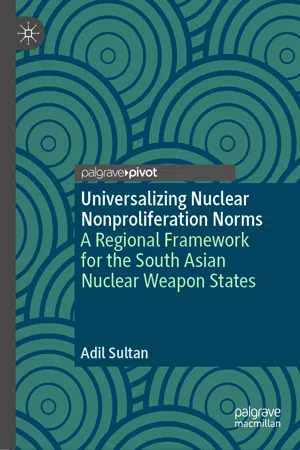
Universalizing Nuclear Nonproliferation Norms
A Regional Framework for the South Asian Nuclear Weapon States
- English
- ePUB (mobile friendly)
- Available on iOS & Android
eBook - ePub
Universalizing Nuclear Nonproliferation Norms
A Regional Framework for the South Asian Nuclear Weapon States
About this book
Information
© The Author(s) 2019
Adil SultanUniversalizing Nuclear Nonproliferation Normshttps://doi.org/10.1007/978-3-030-01334-9_11. Introduction
Adil Sultan1
(1)
Department of War Studies, King’s College London, London, UK
Adil Sultan
Abstract
The existing NPT-based nuclear nonproliferation regime has not been able to bring the non-NPT nuclear possessor states into its folds thus making it difficult to universalize the nuclear nonproliferation norms. The shift from global to regional approaches and interdependent securitization priorities of India and Pakistan offer an incentive to negotiate a regional nonproliferation arrangement. This would not only help strengthen the global nonproliferation norms but could also provide formal recognition to the nuclear status of both India and Pakistan.
Keywords
Regional frameworkRSCTheories of proliferationRegionalismPakistan and India have a long and troubled history of outstanding disputes that have led to a number of wars and military crises between the two countries. Both nuclear weapon states continue to build their conventional and nuclear capabilities to deal with their respective insecurities. More recently, the shift in India’s security orientation and its desire to be reckoned as a potential global power has provided impetus to the ongoing nuclear competition between the two South Asian nuclear powers that continue to remain outside the Nuclear Nonproliferation Treaty (NPT) based global nonproliferation regime .
The two South Asian nuclear states never signed the NPT and had built their nuclear capabilities without violating the existing structures of the international nonproliferation regime . Both have indicated their willingness to join the nuclear nonproliferation regime, but without giving up their nuclear status. Unless these two states are offered a tangible quid pro quo, it would be unrealistic to expect that either of the two would unilaterally agree to accept treaty-based international nonproliferation and disarmament obligations.
One possible way to bring the two non-NPT states into the mainstream regime and help universalize the nonproliferation norms could be to encourage both India and Pakistan to negotiate a regional nonproliferation framework, in line with the principles of the existing NPT based regime , but without making unrealistic demand of a unilateral disarmament. The proposed regional nonproliferation regime (RNR ) skirts NPT’s limitation which makes it diffilcult to formally recognize the status of a nuclear weapon state (NWS) for countries that tested nuclear weapons after 1 January 1967.
This study follows both normative and empirical approaches to identify the underlying causes that led towards the nuclearization of India and Pakistan and discusses their relationship with the international arms control treaties and other nonproliferation measures. This background would be helpful in suggesting an RNR which is derived from the Regional Security Complex (RSC) theory provided by Barry Buzan and Ole Waever. The RNR is based on a premise that since India–Pakistan have inter-dependent securitization priorities, therefore, there could be an incentive for them to work jointly toward a regional nonproliferation framework. Such an arrangement would not only help address each other’s sensitivities but could pave the way for normalizing their relationship with the NPT based international nonproliferation regime .
1.1 Is There a Theory of Nuclear Proliferation?
States develop nuclear weapons when they are faced with a military threat that cannot be addressed through any other means, and if they do not face a serious threat to their national security , they may not pursue a nuclear weapons program. 1 Security nevertheless, is not the only guiding factor that drives states’ nuclear weapons program, and there could be several other considerations or a combination of factors that may lead towards the nuclearization process. And once a state acquires nuclear weapons, it would be reluctant to give up nuclear weapons even if it no longer faces an existential threat to its national security . This is because the process of nuclearization creates various interest groups, including the political leadership, the scientific community, civil and military bureaucracies; who benefit from the continued expansion and modernization of the nuclear arsenal.
The proponents of the realists school of thought are of the view that, “states are unitary actors that seek nuclear weapons because their security, precarious in an anarchic world, demands it,” 2 and for them, nuclear weapons remain the gold standard for deterring existential threats . 3 Within the realists, there are some who argue that “states obtain nuclear weapons because they learn to stop worrying and love the bomb,” 4 while others consider proliferation as a necessity to meet national security demands. For them:
All states can go nuclear, should go nuclear, and sooner, the better. If they have not done so yet, it is simply a matter of time before they do. The core realist prediction about proliferation is that some event will inevitably come along, sooner rather than later, that finally causes the dam to break and the world to go nuclear. 5
Neorealists, on the other hand, view the structure of the international system as the primary reason for nuclear proliferation. They believe that: “regime type, domestic politics, and personalities are of no consequence, and all that really matters is an understanding of the balancing dynamic in which one state’s pursuit of nuclear weapons begets another.” 6 These perspectives are useful to understand the causes of nuclear proliferation, but since no single theory has been able to explain the proliferation puzzle thoroughly, therefore, several analysts tend to create unsubstantiated alarm by arguing that the opacity in national nuclear programs of many states has led to unchecked proliferation, which eventually could end up in a nuclear domino effect—a phenomenon best described by Arkin as the “sky is falling profession.” 7
One possible way of studying the problem of nuclear proliferation is through the levels of analysis approach that Waltz has categorized as ‘images.’ 8 Some states pursue nuclear weapons to be recognized as a credible military power or possibly as a consequence of a regional or global security competition. The process of nuclearization itself has the potential to alter state’s security orientation; therefore, it is more likely that these images would also evolve with the advancement of nuclear capabilities, which could further complicate the study of proliferation puzzle . Understanding and the transformation of these self-images by a state could be useful in developing a responsive and a credible nonproliferation framework.
Most existing theories dealing nuclear proliferation are limited in scope as the focus is confined to finding solutions to the proliferation puzzle by negotiating treaties or conventions and limit further growth or reduce the nuclear weapons, but the fundamental question that remains unaddressed is, what would constitute knowledge in the area of proliferation? 9 Ogilvie-White believes that lack of empirical evidence about the nuclear weapons programs of almost all states has led to an abstract debate over the nuclear proliferation causes, which makes it doubtful whether a positivist 10 approach towards the study of nuclear proliferation is possible due to criticism on epistemological and ontological grounds. 11
One major problem while studying the causes of nuclear proliferation is that the lessons learned from relatively more transparent nuclear programs are generalized and applied universally. This has the potential to misinterpret cause and effect relationship since preventive policies that are effective for a particular environment, or a region may not be applicable for others.
1.2 From Globalism to Regionalism
Traditionally nuclear proliferation has been dealt with by developing and enforcing global solutions through internationally negotiated treaties on the pattern of cultural, transnational and international political economy approaches. Since the end of the Cold War the regionalist approach, however, has become more autonomous and prominent in the international politics, and is seen as the most viable level of analysis to understand patterns of amity and enmity within a region, and could also provide a useful mean to find regional nonproliferation solutions.
A region, according to Fawcett “is a contested and ambiguous concept. Like states, regions could be of varying composition, capabilities and aspirations. They may also be fluid and changing in their make-up.” 12 Payne defines regionalism as a “state-led, or states-led project designed to recognize a particular regional space along defined economic and political lines.” 13 It could be further divided into ‘old or classical’ regionalism and the ‘new’ regionalism. Old regionalism, which is a Cold War era phenomenon was imposed from the above and collaboration focused on aligning regional interests with either of the two global powers. New regionalism, which is a post-Cold War phenomenon is more comprehensive and open and includes non-state actors, such as the NGOs and the think tanks who play an important role in enforcing nonproliferation norms.
1.3 The Relevance of Regional ...
Table of contents
- Cover
- Front Matter
- 1. Introduction
- 2. South Asian Proliferation Puzzle
- 3. The Nuclear Nonproliferation Regime
- 4. Pakistan and India’s Approaches Toward Arms Control and Disarmament
- 5. Technology Control Regimes
- 6. Nuclear Governance in South Asia
- 7. Nuclear Confidence-Building Measures (CBMs) in South Asia
- 8. Regional Nonproliferation Regime (RNR)
- Back Matter
Trusted by 375,005 students
Access to over 1.5 million titles for a fair monthly price.
Study more efficiently using our study tools.
Frequently asked questions
Yes, you can cancel anytime from the Subscription tab in your account settings on the Perlego website. Your subscription will stay active until the end of your current billing period. Learn how to cancel your subscription
No, books cannot be downloaded as external files, such as PDFs, for use outside of Perlego. However, you can download books within the Perlego app for offline reading on mobile or tablet. Learn how to download books offline
Perlego offers two plans: Essential and Complete
- Essential is ideal for learners and professionals who enjoy exploring a wide range of subjects. Access the Essential Library with 800,000+ trusted titles and best-sellers across business, personal growth, and the humanities. Includes unlimited reading time and Standard Read Aloud voice.
- Complete: Perfect for advanced learners and researchers needing full, unrestricted access. Unlock 1.5M+ books across hundreds of subjects, including academic and specialized titles. The Complete Plan also includes advanced features like Premium Read Aloud and Research Assistant.
We are an online textbook subscription service, where you can get access to an entire online library for less than the price of a single book per month. With over 1.5 million books across 990+ topics, we’ve got you covered! Learn about our mission
Look out for the read-aloud symbol on your next book to see if you can listen to it. The read-aloud tool reads text aloud for you, highlighting the text as it is being read. You can pause it, speed it up and slow it down. Learn more about Read Aloud
Yes! You can use the Perlego app on both iOS and Android devices to read anytime, anywhere — even offline. Perfect for commutes or when you’re on the go.
Please note we cannot support devices running on iOS 13 and Android 7 or earlier. Learn more about using the app
Please note we cannot support devices running on iOS 13 and Android 7 or earlier. Learn more about using the app
Yes, you can access Universalizing Nuclear Nonproliferation Norms by Adil Sultan in PDF and/or ePUB format, as well as other popular books in Politics & International Relations & Energy Industry. We have over 1.5 million books available in our catalogue for you to explore.