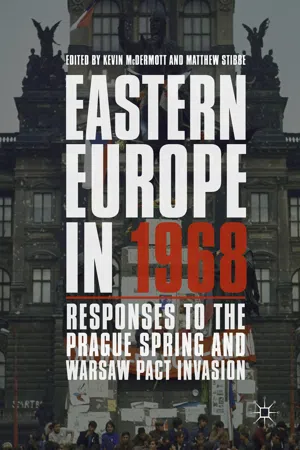
eBook - ePub
Eastern Europe in 1968
Responses to the Prague Spring and Warsaw Pact Invasion
- English
- ePUB (mobile friendly)
- Available on iOS & Android
eBook - ePub
Eastern Europe in 1968
Responses to the Prague Spring and Warsaw Pact Invasion
About this book
This collection of thirteen essays examines reactions in Eastern Europe to the Prague Spring and Warsaw Pact invasion of Czechoslovakia in 1968. Countries covered include the Soviet Union and specific Soviet republics (Ukraine, Moldavia, the Baltic States), together with two chapters on Czechoslovakia and one each on East Germany, Poland, Hungary, Bulgaria, Romania, Yugoslavia and Albania. The individual contributions explain why most of these communist regimes opposed Alexander Dub?ek's reforms and supported the Soviet-led military intervention in August 1968, and why some stood apart. They also explore public reactions in Eastern Europe to the events of 1968, including instances of popular opposition to the crushing of the Prague Spring, expressions of loyalty to Soviet-style socialism, and cases of indifference or uncertainty. Among the many complex legacies of the East European '1968' was the development of new ways of thinking about regional identity, state borders, de-Stalinisation and the burdens of the past.
Information
© The Author(s) 2018
Kevin McDermott and Matthew Stibbe (eds.)Eastern Europe in 1968https://doi.org/10.1007/978-3-319-77069-7_4The Impact of the Prague Spring on the USSR
Zbigniew Wojnowski1
(1)
University of Roehampton, London, UK
The Prague Spring marked the end of de-Stalinisation in the USSR. 1 Over the previous 15 years, the Soviet leadership had searched for ways to rekindle popular faith in the communist system after the traumas of Stalinism. Following Nikita Khrushchev’s ‘Secret Speech’ at the Twentieth Congress of the Communist Party of the Soviet Union in February 1956, rank-and-file party members were encouraged to take a more active role in debating and implementing policy. Most prisoners were released from the Gulag in the first few years after Stalin’s death as the new leadership relied more on persuasion and material incentives, and less on terror and coercion, to mould people into Soviet citizens. Censorship was relaxed, though fundamental aspects of the political, social and economic system were still beyond criticism in the USSR’s public culture. 2 These ambitious attempts to foster new forms of ‘participatory citizenship’ were curtailed with Khrushchev’s ouster from the Kremlin in October 1964. 3 But until the Warsaw Pact invasion of Czechoslovakia, Leonid Brezhnev’s team still saw gradual economic reform and limited intellectual and cultural openings as a means of winning popular legitimacy. 4
Soviet relations with Czechoslovakia and other East European satellite states reflected the broader dynamics of de-Stalinisation. Czechoslovakia remained politically, militarily and economically dependent on the USSR. At the same time, the late 1950s saw the emergence of special organisations devoted to promoting new types of transnational contacts between the Soviet Union and Czechoslovakia. Their goal was to demonstrate the international success of Soviet-style socialism. Soviet travel to Eastern Europe was a particularly important means of fostering faith in the communist project among the population of the USSR: trips to the satellite states were meant to include ordinary blue-collar workers, eclipsing ‘any significant expression of ethnic or national difference… in favor of a shared socialist/working class identity’. 5 Soviet and Czechoslovak citizens engaged with the transnational friendship project for a variety of reasons, ranging from personal memories of World War II ‘to professional interests to attempts to further transnational friendships made in other contexts to a desire for goods and culture unavailable at home’. 6
The 1950s and the 1960s also witnessed the rise of new transnational contacts that were beyond the Kremlin’s control. 7 Especially (though not exclusively) in the USSR’s western borderlands, Soviet citizens learned about the outside world from western radio stations broadcasting into the country, as well as East European newspapers, radio and television. East European broadcasts and publications featured items that Soviet censors considered ‘antisocialist’. 8 At the same time, the Soviet leadership was reluctant to stop the flow of news from the USSR’s satellite states, lest socialist friendship be exposed as a mere propaganda façade. By the late 1960s, Soviet leaders looked upon a fast globalising world with apprehension. When Alexander Dubček launched his reforms in Czechoslovakia, people in the USSR were surprisingly well-informed about the momentous events across their western border.
As Soviet citizens commented on the Czechoslovak crisis widely, Thaw-era notions of what it meant to be Soviet and what it meant to be socialist crumbled. From the Politburo’s perspective, the Czechoslovak events were part of a broader international crisis facing communism that encompassed student protests in Poland, escalating tensions with China and a break with Nicolae Ceauşescu’s socialist Romania. 9 In this context, Czechoslovakia represented the most sustained and ambitious attempt to reform a regime that very closely resembled the Soviet model. Dubček’s experiment was thus a testing ground for Soviet policies and ideas. Commenting on the Prague Spring reforms and the Warsaw Pact invasion of Czechoslovakia, leaders and citizens of the USSR reflected not only on their country’s foreign policy, but also on the extent to which it was possible to increase political participation, open borders and relax censorship without undermining party control over society and inducing instability. The Soviet-led invasion of Czechoslovakia was a clear sign that the Brezhnev leadership would no longer pursue or tolerate attempts at democratisation within the bloc’s communist parties or in society more broadly. Ambitious attempts to increase citizens’ participation in debating and implementing policy thus ended with a bang in August 1968.
This clear anti-reformist direction created deep rifts in Soviet society. Some citizens turned to illegal means to defend the de-Stalinisation agenda. At the same time, faced with a major crisis of the socialist system that challenged Soviet ideas of progress, leaders of the USSR were able to rally many citizens around the idea that Soviet interests had to be protected against the supposed chaos emanating from Eastern Europe, as well as a potential ‘fifth column’ at home. In various public forums, citizens underlined their loyalty to the Soviet homeland and its titular ethnic groups. While it is impossible to judge levels of genuine belief, these public articulations of Soviet patriotism shaped social and political dynamics in the USSR during the late 1960s. The ‘search for socialism’ that had animated state–society relations over the previous fifteen years was over in 1968. Instead, ethnically and geographically defined Soviet patriotism, often framed in xenophobic terms, became the main tool of social and political mobilisation in the USSR.
My analysis encompasses developments in Moscow, where the top Soviet leadership as well as members of the intelligentsia followed the Czechoslovak crisis in detail. But the chapter focuses in particular on Soviet Ukraine. Ukraine lay in the west of the USSR and it shared a border with Czechoslovakia. 10 Its inhabitants were therefore very well-informed about the Prague Spring. In the borderland region of Transcarpathia, memories of Czechoslovak rule in the interwar period made the crisis seem very close to home. 11 Moreover, the example of Czechoslovakia’s rising autonomy from Moscow followed by a military crackdown on Dubček’s reforms carried particular significance in the USSR’s non-Russian periphery, which itself had a complicated relationship with the Soviet centre in Moscow.
Official Reactions
The Prague Spring sparked a crisis of identity among the Soviet leadership. Throughout the first half of 1968, Brezhnev in particular was keen to salvage the idea that political and economic reform was possible in the Soviet bloc and, by extension, in the USSR itself. He was therefore reluctant to crack down on ‘socialism with a human face’ that promised to lend Soviet-style regimes new legitimacy. But other members of the Politburo were also painfully aware that Dubček’s reforms challenged Soviet-made visions of what it meant to be socialist. The Warsaw Pact invasion of Czechoslovakia pushed Soviet leaders to search for new sources of legitimacy at home and abroad, as attempts to involve citizens in debating and implementing policy were now associated with chaos and violence.
In conversations with Soviet diplomats in Prague in early 1968, Dubček presented his reforms as a fight against ‘violations of party discipline’, excessive bureaucracy and attempts to concentrate all political power in the hands of just one individual. These ideas echoed Brezhnev’s own slogans that had helped him to justify the overthrow of Khrushchev in 1964. 12 In January and February 1968, the Kremlin did not therefore express alarm at the unfolding events in Czechoslovakia. The tide turned in March when, concerned by the removal of former party leader Antonín Novotný from the office of president, major changes in Communist Party cadres and increasingly free mass media in Czechoslovakia, Moscow issued a stern warning to Prague. Even then, members of the Politburo insisted that some of the most confrontational phrasing prepared by Soviet Foreign Minister Andrei Gromyko and the head of the KGB Yurii Andropov be dropped from the letter they drafted. 13 An eyewitness recalled ‘long and heated’ arguments in the CPSU Politburo during deliberations on the Czechoslovak crisis. 14 Top Soviet leaders were clearly at a loss about how to interpret Dubček’s policies. Prime Minister Alexei Kosygin, for example, was a very harsh critic of Czechoslovak reforms in March 1968, but seemed to take a more positive view of Dubček after a visit to Karlovy Vary in May. He continued to question the idea of a military intervention in Czechoslovakia at Politburo meetings: ‘We will take our armies in, and then what?’. Even in early August, shortly before the invasion, Moscow harboured hopes that the bilateral Čierna nad Tisou agreements would help to avoid open confrontation with Czechoslovakia. 15
Soviet leaders knew that their own legitimacy was at stake in Czechoslovakia. Albeit highly critical of the mooted idea to introduce a multi-party system in Czechoslovakia, Brezhnev still wanted inhabitants of the socialist camp to believe that communist parties and state institutions could bring more prosperity and opportunities for citizens to participate in power. 16 In May 1968, the head of the Supreme Soviet Nikolai Podgornyi was likewise alarmed that an overly heavy-handed approach in Czechoslovakia would convince ‘enemies of socialism’ that th...
Table of contents
- Cover
- Front Matter
- The Prague Spring and Warsaw Pact Invasion Through the Soviet and East European Lens
- For a Civic Socialism and the Rule of Law: The Interplay of Jurisprudence, Public Opinion and Dissent in Czechoslovakia, 1960s–1980s
- The ‘Anti-Prague Spring’: Neo-Stalinist and Ultra-Leftist Extremism in Czechoslovakia, 1968–70
- The Impact of the Prague Spring on the USSR
- Ideological Offensive: The East German Leadership, the Prague Spring and the Warsaw Pact Invasion of August 1968
- ‘To Hell with Sovereignty!’: Poland and the Prague Spring
- Hungary 1968: Reform and the Challenge of the Prague Spring
- 1968: A Bulgarian Perspective
- Ceauşescu’s Finest Hour? Memorialising Romanian Responses to the Warsaw Pact Invasion of Czechoslovakia
- The ‘June Events’: The 1968 Student Protests in Yugoslavia
- 1968: The Prague Spring and the Albanian ‘Castle’
- Echoes of the Prague Spring in the Soviet Baltic Republics
- ‘Down with Revisionism and Irredentism’: Soviet Moldavia and the Prague Spring, 1968–72
- Back Matter
Trusted by 375,005 students
Access to over 1.5 million titles for a fair monthly price.
Study more efficiently using our study tools.
Frequently asked questions
Yes, you can cancel anytime from the Subscription tab in your account settings on the Perlego website. Your subscription will stay active until the end of your current billing period. Learn how to cancel your subscription
No, books cannot be downloaded as external files, such as PDFs, for use outside of Perlego. However, you can download books within the Perlego app for offline reading on mobile or tablet. Learn how to download books offline
Perlego offers two plans: Essential and Complete
- Essential is ideal for learners and professionals who enjoy exploring a wide range of subjects. Access the Essential Library with 800,000+ trusted titles and best-sellers across business, personal growth, and the humanities. Includes unlimited reading time and Standard Read Aloud voice.
- Complete: Perfect for advanced learners and researchers needing full, unrestricted access. Unlock 1.5M+ books across hundreds of subjects, including academic and specialized titles. The Complete Plan also includes advanced features like Premium Read Aloud and Research Assistant.
We are an online textbook subscription service, where you can get access to an entire online library for less than the price of a single book per month. With over 1.5 million books across 990+ topics, we’ve got you covered! Learn about our mission
Look out for the read-aloud symbol on your next book to see if you can listen to it. The read-aloud tool reads text aloud for you, highlighting the text as it is being read. You can pause it, speed it up and slow it down. Learn more about Read Aloud
Yes! You can use the Perlego app on both iOS and Android devices to read anytime, anywhere — even offline. Perfect for commutes or when you’re on the go.
Please note we cannot support devices running on iOS 13 and Android 7 or earlier. Learn more about using the app
Please note we cannot support devices running on iOS 13 and Android 7 or earlier. Learn more about using the app
Yes, you can access Eastern Europe in 1968 by Kevin McDermott, Matthew Stibbe, Kevin McDermott,Matthew Stibbe in PDF and/or ePUB format, as well as other popular books in History & Eastern European History. We have over 1.5 million books available in our catalogue for you to explore.