This book reveals how Moses ibn Ezra, Judah Halevi, Moses Maimonides, and Shem Tov ibn Falaquera understood metaphor and imagination, and their role in the way human beings describe God. It demonstrates how these medieval Jewish thinkers engaged with Arabic-Aristotelian psychology, specifically with regard to imagination and its role in cognition. Dianna Lynn Roberts-Zauderer reconstructs the process by which metaphoric language is taken up by the imagination and the role of imagination in rational thought. If imagination is a necessary component of thinking, how is Maimonides' idea of pure intellectual thought possible? An examination of select passages in the Guide, in both Judeo-Arabic and translation, shows how Maimonides' attitude towards imagination develops, and how translations contribute to a bifurcation of reason and imagination that does not acknowledge the nuances of the original text. Finally, the author shows how Falaquera's poetics forges a new direction for thinking about imagination.
eBook - ePub
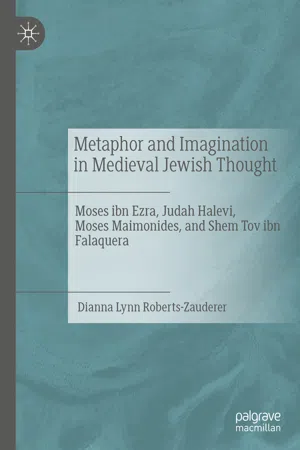
Metaphor and Imagination in Medieval Jewish Thought
Moses ibn Ezra, Judah Halevi, Moses Maimonides, and Shem Tov ibn Falaquera
- English
- ePUB (mobile friendly)
- Available on iOS & Android
eBook - ePub
Metaphor and Imagination in Medieval Jewish Thought
Moses ibn Ezra, Judah Halevi, Moses Maimonides, and Shem Tov ibn Falaquera
About this book
Information
Topic
Philosophy© The Author(s) 2019
D. L. Roberts-ZaudererMetaphor and Imagination in Medieval Jewish Thoughthttps://doi.org/10.1007/978-3-030-29422-9_11. Introduction
Dianna Lynn Roberts-Zauderer1
(1)
Toronto, ON, Canada
Dianna Lynn Roberts-Zauderer
Once in my youth in the city of my birth, a scholar of Muslim law asked me – I was in his favour and certain of his fondness – to read before him the Ten Commandments in Arabic. I understood his intention : he wanted to reveal the dullness of [Scriptures’] figures of speech. I asked him to read the opening of the Qur’ā;n in the Latin language – he knew how to speak and understand it. When he undertook to transfer [the Qur’ā;n ] to that language, his words were sullied and their beauty became abominable. He then understood my intentions and discharged me from his request.
—Moses ibn Ezra, Kitā;b al-muḥā;ḍara wal-mudhā;kara/Sefer ha-‘iyunim ve-ha-diyunim al ha-shirah ha-‘ivrit [Heb.], edited and translated by A.S. Halkin (Jerusalem: 1975) 45. My translation from Hebrew to English.
End AbstractThe anecdote retold above by Moses ibn Ezra (c. 1055–c. 1135) helps to describe the social, cultural and intellectual position of Jews in medieval al-Andalus . The protagonists of the story – one a young Jewish scholar and poet , the other a Muslim legal expert – are clearly members of the educated class: they move effortlessly between Arabic, Hebrew and Latin and quote freely from Hebrew Scriptures and the Qur’ān . Their rapport is easy: Ibn Ezra emphasizes how he is esteemed and liked by the Muslim scholar, and when he turns the tables on his companion, he suffers no adverse consequences.
On the surface, this story seems to affirm a “golden age” in medieval Spain, a time characterized by religious diversity and cultural exchange between Jews, Muslims and Christians. Two intellectuals, one Jewish, the other Muslim, engage in a game of linguistic and religious competition. The Jew is acculturated enough to represent his Scripture in Arabic and to challenge his interlocutor to translate the Qur’ān into Latin . He is clearly schooled in adab , the cultivated knowledge of grammar, poetry, history and ethics, among other intellectual subjects. The familiarity of both parties with each other’s language and scripture hints at linguistic borrowings and cultural hybridity, with Ibn Ezra as an example of an “Arabized Jew”1 who has internalized Arabic theology and culture.
The notion of Jews well-versed in high culture at this time plays into the convention that Jews and Muslims indeed coexisted peacefully and respectfully in medieval al-Andalus . While Jews in Muslim Spain did have freedom of religion, autonomy in legal and religious affairs within their community and the freedom to engage in trade without restriction, they were tolerated rather than embraced. In the ṭā’ifa kingdoms of the eleventh century, Jews were useful to the rulers: those who had commercial connections and proficiency in languages became intermediaries between Muslim and Christian Spain . Jews could be “tolerated” as long as they maintained their inferior, “humiliated” status.2 Linguistic and theological rivalries between Muslims and Jews mirrored the polemical ‘arabiyya/shu‘ubiyya debate wherein Muslims who traced their genealogy from pre-Islamic Arabia viewed themselves as superior to later converts to Islam, with Arabic deemed the superior language for literary expression.3
While this anecdote confirms shared cultural values between Andalusī Jews and Muslims, it complicates the assumption of a “golden age” of co-existence between the two faiths. The young Jewish scholar is challenged by the Muslim scholar to recite the Ten Commandments in Arabic and has no choice but to answer his charge. The Muslim scholar wants to prove to him the inferiority of the Hebrew Bible and the paucity of biblical language, to the extent that even when Jewish Scripture is recited in Arabic – the language of divine revelation for Muslims – it will not sound good. However, Ibn Ezra parries the Muslim scholar by asking him to recite a sūra in Latin , knowing full well that even when translated, the poetry of Qur’ānic verse cannot be adequately transferred to another language; in attempting to do so, its beauty would be sullied and its holiness debased.
Issues of language and the transference of images and words from one idea or language to another are central to this book. Transference is a theme that recurs in various forms throughout this book, be it the transference of images and ideas within a metaphor , the progress of knowledge from imagination to reason, the movement of words from one language to another in translation, and the conveyance and subsequent entrenchment of ideas by scholars in a commentary or translation that may or may not transfer all the nuances of the original text.
In medieval al-Andalus , two highly valued elements of Muslim court culture were recitation of verse and theological discourse based on analogical reasoning . Poetry was defined in Arabic poetics in two distinct ways. The first trend defined poetry formally as metre and rhyme. The second determined that poetry was “related…to creativity, to the power of emotional and intellectual apprehension , to intuition and imaginative creation.”4 Metre and rhyme alone could not capture these conceptual facets of poetry. Arabic Aristotelian philosophers took note of the critical inquiry into poetry and poetics; they looked to Greek commentaries for terminology and linked poetry to imitation or mimesis (muḥākāh ), imagination (takhyīl ), and metaphor (ist‘iāra).5 They recognized that language could carry both literal and non-literal messages, and similarly, figurative language could signify multiple meanings.
In the ṭā’ifa courts of eleventh-century Muslim Spain, scribes were elevated to positions of power and the palace became a place where written and oral eloquence were esteemed. This eloquence was manifest in court poetry that praised the ṭā’ifa sovereign in elaborate elegies, among other styles of poetry that contained “hidden significations.”6 These encoded messages were carefully and artfully woven into poetry, philosophy and architecture, with the intent of puzzling the listener, reader or viewer, who would then decipher their meaning. As a result, artists and thinkers composed with multivalence in mind. In poetry, meanings were encoded through metaphor, or isti‘āra , a means of figurative expression that allowed difficult or abstract concepts to be understood through “likeness or similarity articulated through analogy.”7 Using metaphors, similes and other rhetorical devices , poets encoded multiple meanings into their poetry, in the same way that palace architects built rooms within rooms, gardens within courtyards, and layer upon layer of pattern into Andalusī palaces.8
Medieval Jewish thinkers, following their Arabic Aristotelian precursors, understood metaphor to be a function of human imagination. Metaphor was viewed as one of the most beautiful aspects of literature; an analogy between two disparate concepts was a puzzle to be solved and to be delighted by when deciphered. However, metaphor also pointed to the limits of human intelligence, because without figurative language the mind could not fathom the immaterial, such as God or his actions. Comparing God’s actions with something analogous in the sensible world allowed people to comprehend figurative biblical language. Medieval Jewish thinkers sought to define a role for the proper usage of metaphor in poetry and scripture. These guidelines were expressed in both poetic and theological treatises.
This book examines the role of metaphor as a form of cognitive expression in three treatises ...
Table of contents
- Cover
- Front Matter
- 1. Introduction
- 2. “Human Language”: Classifying Metaphor in Jewish Sources
- 3. “Taste and See:” Imagination and Intellect
- 4. Transmission
- 5. Shem Tov ibn Falaquera and the Iberian ‘Afterlife’ of Maimonides’ Guide
- 6. “No Share in Poetry:” The Ethics of Figurative Language
- 7. Afterword
- Back Matter
Trusted by 375,005 students
Access to over 1.5 million titles for a fair monthly price.
Study more efficiently using our study tools.
Frequently asked questions
Yes, you can cancel anytime from the Subscription tab in your account settings on the Perlego website. Your subscription will stay active until the end of your current billing period. Learn how to cancel your subscription
No, books cannot be downloaded as external files, such as PDFs, for use outside of Perlego. However, you can download books within the Perlego app for offline reading on mobile or tablet. Learn how to download books offline
Perlego offers two plans: Essential and Complete
- Essential is ideal for learners and professionals who enjoy exploring a wide range of subjects. Access the Essential Library with 800,000+ trusted titles and best-sellers across business, personal growth, and the humanities. Includes unlimited reading time and Standard Read Aloud voice.
- Complete: Perfect for advanced learners and researchers needing full, unrestricted access. Unlock 1.5M+ books across hundreds of subjects, including academic and specialized titles. The Complete Plan also includes advanced features like Premium Read Aloud and Research Assistant.
We are an online textbook subscription service, where you can get access to an entire online library for less than the price of a single book per month. With over 1.5 million books across 990+ topics, we’ve got you covered! Learn about our mission
Look out for the read-aloud symbol on your next book to see if you can listen to it. The read-aloud tool reads text aloud for you, highlighting the text as it is being read. You can pause it, speed it up and slow it down. Learn more about Read Aloud
Yes! You can use the Perlego app on both iOS and Android devices to read anytime, anywhere — even offline. Perfect for commutes or when you’re on the go.
Please note we cannot support devices running on iOS 13 and Android 7 or earlier. Learn more about using the app
Please note we cannot support devices running on iOS 13 and Android 7 or earlier. Learn more about using the app
Yes, you can access Metaphor and Imagination in Medieval Jewish Thought by Dianna Lynn Roberts-Zauderer in PDF and/or ePUB format, as well as other popular books in Philosophy & Medieval & Early Modern Literary Criticism. We have over 1.5 million books available in our catalogue for you to explore.