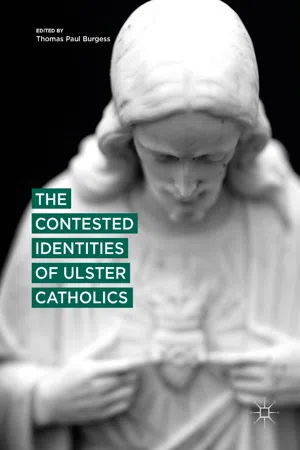
This book investigates the often-fragmented nature of Ulster Nationalist / Republican / Roman Catholic politics, culture and identity. Itoffers a companion publication to The Contested Identities of Ulster Protestants (2015).Historically the Catholic community of Ulster are regarded as a unified and coherent group, sharing cultural and political aspirations. However, the volume explores communities of many variants and strands, belying the notion of an easy, homogenous bloc in terms of identity, political aspirations, voting preferences and cultural identity. These include historical differences within constitutional nationalism and Republicanism, gender politics, partition, perceptions of this community from The Republic of Ireland, and more. The book will appeal to students and scholars across the fields ofPolitics, Cultural Studies, Sociology, Irish Studies and Peace Studies.
- English
- ePUB (mobile friendly)
- Available on iOS & Android
eBook - ePub
The Contested Identities of Ulster Catholics
About this book
Information
Topic
Theology & ReligionSubtopic
Cultural Policy© The Author(s) 2018
Thomas Paul Burgess (ed.)The Contested Identities of Ulster Catholicshttps://doi.org/10.1007/978-3-319-78804-3_11. Introduction
Thomas Paul Burgess1
(1)
School of Applied Social Studies, University College Cork, Cork, Ireland
Our object in the construction of the state is the greatest happiness of the whole, and not that of any one tribe.
—Plato. The Republic
Keywords
CityAnthropoceneUrban ethicsEnvironmental designUrbanizationBuilt environment‘May you live in interesting times’, as the ancient Chinese curse would have it. And whilst undeniably ‘interesting’, disorder, change and democratic deficit have irrefutably been to the fore in the recent political developments of Northern Ireland.
At time of writing, the absence of an elected assembly at Stormont, during a tumultuous period when constitutional stability was most required, continues unabated and seemingly with little prospect of resolution. The last time that there was any demonstrable activity in the Northern Ireland Executive, it followed The Assembly elections called by the then Secretary of State, James Brokenshire, in March 2017. These produced gains for Sinn Fein, with the party taking 27 seats, just one behind the DUP’s
total.
With so much in flux, you will not be surprised to learn that the contributors to this collection were barely able to hit ‘save’ on their keyboards, before another, seemingly more portentous event overtook their analysis. Attempting to ‘take the temperature’ of a community and thus establish trends and predict outcomes became an even more unusually fraught and inexact science. Even at the best of times, consensus around political aspiration, cultural affinity and the methodologies by which to express these has historically been contested within the nationalist and Republican peoples of the region.
Nevertheless, guided by the remit that informed our earlier collection, ‘The Contested Identities of Ulster Protestants’, the editorial policy of this book remained focused on offering up an eclectic collection of commentators, not drawn exclusively from the academic fraternity. Subsequently, former Republican prisoners sit cheek by jowl with journalistic commentary and conventional empirical academic findings. This in turn offers a variety of writing styles and, of course, viewpoints.
Perhaps, the most logical place to begin such an undertaking was with my own chapter, which offers a somewhat ‘glass-half-full’ perspective (albeit an ‘imagined’ one). External events and a changing of the guard—where some key political actors are concerned—has fashioned both threat and opportunity on the island of Ireland. Chapter 2 seeks to propose something of an invitation to both nationalists (and unionists) to ‘reimagine and own’ the changing political landscape, rather than have events dictate to them. I posit the view that Irish nationalists—north and south—must be prepared to re-examine (and perhaps compromise) treasured shibboleths established from the formation of the Irish state and before. In doing so I argue, a federal model can move Ireland forward with the imagination and courage of a state no longer mired in the politically infantile legacies of the twentieth century; Revolution and rebellion, church-state controls and post-colonial inferiority complexes.
Following from this is Professor John Coakley’s overview of Chapter 3. Coakley’s chapter assesses the evolution of Catholic public opinion in Northern Ireland over the past half-century, seeking to trace the manner in which it has shifted in apparent response to the reality of partition. He concludes that there is an increasing complexity in the manner in which Catholics define their identity patterns, a persisting loyalty to the main nationalist parties of the past, and a fluid, open attitude towards the question of Irish unity.
This endeavour to ‘locate’ a definitive identity or political aspiration within the Catholic communities of Ulster, when placed against a constantly changing political landscape, is one that journalist and broadcaster Malachi O’Doherty also addresses. O’Doherty examines the many ambiguities that surround the notion of a collective Irish, Catholic, nationalist identity. He suggests that many of the traditional indicators of this culture remain equivocal. The Irish language is respected but not widely spoken. The ideal of Irish unity has receded. Brexit
may revive it, but that is under the auspices of an Ireland as part of an international community, very different from the ideal of De Valera
, that it should be insular and protected, or of Adams
in 1977, that it should be a socialist state.
Further investigations into exactly where sentiments regarding the place of Irish Republicanism might currently lie come from former IRA
prisoners, commentators, Anthony McIntyre and Tommy Mc Kearney.
In Chapter 11, McKearney examines whether the changing make-up within the North’s population will also mean an end to partition followed by the political reunification of Ireland. While most northern Catholics have a shared experience (or at least a shared folk memory); their experiences have not always been identical. As with any community, there are differences shaped by class, by family and even by location. How this group of people will react to future happenings will be determined as much by external factors as by residual historical memory. Issues such as Brexit
, Scotland’s growing disenchantment with London and economic conditions in the Republic are all bound to influence opinion in the North. He poses the question, therefore, whether a milder and more accommodating form of Unionism might persuade the Catholic bourgeoisie to remain within the UK, if indeed that state survives.
McIntyre looks at the widespread fragmentation within Republicanism and examines the more salient causes. He contends that within the nationalist constituency, constitutional nationalism has a hegemonic position that is virtually unassailable from within. The chapter questions what—if any—potential there exists for Republicanism to overcome its disparate composition to the point where it can challenge the current nationalist hegemon.
Sinn Féin
now has a woman, Mary Lou McDonald, as president of the party, while Michelle O’Neill holds the position of Leas Uachtarán Sinn Féin and party leader in the North. Yet the Irish constitution still makes reference to a woman’s place as in the home. And the referendum on abortion in Ireland—and landslide victory for the ‘Yes’ campaign—proved to be emotionally driven, contested and divisive.
Claire Pierson’s chapter addresses this topical and still fiercely disputed issue for Irish Catholics. Gendered conceptualisations of nationalism present resonant imagery of women as mothers of the nation, often stereotyped in Irish nationalism through the highly Catholic imagery of the Blessed Virgin. Viewing women’s key contributions to national identity through the role of motherhood creates assumed notions of nurturing and self-sacrificing identity. Abortion and its assumed rejection of motherhood crosses boundaries of ideal womanhood, and as such is presented as abhorrent to Irish Catholic nationalism and to Irishness more widely on the island of Ireland. This chapter calls on liberal theological conceptions of Catholicism such as that voiced by Catholics for Choice to envision how abortion stigma could be broken down in Northern Ireland.
Another fascinating aspect of gender politics in a northern Irish context involves women and the legacy of armed conflict. In Chapter 10, Niall Gilmartin contends that the gendered dichotomy of male-protector/female-protected remains a pervasive representational model of gender roles in armed conflict. Feminist scholars have long challenged the dubious links between femininity and ‘peacefulness’ by documenting women’s role as armed activists. This chapter explores the pressing question of what happens to female combatants after armed conflict. While combatant women in non-state nationalist movements often experience high levels of activism and politicisation during the war period, feminist critiques of nationalism as a patriarchal structure often cite post-war regression, among others, as robust evidence of the pitfalls for women’s participation within such highly gendered movements.
Both Education and Sport are at the heart of identity formation and allegiance within this cohort. Professor Tony Gallagher contends that Catholic schools remain the most significant social institution of the minority in the North, and their relationship with the State represents the most important interface between the Catholic community and the Unionist establishment. That relationship has changed significantly over time, and the author assesses the challenges to the power of the Bishops by the refusal of most Catholic grammar schools to move away from academic selection.
Professor David Hassan and Conor Murray suggest that many of Northern Ireland’s unresolved issues are not solely political in nature but in fact have more to do with cultural identity and expression, when settling upon an agreed narrative concerning the country’s divided past and it’s telling in a public forum. A range of agencies has attempted to play their role, many again operating outside established political structures, focusing instead on expressions of identity promoted through sports. For the Catholic community, these are viewed as entirely legitimate forms of cultural expression, even if they carry added significance within such a divided society (where they constitute both a form of political allegiance by proxy and an important aspect of community expression for many, including those who feel disenfranchised from wider society).
Biographical research methods have increasingly become a useful and popular tool for contemporary social scientists. Three contributors here combine an exploration of the historical and philosophical origins of their topic, embracing this important field of qualitative research, using examples of the different ways in which biographical methods can be successfully applied in this context.
Connal Parr (the grandson of former prominent politician and activist, the late Paddy Devlin
) employs a biographical approach to his chapter, where—via personal interviews, reportage and scholarly works—he fuses the biographical with the academic to explore Catholic politics in west Belfast. He reasserts Devlin’s belief in the Labour movement, which led to his rejection of Catholicism and speculates whether his variegated political trajectory was a reflection of his own complex Catholic background.
Gareth Mulvenna draws on personal experience and family history in seeking to examine if Catholic social and political attitudes towards Protestants, Unionists and Loyalists has changed throughout the course of the ‘Troubles’ and the ‘peace process’ eras. He posits the view that the debate has been reversed from two generations ago and it is now Protestants who feel socially, economically and politically bereft in a society where republicanism is making significant cultural and political strides. As both communities talk of equality and inequality in a post-Brexit
landscape, the chapter assesses the factors that have contributed to these discourses.
In Chapter 13, Stephen Hopkins analyses the politics of life-writing and published narratives in relation to the founding generation of the SDLP
. His revealing insights pay particular reference to their attitudes towards the outbreak of the ‘Troubles’, and the increasing violence of the conflict in the early 1970s. He examines attitudes to critical aspects of the party’s past, one of which is the complex relationship of many of the key individuals in the ‘leading group’ of SDLP founders to the Republican movement, and its embrace of political violence. He reflects upon the benefits and limitations of ‘life-writing’ as a research methodology, suggesting it is a key element in facilitating a more nuanced understanding of the ‘memory struggles’ which characterise the legacy of the ‘Troubles’ in Northern Ireland.
Throughout many of the chapters (and reflected in my preface), there emerges an ambivalence, ambiguity and at times downright hostility towards Northern nationalists from their southern kinfolk.
With Chapter 5, Brian Hanley suggests some origins for this. Hanley’s chapter examines the reaction in the Republic to the outbreak of the conflict in 1969 and examples of widespread sympathy with nationalists between that year and 1972. He writes of a ‘symptom of spreading infection… a new form of intolerance in Ireland, between Southern and Northern Catholics’. The chapter looks at the experience of those who came south as refugees and the growing perception that many northerners, in the words of Conor Cruise O’Brien, are ‘tough, violent and virtually ungovernable’.
Finally, in a collection of this nature, it would be remiss not to ascertain something of the thoughts and opinions of the post-conflict generation within Northern Ireland. With Chapter 15, Aimee Smith explores feelings of identity amongst young Catholic’s who are part of the first generation to have grown up during the Northern Irish peace process. While recent survey data shows that young Catholic’s still see themselves as predominantly Irish, rather than British or Northern Irish, the traditional political identity of nationalism and support for a united Ireland are not as strong. Nevertheless, the chapter suggests a degree of ambivalence surrounding identity and social relations in Northern Ireland. Additionally, it shows that progress made in certain areas has not necessarily led to a social reconciliation between Catholic and Protestant young people who have grown up in the absence of inter-communal violence.
© The Author(s) 2018
Thomas Paul Burgess (ed.)The Contested Identities of Ulster Catholicshttps://doi.org/10.1007/978-3-319-78804-3_22. ‘The State We’re In: Imagining a New Republic; The Challenge to Irish Nationalism’
Thomas Paul Burgess1
(1)
School of Applied Social Studies, University College Cork, Cork, Ireland
Leo Varadkar’s recent ‘bullish’ promise to Northern nationalists might have been unthinkable under an earlier Enda Kenny-led Fine Gael administration.
‘To the Nationalist people in Northern Ireland, I want to assure you that we have protected your interests throughout these negotiations. Your birth right as Irish citizens, and therefore as EU citizens, will be protected. There will be no hard border on our island. You will never again be left behind by an Irish Government’, An Taoiseach, Leo Varadkar TD, 8 December 2017.
Yet, his comments and general demeanour regarding post-Brexit border arrangements—whether bolstered by assurances from Brussels or necessitated by the threat of potential Sinn Féin gains in any forthcoming el...
Table of contents
- Cover
- Front Matter
- 1. Introduction
- 2. ‘The State We’re In: Imagining a New Republic; The Challenge to Irish Nationalism’
- 3. Catholics in Northern Ireland: Changing Political Attitudes, 1968–2018
- 4. Rights Versus Rites? Catholic Women and Abortion Access in Northern Ireland
- 5. ‘Tough, Violent and Virtually Ungovernable’: Lessons from History—Northern Nationalists in the Irish Republic 1969–75
- 6. ‘E pluribus unum; The Elusiveness of a Singular Community Identity’
- 7. The Story of Catholic Schools in Northern Ireland: Past, Present and Possible Future
- 8. Paddy Devlin, the Labour Movement and the Catholic Community
- 9. Sport, Politics and Catholics in Northern Ireland
- 10. From the Front-Lines of War to the Sidelines of Peace? Gender, Republicanism and the Peace Process
- 11. From Platitude to Realpolitik; Challenging Generic Designations
- 12. Meet the New Boss…Same as the Old Boss; Assessing Republican Attitudes Towards the Protestant, Unionist and Loyalist Communities in Northern Ireland
- 13. Ideology and Identity in the Founding Group of the Social Democratic and Labour Party: Evaluating the Life-Writing of a Political Generation
- 14. Republican Fragmentation in the Face of Enduring Partition
- 15. Ambivalence in a Post-conflict Society: Young Catholics Growing Up in Northern Ireland
- Back Matter
Trusted by 375,005 students
Access to over 1.5 million titles for a fair monthly price.
Study more efficiently using our study tools.
Frequently asked questions
Yes, you can cancel anytime from the Subscription tab in your account settings on the Perlego website. Your subscription will stay active until the end of your current billing period. Learn how to cancel your subscription
No, books cannot be downloaded as external files, such as PDFs, for use outside of Perlego. However, you can download books within the Perlego app for offline reading on mobile or tablet. Learn how to download books offline
Perlego offers two plans: Essential and Complete
- Essential is ideal for learners and professionals who enjoy exploring a wide range of subjects. Access the Essential Library with 800,000+ trusted titles and best-sellers across business, personal growth, and the humanities. Includes unlimited reading time and Standard Read Aloud voice.
- Complete: Perfect for advanced learners and researchers needing full, unrestricted access. Unlock 1.5M+ books across hundreds of subjects, including academic and specialized titles. The Complete Plan also includes advanced features like Premium Read Aloud and Research Assistant.
We are an online textbook subscription service, where you can get access to an entire online library for less than the price of a single book per month. With over 1.5 million books across 990+ topics, we’ve got you covered! Learn about our mission
Look out for the read-aloud symbol on your next book to see if you can listen to it. The read-aloud tool reads text aloud for you, highlighting the text as it is being read. You can pause it, speed it up and slow it down. Learn more about Read Aloud
Yes! You can use the Perlego app on both iOS and Android devices to read anytime, anywhere — even offline. Perfect for commutes or when you’re on the go.
Please note we cannot support devices running on iOS 13 and Android 7 or earlier. Learn more about using the app
Please note we cannot support devices running on iOS 13 and Android 7 or earlier. Learn more about using the app
Yes, you can access The Contested Identities of Ulster Catholics by Thomas Paul Burgess in PDF and/or ePUB format, as well as other popular books in Theology & Religion & Cultural Policy. We have over 1.5 million books available in our catalogue for you to explore.