This book explains the causal pathways, the mechanisms and the politics that define the quantity and quality of policy learning. A rich collection of case studies structured around a strong conceptual architecture, the volume comprises fresh, original, empirical evidence for a large number of countries, sectors and multi-level governance settings including the European Commission, the European Union, and individual countries across Europe, Australia, Canada and Brazil. The theoretically diverse chapters address both the presence of learning and its pathologies, deploying state-of-the-art methods, including process tracing, diffusion models, and fuzzy-set techniques.
Claire A. Dunlop, Claudio M. Radaelli and Philipp Trein (eds.)Learning in Public PolicyInternational Series on Public Policy https://doi.org/10.1007/978-3-319-76210-4_1
Begin Abstract
1. Introduction: The Family Tree of Policy Learning
Claire A. Dunlop1, Claudio M. Radaelli1 and Philipp Trein2
(1)
Department of Politics, University of Exeter, Exeter, UK
DemocracyMechanismsMethodsPolicy learningTheories of the policy process
End Abstract
Demand for learning is high in practically all policy domains, whether we consider growth, the control of corruption, improvement in schools and health, or the dissemination of benchmarking and good practice by international organizations. At the same time, the supply of research findings shows that learning mechanisms are often stymied, the most obvious triggers like evidence-based policy do not work or work differently than expected. Or learning is not desirable, either because it is inefficient, for example by persevering in listening to the wrong teachers or by implementing the wrong lesson, or by applying the right lesson to the wrong institutional context. In other circumstances, learning may fail our criteria of democratic quality—such as, transparency, fairness, equality, accountability.
One way to describe this state of play is to say that the constellation of actors, incentives and norms in a policy process or a political system is not aligned with the objective of learning how to improve on public policy and following the criteria of democratic theory. Another is to say that bureaucracies, politicians in office, pressure groups, organized citizens and experts have objectives that are normally different from policy learning, such as consensus, the control of expertise and knowledge, cultivating membership, influence over the definition of a social or economic problem, and the management of implementation processes.
This raises a number of questions that today define the field of policy learning. First, what exactly do we mean by learning in the context of comparative public policy analysis and theories of the policy process (Weible and Sabatier 2017)? Second, what do we know about the causes of learning, its mechanisms, how it develops in different policy processes, within and across countries? Third, what are triggers and hindrances of mechanisms of learning ? (Dunlop and Radaelli 2018). Fourth, what are the consequences of different types of learning for the efficiency of public policy as well as for the normative criteria of the democratic theory we adopt? The first question brings us to definitional issues. The second and third question are about causality—in fact, they refer to causes, mechanisms and consequences. Even if our ambition is not to develop policy learning as stand-alone theory of the policy process, but rather to perfect our knowledge of learning within the established theories of the policy process, we have to assemble the building blocks of causality more systematically, in terms of micro-foundations , learning in organizations, and how group learning becomes policy learning and, sometimes, social learning (Dunlop and Radaelli 2017). The fourth question is about the outcome of learning—in the literature, this is often captured by the relationship between learning and policy change (Moyson et al. 2017), but actually there are many more possible outcomes, and some involve normative issues that haven’t always been prominent in the field.
In this introductory chapter, we explain how the study of policy learning has evolved to the point where it is today, and show how the contributions to the volume provide empirical and conceptual insights that, to be entirely honest, do not answer the four questions, or at least not completely, but assist us in providing the building blocks for a research agenda that has potential to provide successful answers. In doing this, we aware of the existence of some important reviews of the state of play in the field, and we refer the readers to these in order to keep our chapter within a decent word budget limit. Chapter 2 of our volume also provides a systematic bibliometric review of policy learning based on the most recent data by Goyal and Howlett—hence all the bibliometric data we need to support our discussion are in there. Other comprehensive reviews include Dunlop and Radaelli (2013), Freeman (2006), Hekkila and Gerlak (2013), Moyson and Scholten (2018) and Trein (2015).
At the outset, what do we mean by learning? Obviously there isn’t a single definition in the field. Indeed, the history of the political science literature on this topic suggests that learning is seen by different strands and authors as the solution to different problems, including:
the problem of cybernetic equilibrium in a system,
the problem of managing and reducing radical uncertainty ,
the problem of cross-national diffusion and convergence ,
the problem of knowledge utilization, and, (more recently),
the problem of learning in different modes or types of policy processes.
Thus, definitions do not come out of thin air. Rather, they are linked to approaches that capture one problem-solution association instead of another.
For us, it is sufficient to begin our brief overview of the historical development of the field by keeping in mind a basic definition of learning as updating of knowledge and beliefs about public policy (Dunlop and Radaelli 2013). In turn, updating is either the result of social interaction among policy actors, or personal-organizational experience, or the provision of new or different evidence. It can of course also result from variable combinations of the three.
The Roots
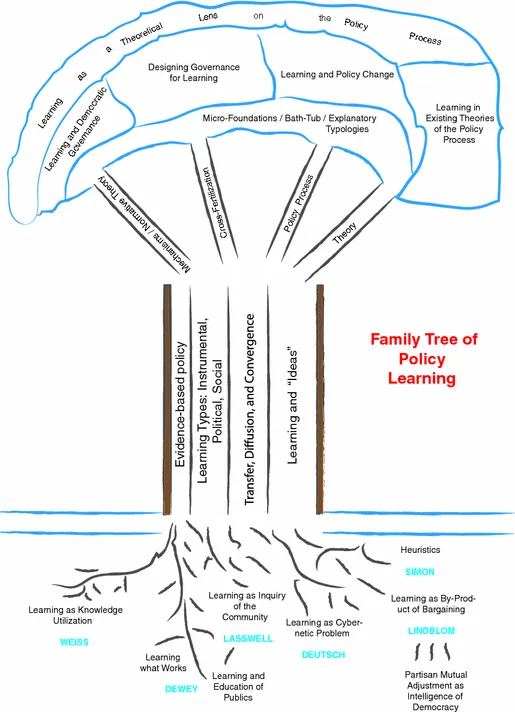
Let us now briefly see how political science research on policy learning has emerged and developed. We do so because an appraisal of what has already been done is the strongest foundation to design the coordinates of an agenda like the one supporting our volume, and more generally the research agenda in the field for the near future. The metaphor of the family tree will assist us in our journey through authors and themes (see Fig. 1.1).
Fig. 1.1
Family tree of policy learning
It is not difficult to identify the roots of policy learning. Names like John Dewey , Harold Lasswell, Karl Deutsch, Charles Lindblom (in turn, intimately connected to the research agenda of the economics Nobel prize-winner Herbert Simon ), and Hugh Heclo belong firmly to the roots of this family tree. We realize we are grouping together authors that did not live in the same period, but what matters is the overall consistency of the roots as developed by these giants.
The foundations of policy learning are philosophically grounded in pragmatism and its concern for what works. Pragmatic thinking marked a fundamental historical turn away from ideological approaches to public policy. If all that matters is what works, we have to be open to whatever mechanism may empirically occur in public policy, and learn how to generate usable lessons from experience and evidence.
Dewey’s pragmatism, however, went beyond that, because it included the seeds of a profound reflection on the normative issues we mentioned above. One of his core ideas was that education, policy and the publics define a single social problem of learning. In fact, Dewey’s (1927) classic The public and its problems, reprinted in 2012, was all about re-connecting a public distracted and un-interested in public policy problems w...
Table of contents
Cover
Front Matter
1. Introduction: The Family Tree of Policy Learning
2. Lessons Learned and Not Learned: Bibliometric Analysis of Policy Learning
3. Learning in the European Commission’s Renewable Energy Policy-Making and Climate Governance
4. Mechanisms of Policy Learning in the European Semester: Pension Reforms in Belgium
5. Individual Learning Behaviour in Collaborative Networks
6. Learning from Practical Experience: Implementation Epistemic Communities in the European Union
7. The Rise and Demise of Epistemic Policy Learning: The Case of EU Biotechnology Regulation
8. Public Versus Non-profit Housing in Canadian Provinces: Learning, History and Cost-Benefit Analysis
9. Blocked Learning in Greece: The Case of Soft-Governance
10. Structure, Agency and Policy Learning: Australia’s Multinational Corporations Dilemma
11. Median Problem Pressure and Policy Learning: An Exploratory Analysis of European Countries
12. The Hard Case for Learning: Explaining the Diversity of Swiss Tobacco Advertisement Bans
13. The Policy-Making of Investment Treaties in Brazil: Policy Learning in the Context of Late Adoption
14. Interdependent Policy Learning: Contextual Diffusion of Active Labour Market Policies
Back Matter
Trusted by 375,005 students
Access to over 1.5 million titles for a fair monthly price.
Study more efficiently using our study tools.
Frequently asked questions
Yes, you can cancel anytime from the Subscription tab in your account settings on the Perlego website. Your subscription will stay active until the end of your current billing period. Learn how to cancel your subscription
No, books cannot be downloaded as external files, such as PDFs, for use outside of Perlego. However, you can download books within the Perlego app for offline reading on mobile or tablet. Learn how to download books offline
Perlego offers two plans: Essential and Complete
Essential is ideal for learners and professionals who enjoy exploring a wide range of subjects. Access the Essential Library with 800,000+ trusted titles and best-sellers across business, personal growth, and the humanities. Includes unlimited reading time and Standard Read Aloud voice.
Complete: Perfect for advanced learners and researchers needing full, unrestricted access. Unlock 1.5M+ books across hundreds of subjects, including academic and specialized titles. The Complete Plan also includes advanced features like Premium Read Aloud and Research Assistant.
Both plans are available with monthly, semester, or annual billing cycles.
We are an online textbook subscription service, where you can get access to an entire online library for less than the price of a single book per month. With over 1.5 million books across 990+ topics, we’ve got you covered! Learn about our mission
Look out for the read-aloud symbol on your next book to see if you can listen to it. The read-aloud tool reads text aloud for you, highlighting the text as it is being read. You can pause it, speed it up and slow it down. Learn more about Read Aloud
Yes! You can use the Perlego app on both iOS and Android devices to read anytime, anywhere — even offline. Perfect for commutes or when you’re on the go. Please note we cannot support devices running on iOS 13 and Android 7 or earlier. Learn more about using the app
Yes, you can access Learning in Public Policy by Claire A. Dunlop, Claudio M. Radaelli, Philipp Trein, Claire A. Dunlop,Claudio M. Radaelli,Philipp Trein in PDF and/or ePUB format, as well as other popular books in Política y relaciones internacionales & Políticas europeas. We have over 1.5 million books available in our catalogue for you to explore.