- English
- ePUB (mobile friendly)
- Available on iOS & Android
eBook - ePub
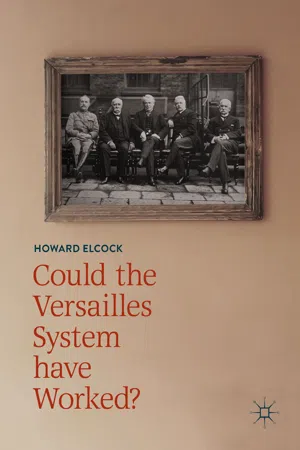
Could the Versailles System have Worked?
About this book
This book explores the significance of the post-First World War peace settlement negotiated at Versailles in 1919. Versailles has always been a controversial subject and it has long been contended that the Treaty imposed unnecessarily severe conditions upon the defeated nations, particularly Germany, and in large part can be held responsible for the outbreak of war in 1939. This book considers the critical question as to whether the Treaty of Versailles established a new international settlement that could produce a peaceful and prosperous Europe, something that many have alleged was impossible. In an exhaustive analysis of the events that followed the Paris Peace Conference, Howard Elcock argues that the Versailles Treaty created a more stable diplomatic framework than has commonly been recognised, and challenges the traditional understanding that the delegates at Versailles can be held responsible for the failure to secure long-term peace in Europe.
Information
© The Author(s) 2018
Howard ElcockCould the Versailles System have Worked?https://doi.org/10.1007/978-3-319-94734-1_11. Introduction: The Carthaginian Peace—Or What?
Howard Elcock1
(1)
Northumbria University, Newcastle upon Tyne, UK
1 The Verdicts on the Treaty
The Treaty of Versailles has over many years had a bad press. From shortly after its signing, authors, politicians, journalists, commentators and historians argued that the terms of the Treaty had been excessively severe and later that the Treaty had been the prelude to the Second World War. Certainly, the proximate cause of war in 1939 was Hitler’s invasion of Poland in order to correct the allocation of 2 million or so Germans to Polish rule in order the meet President Wilson’s demand in the Fourteen Points (Point 13) for an independent Poland with a secure access to the sea. The “Polish Corridor” was a source of friction between Germany, Poland and the rest of Europe from the beginning of the inter-war period to its end. The Second World War was indeed, at least as its immediate cause, “war for Danzig” (Taylor 1961: Chapter 11). A. J. P. Taylor’s final verdict is interesting:
In this curious way the French, who had preached resistance to Germany for twenty years appeared to be dragged into war by the British who had for twenty years preached conciliation. Both countries went to war for that part of the peace settlement which they had long regarded as least defensible. (ibid.: 277–278)
The “Polish Corridor” had indeed been an irritant throughout the inter-war years, but the wider failure to defend and implement the Treaty of Versailles had more extensive origins.
Almost as soon as the ink was dry on the Treaty of Versailles, its justice and fairness were called into question by influential commentators, most notably J. M. Keynes, who had resigned from the Treasury section of the British Delegation because he was appalled by the overall severity of the Treaty. He told Prime Minister Lloyd George that “I ought to let you know that on Saturday I am slipping away this scene of nightmare. I can do no more good here” (Harrod 1953: 253). He retreated to Cambridge and there proceeded to write a book which was to have huge and severe consequences for the future of the “Versailles System” and indeed did much to discourage respect for the terms of the Treaty and to dissuade the former Allies’ willingness from implementing them. Nonetheless, the “Versailles System” did work for a while but was eventually overwhelmed by the unresolved defects of the Treaty and the calamity that hit first the USA, then Europe and the world after October 1929.
Keynes’s rapidly written book, The Economic Consequences of the Peace, was published towards the end of 1919 and caused an immediate storm of reaction in Britain and elsewhere. Zara Steiner (2005: 67) described it as “pernicious but brilliant” and argues that “the reverberations of Keynes’s arguments were still to be heard after Hitler took power. They are still heard today”. Although historians as well as others who were present at the Conference have argued for years that Keynes’s interpretation of the “Big Four” and the making of the Treaty were in important respects wrong (see Headlam-Morley 1972; Nicolson 1964 edition; Mantoux 1946; Sharp 1991; Elcock 1972; Macmillan 2001 and others), these arguments have not been heeded by ministers, civil servants, US Senators and news media reporters who have been influenced by Keynes’s book rather than the scholars and others who have challenged his interpretation. This is indeed a classic example of the gulf that exists, especially in Britain between academic students of history and politics on the one hand and the ministers and civil servants who make government decisions on the other. Policy-makers and journalists but not academic historians were mesmerised by Keynes’s accusations, which were a significant cause of Wilson’s failure to secure the ratification of the Treaty by the Senate and in the longer term to the appeasement of Hitler.
Keynes’s criticism related not only to the content of the Treaty but also to the characters of the three principal statesmen responsible for drafting it: Georges Clemenceau of France, David Lloyd George, the British Prime Minister, and the American President Thomas Woodrow Wilson, of all of whom he painted vivid but erroneous pictures, to be discussed shortly. Keynes’s work can be examined from two directions. The early chapters discuss the process by which the Treaty was drafted and the personal attributes of the three statesmen who were responsible for its contents. They were advised by numerous commissions of experts, as well as holding hearings with the authorities from the various states that wished to make territorial or financial claims on the defeated Germans and their allies. The final decisions were originally to be taken in the Council of Ten, which consisted of the Heads of Government and Foreign Ministers of the five principal Allied and Associated Powers: the British Empire, France, the USA, Italy and Japan, attended and advised by numerous officials from each delegation. However, this body was plagued by leaks to the Press corps gathered around the hotels and government buildings in Paris where the clauses of the Treaty were being drafted and decisions made about them. In consequence, the principal statesmen Wilson, Clemenceau, Lloyd George and the Italian Prime Minister, Vittorio Orlando, decided in early March to meet as the Council of Four. This decision led to the intimate atmosphere that Keynes attached so much importance to in his account of the personalities of the “Big Three” and their interaction (he had little to say about Orlando). His account included vivid descriptions of the physical characteristics of the three men. Here, our concern is to outlineKeynes’s opinions of the three statesmen; assessing their validity is a task for the next chapter.
2 The Statesmen
First up is the 78-year-old Prime Minister of France, Georges Clemenceau. For Keynes, Clemenceau “felt about France what Pericles felt of Athens – unique value in her, nothing else mattering. He had one illusion – France – and one disillusion – mankind, including Frenchmen and his colleagues not least” (Keynes 1919: 29). He goes on, “In the first place, he was a foremost believer in the view that the German understands and can understand nothing but intimidation, that he is without generosity or remorse in negotiation” (ibid.). Clemenceau’s vision of the future was pessimistic: “European history is to be a perpetual prize-fight of which France has won this round but of which this round is certainly not the last” (ibid.: 31). Keynes uses Clemenceau’s long-standing nickname, “the Tiger”, to summarise his view of Clemenceau: obstinate in his defence of French interests and his determination to secure guarantees for her future safety, especially by weakening Germany as much as possible: “This is the policy of an old man, whose most vivid impressions and most lively imagination are of the past and not of the future. He sees the issue in terms of France and Germany, not of humanity and of European civilisation struggling forwards to a new order” (ibid.: 31). Earlier in the chapter, Keynes pronounced his damning verdict on Clemenceau: “One could not despite Clemenceau or dislike him but only take a different view as to the nature of civilised man, or at least indulge a different hope” (ibid.: 26). Nonetheless, Keynes took the view that Clemenceau’s policies largely prevailed in the writing of the Treaty.
This leads directly to the issue of President Wilson, whose Fourteen Points had been the basis on which the Germans had sought an armistice in November 1918 and which many participants in the Conference as well as the wider publics of Europe and America supposed would form the ethical and practical basis of the Peace Treaty. Hence, “When President Wilson left Washington he enjoyed a prestige and a moral influence throughout the world unequalled in history” (ibid.: 34). He went on, “With what curiosity, anxiety and hope we sought a glimpse of the features and bearing of the man of destiny who, coming from the West, was to bring healing to the wounds of the ancient parent of his civilisation and lay for us the foundations of the future” (ibid.: 35). For Keynes, then the essential question was why Wilson betrayed his principles and allowed the creation of a Carthaginian peace treaty. His explanation was that Wilson was badly prepared for the negotiations and unable to comprehend, let alone respond to the devices and desires of his British and French colleagues: “Never could a man have stepped into the parlour a more perfect and predestined victim to the finished accomplishments of the Prime Minister (Lloyd George)” (ibid.: 38). More severe criticism in the same vein follows: “… the Old World’s heart of stone might blunt the sharpest blade of the bravest knight-errant. But this blind and deaf Don Quixote was entering a cavern where the swift and glittering blade was in the hands of his adversary” (ibid.: 38). Keynes characterised Wilson as being “like a Nonconformist minister, perhaps a Presbyterian. His thought and his temperament were essential theological, not intellectual …” (ibid.: 38). To make matters worse, “in fact the President had thought out nothing; when it came to practice his ideas were nebulous and incomplete. He had no plan, no scheme, no constructive ideas whatever for clothing with the flesh of life the commandments which he had thundered from the White House” (ibid.: 39). Hence “he was liable to defeat by the mere swiftness, apprehension and agility of a Lloyd George” (ibid.: 40). He also failed to make appropriate use of his advisers in the American Delegation: “Caught up in the toils of the Old World, he stood in great need for sympathy, of moral support, of the enthusiasm of the masses. But buried in the Conference, stifled in the hot and poisoned air of Paris no echo reached him from the outer world” (ibid.: 45). Keynes also argued that Wilson had often been deceived by clever drafting, “sophistry and Jesuitical exegesis” (ibid.: 47) that caused Wilson to be persuaded that his principles were being honoured when in practice they were not. The other statesmen bamboozled him into thinking that his principles had been honoured and when Lloyd George tried to modify the Treaty in early June, “it was harder to de-bamboozle the old Presbyterian than it had been to bamboozle him … So in the last act the President stood for stubbornness and a refusal of conciliation” (ibid.: 50); in reality, Keynes argued, the result was a bad Treaty.
Of the British participant in the deliberations of the Council of Four, Prime Minister David Lloyd George, Keynes said relatively little in The Economic Consequences of the Peace except to refer to his quickness of mind and his flexibility in responding to the successive issues that arose during the Council of Four’s discussions. However, in a later publication Keynes issued a similarly damning verdict on Lloyd George (Keynes 1933), which he had hesitated to publish in the earlier volume because he retained a certain regard for the Prime Minister. He saw Lloyd George as an unprincipled operator who simply sought an agreement as sympathetic as possible to British interests; otherwise, he did what seemed best at the moment:
Lloyd George is rooted in nothing: he is void and without content; he lives and feeds on his immediate surroundings; he is an instrument and a player at the same time which plays on the company and is played on by them too; he is a prism, as I have heard him described, which collects light and distorts it and is most brilliant if the light comes from many quarters at once; a vampire and a medium in one. (Keynes 1933: 37)
In this piece, Keynes likened Lloyd George to a Welsh witch; his charm and flexibility were for Keynes feminine qualities: “How can I convey to the reader who does not know him any just impression of this extraordinary figure of our time, this syren, this goat-footed bard, this half-human visitor to our age from the hag-ridden, magic and enchanted woods of Celtic antiquity?” (ibid.: 36). It was with these wiles, according to Keynes, that Lloyd George was able to persuade the President to forego his ideals and sign up to a severe Treaty that in many ways ran counter to the Fourteen Points. In this essay, Keynes presents a portrait of Lloyd George that combines savage criticism with a certain admiration for his subject.
3 The Council of Four
Like Keynes’s other portraits of the major statesmen at Paris, this picture is inaccurate, as we shall see in Chapter 2, but for the meantime, there is one more issue to note, the nature of which Keynes describes with considerable insight: the relations that developed between the participants in the Council of Four. Indeed, he regarded this pattern of relationships...
Table of contents
- Cover
- Front Matter
- 1. Introduction: The Carthaginian Peace—Or What?
- 2. The Conference and the Treaty
- 3. “Double, Double, Toil and Trouble”: Years of Frustration in the Early 1920s
- 4. More Troubles
- 5. The Dawn Breaks: Progress Towards Peace
- 6. Peace and Prosperity Come to Europe—For the Time Being
- 7. Things Fall Apart: The Great Crash and the Onset of Disaster
- 8. Götterdämmerung: Hitler and the End of the Versailles System
- Back Matter
Trusted by 375,005 students
Access to over 1.5 million titles for a fair monthly price.
Study more efficiently using our study tools.
Frequently asked questions
Yes, you can cancel anytime from the Subscription tab in your account settings on the Perlego website. Your subscription will stay active until the end of your current billing period. Learn how to cancel your subscription
No, books cannot be downloaded as external files, such as PDFs, for use outside of Perlego. However, you can download books within the Perlego app for offline reading on mobile or tablet. Learn how to download books offline
Perlego offers two plans: Essential and Complete
- Essential is ideal for learners and professionals who enjoy exploring a wide range of subjects. Access the Essential Library with 800,000+ trusted titles and best-sellers across business, personal growth, and the humanities. Includes unlimited reading time and Standard Read Aloud voice.
- Complete: Perfect for advanced learners and researchers needing full, unrestricted access. Unlock 1.5M+ books across hundreds of subjects, including academic and specialized titles. The Complete Plan also includes advanced features like Premium Read Aloud and Research Assistant.
We are an online textbook subscription service, where you can get access to an entire online library for less than the price of a single book per month. With over 1.5 million books across 990+ topics, we’ve got you covered! Learn about our mission
Look out for the read-aloud symbol on your next book to see if you can listen to it. The read-aloud tool reads text aloud for you, highlighting the text as it is being read. You can pause it, speed it up and slow it down. Learn more about Read Aloud
Yes! You can use the Perlego app on both iOS and Android devices to read anytime, anywhere — even offline. Perfect for commutes or when you’re on the go.
Please note we cannot support devices running on iOS 13 and Android 7 or earlier. Learn more about using the app
Please note we cannot support devices running on iOS 13 and Android 7 or earlier. Learn more about using the app
Yes, you can access Could the Versailles System have Worked? by Howard Elcock in PDF and/or ePUB format, as well as other popular books in History & European History. We have over 1.5 million books available in our catalogue for you to explore.