eBook - ePub
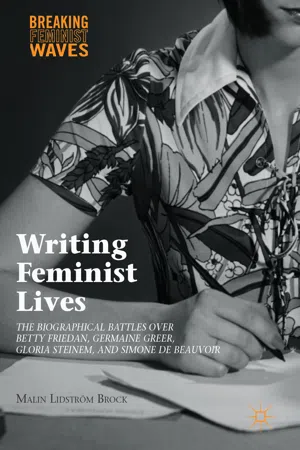
Writing Feminist Lives
The Biographical Battles over Betty Friedan, Germaine Greer, Gloria Steinem, and Simone de Beauvoir
- English
- ePUB (mobile friendly)
- Available on iOS & Android
eBook - ePub
Writing Feminist Lives
The Biographical Battles over Betty Friedan, Germaine Greer, Gloria Steinem, and Simone de Beauvoir
About this book
Information
© The Author(s) 2016
Malin Lidström BrockWriting Feminist LivesBreaking Feminist Waves10.1007/978-3-319-47178-5_11. Introduction
Malin Lidström Brock1
(1)
Luleå University of Technology, New York, New York, USA
What value can biography have in the wake of the dismantling of narrative authority and the belief in the integrity and knowability of the human subject? What value, more specifically, can biography have for feminists, who have particular reasons for being skeptical of modern ideas about the subject and the author, yet who also have pressing reasons to remain faithful to those ideas? These questions highlight the central role occupied by ideas about subjectivity, the self and the author in critical discussions of both feminism and biography. In Writing Feminist Lives, I set out to answer these questions by identifying how battles over feminism and its meaning have been articulated in the biographies of some of the most influential feminists of the twentieth century. The women whose biographies are the subject of this book are Betty Friedan, Germaine Greer, Gloria Steinem and Simone de Beauvoir—all pivotal characters in the history of late twentieth-century Western feminism and women who have contributed to modern feminism through political writing that includes autobiographical elements.
As part of distinct political statements, these autobiographical elements contribute to differentiating the four women ideologically and epistemologically. Friedan and Steinem are self-proclaimed humanists, whoseengagement with politics grew out of careers in left-wing and liberal journalism. Friedan, however, is commonly viewed as a liberal feminist, while Steinem refers to her political viewpoint as radical feminist.1 In contrast to Friedan and Steinem, Beauvoir’s feminism has a philosophical basis and is rooted in Hegelian Marxism and Sartrean existentialism. Her phenomenological account of what it means to be a woman originates in theories that stress the “situatedness” of lives, as well as women’s domination by and potential liberation from oppressive social structures.2 Finally, Greer has referred to herself as both an anarchist and a Marxist, while her political writing reflects a libertarian feminist and occasionally almost Romantic view of the subject.3
The dawn of a new millennium and the end of the twentieth century set off an evaluation of the century’s major events, including so-called second-wave feminism.4 The effect was an outpouring of histories and memoirs of, in particular, the American women’s movement.5 During the 1990s, seven biographies of the four women were also published. In Writing Feminist Lives, I read these biographies as symptoms of an ideological battle over the meaning and future of feminism. Friedan, Greer, Steinem and Beauvoir are all contestants in this battle through autobiographically informed political arguments. When the authors of the seven biographies wrote these women’s lives, an interesting dilemma thereby presented itself to them. Inevitably, the biographers became participants in the ideological battle, but not always on the same side as their subjects. In reading the biographies, I am seeking to identify the ideological distance that the biographers try either to establish or to overcome in relation to their subjects’ autobiographically informed political writing or theories of subjectivity. In the process of ascertaining how the biographers maintain or reduce such a distance, I wish to introduce a further fold of nuance into considerations of biography and feminism.
Ideological Battles of the 1990s
The 1990s was a time of crisis for both feminism and biography, as key concepts and ideas related to both areas were being questioned and reformulated. One purpose of Writing Feminist Lives is to identify the biographies’ positions in the decade’s feminist and biographical disputes, or battles. These battles appeared in the wake of a general postmodern critique of the thoughts and ideas that characterize the modern era. Postmodern and poststructuralist critics have seriously challenged the ideological and epistemological foundations of both feminism and biography. Their systematic dismantling of the human subject threatens the ideas of agency and self-realization on which modern feminism relies.6 The theories advanced by postmodern critics have also been interpreted as direct attacks on biography, resulting in skepticism of the rational and coherent biographical subject, and the biographer as the sole “authority” on the life.7
The modern, universalist Enlightenment ideas that came under attack in the twentieth century were not rendered obsolete, however, by the introduction of postmodern theories.8 On the contrary, old ideas became more visible when contrasted with the new, often gaining in strength and precision from the attacks.9 Furthermore, feminists before the influence of postmodern theorizing have criticized the modern project from within, by insisting on women’s particularity.10 In the 1960s and 1970s, disagreements over how to define women’s particularity resulted in the formation of various feminist phalanges and political ideals (which did not prevent feminists from sharing a belief in women’s universal rights).11 Competing notions of women’s particularity continued to play a vital role in feminist discussions also after the development of postmodern and poststructuralist feminist theories in the 1980s and 1990s.
That is to say, when the seven biographies were first published, feminism was an active battlefield consisting of multiple and simultaneously existing ideological positions, which both confirmed and complicated the modern–postmodern dichotomy. Central to this battlefield were theoretical disputes concerning the (female) self, the subject and her consciousness, and the related ideas of the author and his presumed death.12 These disputes take “particularly interesting shapes,” to borrow a phrase from Liz Stanley, when they are examined in connection with the seven biographies at hand.13
In part, the reason is that the biographies in question portray women with their own highly politicized notions of (female) subjectivity. By the 1970s, the idea of personal change had become an important concept in feminist politics.14 As a consequence, women’s autobiography moved to the center of the feminist literary canon and feminist critics increasingly looked for a biographical structure in women’s fiction.15 At the same time, the female self and the idea of female subjectivity became central concerns in feminist analysis. This is the case also with the political writing by the four women whose biographies I discuss in this book. The biographies merit closer examination partly because the biographers have engaged in some way with the autobiographical elements in their subjects’ political arguments. The reason, of course, is that biographers are similarly caught up in discussions about selfhood, subjectivity, intentionality and authorship.
The turn from autobiography to biography further complicates such discussions. Mary Rhiel and David Suchoff observe that in the 1990s marginalized groups were increasingly turning to biography to tell life stories that had been “previously unheard by the larger culture.” The new interest in the genre resulted in what Rhiel and Suchoff call “battles over biography.”16 Biography, Lisbeth Larsson observes, promised new academic disciplines, such as feminist theory, black criticism, new historicism, and postcolonial and cultural studies, the possibility to present solid, knowable selves and a means to identify social and political oppression.17 On the other hand, biography’s truth-claims were also being openly questioned by academics, critics and journalists.18 Certain feminist groups, too, welcomed the criticism of what Cheryl Walker refers to as the “monolithic authorial presence” in biography and argued for a pluralistic concept of subjectivity.19 To postmodern feminists, biography must display consciousness of multiple and conflicting discourses pertaining to the concept “woman.” Such an approach promised to avoid what Sharon O’Brien calls falsely unifying notions of the female self, without denying “the importance of gender to female experience.”20
In Writing Feminist Lives, I read the seven biographies in the context of two kinds of battles that are not only related, but are taking place simultaneously both within and among the biographies. That is, I view the feminist battles within the biographies as inextricably linked to the biographical battles that are also taking place among them. By identifying how the seven biographies are constructed, and with a special focus on how the biographers define subjectivity and authorship, I aim to establish the biographers’ respective positions in the 1990s feminist and biographical disputes.
The Biographies
According to Laura Miller, modern feminism after the 1960s was “bursting with fascinating, combative, maddening and outrageous characters.”21 Despite such a colorful group to choose from, biographies of only four women associated with second-wave feminism appeared in the 1990s.22 Among those are the seven biographies considered in this book.23 Lack of biographical information partly explains the absence of biographies of other women who were, in Jennifer Scanlon’s words, “catalysts” in developing the American women’s movement.24 In this respect Friedan, Greer, Steinem and Beauvoir are important exceptions. Most likely, the four women’s already established reputations as “significant” contributors to modern feminism—reputations created largely in and by the mainstream media—helped motivate biographers, publishers and readers to focus on these particular women also in the 1990s, when feminism was coming under new scrutiny.25
The women’s pre-existing fame forms a significant part of their “biographical recognition,” as William H. Epstein defines the term.26 For Epstein, biographical recognition is “a way of being and becoming to which special significance is attached, a closely monitored process of inclusion and exclusion.”27 Ultimately, he views such recognition as a form of “interpretative violence.”28 Epstein’s definition of the term, however, does not take into account the possibility that biographical recognition also promises to make visible marginalized groups’ experiences and ideals through individual examples.29 In Writing Feminist Lives, I seek to identify the ideologies behind the four women’s biographical recognition. The appearance of the seven biographies at a time of ideological crisis suggests that Friedan’s, Greer’s, Steinem’s a...
Table of contents
- Cover
- Frontmatter
- 1. Introduction
- 2. A Question of Authority
- 3. Negotiating the Tradition—Feminist Realist Biography
- 4. Breaking New Ground—Feminist Exemplary Biography
- 5. Deconstructing the Life—Feminist Poststructuralist Biography
- 6. Conclusion
- Backmatter
Trusted by 375,005 students
Access to over 1.5 million titles for a fair monthly price.
Study more efficiently using our study tools.
Frequently asked questions
Yes, you can cancel anytime from the Subscription tab in your account settings on the Perlego website. Your subscription will stay active until the end of your current billing period. Learn how to cancel your subscription
No, books cannot be downloaded as external files, such as PDFs, for use outside of Perlego. However, you can download books within the Perlego app for offline reading on mobile or tablet. Learn how to download books offline
Perlego offers two plans: Essential and Complete
- Essential is ideal for learners and professionals who enjoy exploring a wide range of subjects. Access the Essential Library with 800,000+ trusted titles and best-sellers across business, personal growth, and the humanities. Includes unlimited reading time and Standard Read Aloud voice.
- Complete: Perfect for advanced learners and researchers needing full, unrestricted access. Unlock 1.5M+ books across hundreds of subjects, including academic and specialized titles. The Complete Plan also includes advanced features like Premium Read Aloud and Research Assistant.
We are an online textbook subscription service, where you can get access to an entire online library for less than the price of a single book per month. With over 1.5 million books across 990+ topics, we’ve got you covered! Learn about our mission
Look out for the read-aloud symbol on your next book to see if you can listen to it. The read-aloud tool reads text aloud for you, highlighting the text as it is being read. You can pause it, speed it up and slow it down. Learn more about Read Aloud
Yes! You can use the Perlego app on both iOS and Android devices to read anytime, anywhere — even offline. Perfect for commutes or when you’re on the go.
Please note we cannot support devices running on iOS 13 and Android 7 or earlier. Learn more about using the app
Please note we cannot support devices running on iOS 13 and Android 7 or earlier. Learn more about using the app
Yes, you can access Writing Feminist Lives by Malin Lidström Brock in PDF and/or ePUB format, as well as other popular books in Literature & Modern Literary Criticism. We have over 1.5 million books available in our catalogue for you to explore.