Bridging the fields of Religion and Latina/o Studies, this book fills a gap by examining the "spiritual" rhetoric and practices of the Chicano movement. Bringing new theoretical life to biblical studies and Chicana/o writings from the 1960s, such as El Plan Espiritual de Aztlán and El Plan de Santa Barbara, Jacqueline M. Hidalgo boldly makes the case that peoples, for whom historical memories of displacement loom large, engage scriptures in order to make and contest homes. Movement literature drew upon and defied the scriptural legacies of Revelation, a Christian scriptural text that also carries a displaced homing dream. Through the slipperiness of utopian imaginations, these texts become places of belonging for those whose belonging has otherwise been questioned. Hidalgo's elegant comparative study articulates as never before how Aztlán and the new Jerusalem's imaginative power rest in their ambiguities, their ambivalence, and the significance that people ascribe to them.
Jacqueline M. HidalgoRevelation in AztlánThe Bible and Cultural Studies10.1057/978-1-137-59214-9_1
Begin Abstract
1. Introduction: Scriptures, Place, and No Place in the Chicano Movement
Jacqueline M. Hidalgo1
(1)
Williams College, Williamstown, Massachusetts, USA
End Abstract
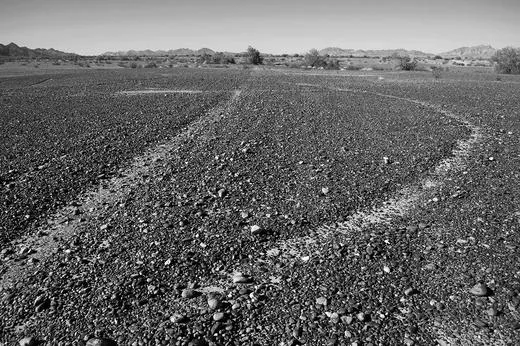
For Alfredo Acosta Figueroa, the small desert city of Blythe, California, and the surrounding Palo Verde/Parker Valleys reveal the archaeological remains of Aztlán, the mythical Aztec place of origin (Fig. 1.1).1 The thesis of his 2002 book, Ancient Footprints of the Colorado River: La Cuna de Aztlán, argues that this lost history is quite easily visible in the shapes and shadows of the mountains, viewed “from our home” in Blythe, on the eastern edge of Southern California. The introduction of Figueroa’s book situates his project as “a Pandora’s Box of unknown history that remained lost for centuries.”2 When I met Figueroa in October 2013, he promised me that our meeting “was the interview that will change [my] life forever.” I had followed Figueroa’s story for years across various media outlets, and in some ways, his ideas had already changed my research, though not necessarily in the fashion he might have imagined. In 2006, I first read about Figueroa in the Los Angeles Times in an article that would partially propel me along as I shaped the research behind this project. That article described Figueroa’s 2002 book and his ongoing work to promote the thesis of that book.
Fig. 1.1
A view of Blythe, CA, from one of the geoglyphs studied by Alfredo Acosta Figueroa (Photograph by Sourena Parham)
As a child, Figueroa was told by classmates that he was a “boy without a country,” but he would fire back, “This is my land. My father told us that you stole our land from us.”3 As an adult, he came to see that the home of the Mexicas (generally called the Aztecs in US4 English), many other indigenous American peoples, and possibly all humanity, might be found along the Colorado River at the California/Arizona border. Figueroa has spent over fifty years participating in a much older quest for Aztlán, one that dates back at least to the Mexica ruler Motechuzoma Ilhuicamina (c. 1398–1469), and Figueroa does not hesitate to locate the import of the “Xicano movement”5 of the 1960s and 1970s as what “has motivated the foundation of [his] book.”6 He has spent much of the past fifty years researching Aztlán, while also working as an activist with farmworkers, for Mexican American civil rights, in opposition to nuclear power and waste disposal near Blythe, and for local Chemehuevi land rights. Of particular import to Figueroa is that the lands around Blythe that he identifies as Aztlán receive federal legal recognition as “sacred” lands.
Because Figueroa is a fifth-generation resident of Blythe, it might seem strange that he has to do so much work to make it home. Yet the very ways that Blythe itself has been a shifting and contested place may partially speak to Figueroa’s scriptural labor. At present, Blythe is a nexus of transit, a good town to stop for the night if you are driving on Interstate 10 between Los Angeles and Phoenix. The area around Blythe, though a desert, was once an agricultural and mining locale nestled between mountains and along the Colorado River. Rather than originating in a utopian sense of joyousness, the name actually comes from a late nineteenth-century English financier who secured and controlled the area’s water rights in 1877, and its population according to the 2010 census is a little more than 20,000.7 Now, many residents of Blythe, including one of Figueroa’s sons, work for the Chuckawalla Valley State Prison, opened in 1988. In his youth, Figueroa had been a miner in the surrounding environment, like his father before him, but he came to question the destruction of the land that mining entailed.8 Figueroa sought a better relationship with the land and a better world for his descendants. In the 1960s, he became a public activist with the farmworkers and the Chicanx9 civil rights movement, protesting police brutality in Blythe and working with friends and family members to found the Escuela de la Raza Unida (School of the United [Chicanx] People),10 still an active day care facility down the street from Figueroa’s house.
Figueroa has spent decades moving between the Aztlán described in modern and colonial texts and the remnants of Aztlán apparent to him in the landscape of Blythe. Sitting at his dining room table in October 2013, he pulled out photocopies of varying Spanish colonial codices, sang corrido selections from his days with César Chávez and the farmworkers, and drew upon various maps that he had laminated and marked up so he could show me how visible signs on local maps connected to descriptions embedded in varying Spanish colonial era texts, mid-twentieth-century Mexican historiographies of the Mexicas/Aztecs, and a prologue to El Plan Espiritual de Aztlán, a Chicanx manifesto written for the Denver Youth Conference in March 1969. Though seventy-nine years old when I met him, Figueroa still carried much of the energy and passion that must have marked his activism in the 1960s. Hiking around local sites with me, he talked for hours and showed me how one could perceive the outline of the eagle from the Mexican flag in the mountain to the north of his house, how the outline of the goddess Tonantzin could be found to the southeast, and how many other important Mexican gods, goddesses, and symbols infiltrate the local landscape; he saw these markers as clear “facts,” visible to any eye that can see. He expressed hope that more scholars from Mexico might bring their expertise to better interpret the surrounding “sacred” landscape and the local indigenous geoglyphs. He has used his work to delay solar power projects near his home, a fight he continues and for which he adamantly seeks aid.
Figueroa’s finding of sacred interconnections between texts, landscapes, and activism reflects the slippage between scriptures, utopia, and place that defines this project. Figueroa’s sense of displacement and work at belonging and self-determination, his dedication to Aztlán—Blythe—and “Xicanismo,” and his thesis of imparting revelatory knowledge drawn from the reading of texts and the reading of landscapes form an entangled thematic web that speaks to the questions that drive this project. Trained in the study of “scriptures,” especially “Christian scriptures,” I ask what forces compel individuals and communities to create, read, write, engage, challenge, and fight over scriptures at all? Rather than focus on textual meaning, I am interested in understanding how scriptures function as loci and tools of social power and belonging. Revelation in Aztlán considers people who have been made to feel homeless or “unhomed,” people such as Figueroa and other members of the Chicanx movement, and it asks how, why, with what consequences, and with what limits have they come to remake home, to reclaim space, in and through scriptures?
This project focuses on a conversation between various Chicanx movement formulations of Aztlán and the book of Revelation as a way of thinking about the legacies of scriptural formations and transformations in the USA. The import of scriptures, especially the Protestant Christian Bible, in the making of people and place in this hemisphere has a long history in the study of hemispherically American religious traditions. Of particular focus has been the importance of certain material Bibles, biblical translations, and specific narrative “myths” in the Protestant Christian Bible as loci through which many different Euro-descended and African American populations have thought about themselves; this conglomeration of mythic approaches to the Bible also ties into the Bible’s “iconic” role in the US imagination. In 1987, US Christian historian Martin E. Marty argued, “The society draws security from the knowledge that an enclosure or support exists, one that transcends mundane and practical living.”11 Even when people do not really read the Bible, they often respect it as a stable and authoritative “homing device.”12 While many parts of the Bible, many different material forms of the Bible, and indeed other traditions one might deem scriptural have been crucial to diverse people in US self-imagination, traditions around Eden, Exodus, Babylon, and the Apocalypse have especially impacted a plurality of imaginations about the USA as a unique place with special, “chosen” peoples.
I understand the Bible as one piece of broader US processes of “scripturalization,” as a making of people and place through a complex set of power relations and significations practiced in relationship to texts. Central to this project is scriptural theorist Vincent L. Wimbush’s definition of scripturalization: “scripturalization should be conceived as a semiosphere, within which a structure of reality is created that produces and legitimates and maintains media of knowing and discourse and the corresponding power relations. Although this structure is not to be collapsed into texts, in the modern period of history—on this side of Gutenberg—it revolves mainly around issues having to do with texts.”13 This definition wrestles with texts but does not rest on texts alone. Scriptures are the means by which we make and contest social worlds. In this book I do focus on texts, and I use scriptures to talk about textual loci through and around which a people imagines, creates, and contests itself. Yet scriptures are more than just objects, they are sites and processes for the making and remaking of social power. I use scripturalization to discuss the practices, politics, and discursive regimes that surround the taking up and reinvention of particular scriptures. Though scripture, as a term, is freighted with the weight of its Christian past, scriptures are not only Christian projects, or even specifically textual, but I deploy scriptures as a categorical “shorthand” for the practices of power-making, negotiating, and discursive centering that many different peoples have taken up and then upheld and reinvigorated with some sort of aura of sacrality. At the same time, I work beyond Wimbush’s definition by examining people’s ongoing contestation, as utopian practice, of the very nature of scripturalization itself.
By focusing on Chicanx movement texts and their relationship to the biblical Apocalypse, Revelation in Aztlán makes the case that peoples for whom historical memories of displacement loom large engage scriptures as utopian homing devices. Through an examination of the Chicanx movement’s scriptural practices and especially its uses of Aztlán, in conversation with reading the legacies of Revelation’s new Jerusalem in the Americas, I show how scriptures, as human endeavors, are utopian practices bound up with social dreaming and the making of people in place and the making of place for people. Scriptures are practices that come out of and relate directly to the world. Yet, scriptures are existentially ambivalent representations of place, a place as scripturalizers want it to be. Minoritized14 communities find ways to negotiate life within that “no place” gap because they have been displaced and emplaced in certain ways. Often these displacements include religious and spiritual dimensions, and thus, I would argue, one can see in the many iterations of Chicanx Aztlán and many readings of Revelation a desire to reconquer the sacred, to take back the very notions of the sacred, as well as physical sacred space, in an attempt to remake the world into a better inhabitable place for dislocated peoples; hence, I once considered “reconquest of the sacred” for this book’s title. The imperial language of “reconquest” matters here, because of its historical roots in Spanish imperial rhetorics, its use in certain Chicanx movement-era texts, the way that the term itself plays with notions of time and space, and the way the term encodes an imperial ambivalence that haunts even seemingly resistant projects of sacred reclamation.
Scriptures in the Chicanx Movement
Chicanx history as conquered racialized and religious other in the US Southwest has necessitated a fraught relationship with scriptural iconicity and scripturalization at large. By focusing on Chicanx uses of scriptures during the civil rights era, I concentrate on a particular group who somehow both belonged and did not belong to Mexico and the USA, a group for whom a reconquest of self, identity, territory—and scriptures—come to a pressing boil in varying historical moments. Although a full accounting of the tense, scripturally inflected and dynamically racialized relations between ethnic Mexicans in the USA and dominating Euro-US power is beyond the scope of this project, the power of scriptural imaginaries in dominantized US rhetorical narratives, as well as the historical experiences of being displaced and caught between places, shapes the analysis of this book.
Much of what is now the southwestern USA, from Texas to California, was once Mexican territory. While Texas seceded from Mexico in 1836, in 1848, certain citizens of Los Estados Unidos Mexicanos, generally just termed “Mexico” in English, technically became citizens of the USA. These citizens were from a variety of socioeconomic, racial, and geographic backgrounds, but they happened to reside in the part of the USA that would become known as the Southwest. The Treaty of Peace, Friendship, Limits, and Settlement, generally known as the Treaty of Guadalup...
Table of contents
Cover
Frontmatter
1. Introduction: Scriptures, Place, and No Place in the Chicano Movement
2. “We Are Aztlán”: Writing Scriptures, Writing Utopia in El Plan Espiritual de Aztlán
3. “The Holy City Which Has Been Written in This Book”: The Utopian Scripturalization of Revelation
4. “The Spirit Will Speak for My People”: El Plan de Santa Barbara and the Chicanx Movement as a Project of Scripturalization
5. “Power and Dominance, Loyalty and Conformity”: Family, Gender, Sexuality, and Utopian Scripturalization
6. “Faith and Social Justice Are So Connected in My Book”: Scriptures, Scrolls, and Scribes as Technologies of Diaspora
Backmatter
Trusted by 375,005 students
Access to over 1.5 million titles for a fair monthly price.
Study more efficiently using our study tools.
Frequently asked questions
Yes, you can cancel anytime from the Subscription tab in your account settings on the Perlego website. Your subscription will stay active until the end of your current billing period. Learn how to cancel your subscription
No, books cannot be downloaded as external files, such as PDFs, for use outside of Perlego. However, you can download books within the Perlego app for offline reading on mobile or tablet. Learn how to download books offline
Perlego offers two plans: Essential and Complete
Essential is ideal for learners and professionals who enjoy exploring a wide range of subjects. Access the Essential Library with 800,000+ trusted titles and best-sellers across business, personal growth, and the humanities. Includes unlimited reading time and Standard Read Aloud voice.
Complete: Perfect for advanced learners and researchers needing full, unrestricted access. Unlock 1.5M+ books across hundreds of subjects, including academic and specialized titles. The Complete Plan also includes advanced features like Premium Read Aloud and Research Assistant.
Both plans are available with monthly, semester, or annual billing cycles.
We are an online textbook subscription service, where you can get access to an entire online library for less than the price of a single book per month. With over 1.5 million books across 990+ topics, we’ve got you covered! Learn about our mission
Look out for the read-aloud symbol on your next book to see if you can listen to it. The read-aloud tool reads text aloud for you, highlighting the text as it is being read. You can pause it, speed it up and slow it down. Learn more about Read Aloud
Yes! You can use the Perlego app on both iOS and Android devices to read anytime, anywhere — even offline. Perfect for commutes or when you’re on the go. Please note we cannot support devices running on iOS 13 and Android 7 or earlier. Learn more about using the app
Yes, you can access Revelation in Aztlán by Jacqueline M. Hidalgo in PDF and/or ePUB format, as well as other popular books in Theology & Religion & Biblical Studies. We have over 1.5 million books available in our catalogue for you to explore.