eBook - ePub
Canada–US Relations
Sovereignty or Shared Institutions?
- English
- ePUB (mobile friendly)
- Available on iOS & Android
eBook - ePub
Canada–US Relations
Sovereignty or Shared Institutions?
About this book
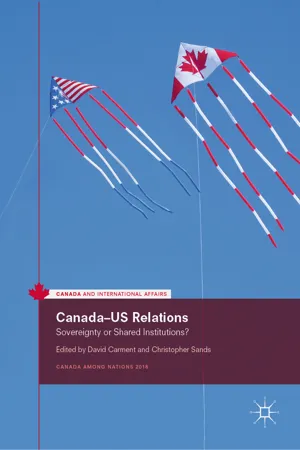
This book, the 32nd volume in the Canada Among Nations series, looks to the wide array of foreign policy challenges, choices and priorities that Canada confronts in relations with the US where the line between international and domestic affairs is increasingly blurred. In the context of the Canada-US relationship, this blurring is manifest as a cooperative effort by officials to manage aspects of the relationship in which bilateral institutional cooperation goes on largely unnoticed. Chapters in this volume focus on longstanding issues reflecting some degree of Canada-US coordination, if not integration, such as trade, the environment and energy. Other chapters focus on emerging issues such as drug policies, energy, corruption and immigration within the context of these institutional arrangements.
Information
© The Author(s) 2019
David Carment and Christopher Sands (eds.)Canada–US RelationsCanada and International Affairshttps://doi.org/10.1007/978-3-030-05036-8_11. Introduction
David Carment1 and Christopher Sands2
(1)
NPSIA, Carleton University, Ottawa, ON, Canada
(2)
Paul H. Nitze School of Advanced International Studies, Johns Hopkins University, Washington, DC, USA
With the results of the North American Free Trade Agreement (NAFTA) re-negotiations only now being made public, pundits and academics are asking what lies ahead for the Canada–US relationship. On September 30, 2018 it was revealed that NAFTA would undergo a name change to the United States, Mexico, and Canada Agreement (USMCA) reflecting, perhaps, a shift from free trade to managed trade in which the United States would play a primary role. Some observers have argued that President Donald Trump got the better of the deal and yet arranged it so all three countries could declare victory (Ivison 2018). Indeed, the substance of the agreement indicates that both Canada and Mexico made a number of significant concessions to the United States. In the words of Larry Kudlow, Trump’s economics adviser: “Canada gave very graciously” (Ivison 2018).
In reality, Trump used the power of tariffs to bring Canada and Mexico in line. Very early on in the negotiations Trump made clear his intent to bring investment back to the United States and, in the end, managed to do exactly that. Some may call that behavior bullying, while others may interpret it as part of Donald Trump’s “America first” strategy. Certainly, with respect to the now all important clause regarding future Canadian trade negotiations with China, it would seem that the United States has imposed on its North American partners a degree of veto power that heretofore never existed. To wit: “entry by any party into a free trade agreement with a non-market country shall allow the other parties to terminate this agreement”. The “America first” strategy holds.1
For Canada the alternative to accepting these terms was rather bleak; namely no deal at all. That is why it was essential that Canadian negotiators convince their American counterparts to retain NAFTA’s all-important Chapter 19 dispute resolution mechanism. American negotiators pushed Canada to have trade disputes resolved through US courts, an alternative that would be tantamount to surrendering sovereignty to a foreign power. Beyond the increases in dairy imports from the United States, an agreement to coordinate foreign exchange policy, higher wages for auto workers, and caps on auto imports, not much was changed in this agreement relative to the old NAFTA. Certainly, the deal was not what Canada’s negotiators had hoped for. Canada had to fight very hard to maintain the status quo in a very difficult three-way negotiation. There was limited success, for example, in engaging the United States on Canada’s progressive trade agenda, labor mobility and big pharma. More importantly, Trump’s all-important tariffs on aluminum and steel remain, a bargaining chip the United States holds in reserve for future considerations.
With the frantic and often contentious trade negotiations concluded it might be reasonable to ask if the relationship between the two countries will ever be the same. There are good reasons to be optimistic. To understand why that is so we must consider the depth of the relationship. When we think of the “deep state” we imagine a country run by narrow and private interests outside the realms of accountability and transparency; a state captured by unelected secretive powers whose actions run parallel to and often in contradiction to the public good and the policies of democratically elected leaders. Few if any would characterize the Canada–US relationship as functioning like a “deep state”; the two countries are not formally integrated into a common political entity like the European Union (EU) and they both sustain distinct foreign, defense, immigration, and security policies.
And yet in so many important ways, the Canada–US relationship is marked by higher levels of institutionalization than is commonly understood. That is because these institutions are not often examined together as a whole but in isolation, as individual pieces of a larger process of increasing interdependence, whether that interdependence exists at the para-diplomacy level through provincial and state relations, through private actor arrangements, or through federal government cooperation.
Shared or bilateral institutions serve an important function in the conduct of Canada–US relations. Each reifies a political agreement to cooperate made by a US president and a Canadian prime minister. As US presidents, and the executive branch they lead, have become more important in the system of United States governance, and as the United States has become a global power with interests around the world, the US chief executive has had to triage engagement in issues in order to focus on urgent priorities. Institutions permit US presidents to “fix it and forget it.” When an issue in the bilateral relationship with Canada becomes urgent; public service professionals then take over day-to-day management of the file and can develop subject matter expertise and familiarity with Canadian government policy and priorities that facilitate cooperation. For Canadian prime ministers, the US presidential authority embodied in these shared institutions provides a politically valuable imprimatur that ensures the cooperation and engagement of US officials, whether political appointees or career professionals in US agencies and departments.
Though the mandates of these institutions vary considerably across different policy domains and in terms of their formality, capacities, and capabilities, the scope and pace of institutionalization between the United States and Canada are profound. Some of these institutions have been long-standing arrangements and are highly formalized such as the near century-old International Joint Commission (IJC), North Atlantic Treaty Organisation (NATO), and The North American Aerospace Defense Command (NORAD), while others, more recent, focus on managing the impacts and benefits of more closely integrated economies such as USMCA and the North American Development Bank (NADBank) and the challenges of shared security threats such as the Arctic Council among others.
Several institutional arrangements have generated outcomes that make the Canada–US relationship unique. For example, our energy market remains distinct (and partially protected) from global energy trends because of shared resource exploitation, cross-border investments, and concerns regarding climate change and environmental degradation. At the same time, barriers to trade and investment have all been but removed save for a few “ring-fenced” sectors such as health, agriculture, telecoms, and airlines. In particular, intelligence sharing as it effects defense and security policy, has become highly institutionalized especially with respect to border security and the monitoring of individuals “of interest.”
It is important to note that the United States and Canada have established institutions with varying degrees of formal structure. NORAD and the IJC, for example, are formalized by treaty. Bilateral cooperation in border security management and regulatory practice is conducted under the aegis of executive agreements. And, as Douglas North has observed, there are “soft institutional” understandings emanating from formal agreements like USMCA that assume decision-making by private citizens and firms and can be consequential even when not spelled out: for example, the structuration of continental supply chains is based on the informal understanding that continental production is a goal of USMCA even though the term “supply chain” never appears in the text.
If there is cause for concern regarding the increasingly institutionalized relationship between the two countries, one need look no further than the UK’s convoluted and poorly managed departure from EU membership in which a principal fear among British voters was the lack of accountability and transparency they believed was embedded in EU membership. Simply put, Brexit voters believed decisions affecting the future of UK citizens were being made by unelected technocrats.
Yet in contrast with European institutions, the shared institutions designed by Canada and the United States are intended to remain accountable to sovereign governments, and therefore are, to some degree, democratically accountable. These shared institutions have, thus far, escaped scrutiny over “democratic deficits” and illegitimacy. They do, however, remain vulnerable to political reconsideration or revision by subsequent US administrations and Canadian governments. For example, the USMCA may well portend the future of such political predilections given that it is susceptible to trilateral review in 16 years. In contrast, the more obscure an area of policy, such as human health standards for safe use of pesticides, the more stable institutionalized cooperation becomes.
For political leaders in both countries, there is the dilemma of supporting such institutions while adapting them based on their own electoral mandates. The asymmetries of mutual significance and governmental capability between the United States and Canada place more political pressure on Ottawa to initiate change and to defend past institutions under normal circumstances. Yet the difficulty to securing US engagement and willingness to address an issue bilaterally, and to cement a response in an institution of some kind leads Canadian leaders to be cautious and to employ the formalization of agreement in shared institutions sparingly.
As the old adage goes, the only thing worse than being ignored by the United States is to have the attention of the United States. What makes this period in the Canada–US relationship remarkable is that it is the United States that has called into question the central shared institution in the bilateral relationship: NAFTA. US President Donald Trump was not simply demanding changes to the institutionalized commitment to liberalized trade out of a misunderstanding of the reasons and purposes behind this shared institution. He went so far as to claim that NAFTA institutionalized a relationship between the two economies that was unfair to the United States. Stepping back from this institution, Trump is advancing an agenda that reinforces national sovereignty, the alternative pole in the historical management of the relationship.
Representing the smaller partner, Canadian governments have traditionally asserted Canadian sovereignty in order to resist shared institutions with the United States. The right of Canada to choose, to decide for itself, was claimed against orders from London during imperial times, and is deeply ingrained in Canadian diplomacy. And Canadian sovereignty is expressed not only as the right of independent decision or action. It is also a version of the American idea of popular sovereignty, with public consent held out as the proper means of legitimizing decisions to surrender sovereignty. Thus, Prime Minister Brian Mulroney called an election in 1988 to “let the people decide” whether to enter into the Canada–US Free Trade Agreement.
In 2016, Donald Trump campaigned on distrust of the elite consensus that had existed in Washington, DC in support of trade liberalization and military defense of the world order with modest contributions from US allies. Trump’s election exposed significant differences between elite, or establishment policy, views and those of many Americans. Trump offered disillusioned Americans a better deal in a dangerous world and a globalizing economy, promising to renegotiate the terms of trade agreements and military alliances. Trump’s message was that US allies and trading partners had taken advantage of US goodwill and generosity at the cost of American jobs and the lives of American troops, and Trump proposed to address this with international policies that leveraged US political and economic power in ways that put “America first.” We can call this the new nationalism if you like, but in many ways it is a reaction; reasonable under the conditions of how democratically elected leaders behave—that puts domestic interests ahead of shared interests. It is a choice to place sovereignty ahead of shared institutions, or perhaps to leverage sovereignty against extant shared institutions to remake them. An obvious example is Donald Trump’s “Make America Great Again” slogan with its claims to strengthening the American economy by acting in a self-interested fashion.
Notwithstanding the Canada–Europe trade deal success story and the fact that Canada has proven capable of striking deals with small economies in emerging markets such as Colombia and Honduras, working with the Trump administration has proving to be a more daunting and unanticipated challenges. While Canada is historically dependent on trade with the United States and Europe, Canada’s multicultural population and its well-organized diaspora communities may well hold the key to Canadian prosperity. If Canada’s changing demography portends future policy choice, then surely there is merit in looking beyond North America.
But the demand for change is fuelled by more than these demographic considerations. By mid-century it’s estimated that Asia, led by China, along with Brazil and South Africa, will have a combined gross national product larger than the G8. The brief moment with the United States as the preeminent world power at the turn of the twentieth century, is now a multipolar system, dominated by rising giants that dwarf Canada militarily, economically, and politically.
To add uncertainty to the mix, Prime Minister Justin Trudeau’s ambitious multilateral agenda has been put on hold as his Foreign Minister, Chrystia Freeland, grappled with the American leader’s trade agenda. Trump who prefers to negotiate bilaterally because it more clearly exploits American leverage over weaker partners has proven to be both disruptive and catalyzing; implicitly cajoling Trudeau and Freeland to reluctantly and hesitantly, embrace change. If there is discomfort in that, it comes largely from the stark choices Canadians must confront in reacting to Trump’s policies.
A case in point is the flooding of the St Lawrence Seaway in 2017, which should have been jointly managed but was interpreted in vastly different ways by representatives from both countries. The net result was conflict between leaders on each side of the border, acting on electoral interests with a more narrow mandate (e.g. property loss and commensurate compensation as seen from the American perspective) vs support for Seaway management with a focus on the public good including environmental protection (as interpreted by Canadian bureaucrats). In much the same way we are now witnessing a battle between leaders whose interests they say are democratic (protection of jobs) versus an institution focused on economic growth (with clearly defined sectoral winners and losers) namely USMCA.
A second concern, more so for the Liberal government than the American administration, is the need to uphold global and regional institutional arrangements for fear that in their absence, Canada would be subject to even greater levels of transactional negotiation and linkage politics. In essence, institutions act as a buffer to ensure continuity and heighten expectations for the purposes of creating a more stable and predictable policy environment. Absent such institutions and it becomes clear how the more influential and powerful can disrupt the global agenda, shift the policy focus and undermine institutional credibility.
In many ways, the need to uphold international institutions is a long-standing Canadian interest. But the dilemma for Canada is that by strengthening and deepening the bilateral relationship Canada’s leaders are trading multilateralism for bilateralism Historically, Canadian foreign policy has balanced multilateralism (e.g., the British Empire, the United Nations, and other fora) against the constricting embrace of bilateral ties to the United States. Indeed Canada has often preferred to offset American influence through a multilateral agenda with its emphasis on the establishment and enforcement of collective rules guiding state behavior. It is through multilateralism and membership in various organizations that Canada has typically addressed questions of peace and security through the rule of law economic prosperity and competitiveness in trade and investment, as well as national unity and Canadian sovereignty.
And yet, unlike countries such as Norway or Sweden, Canada is not a natural multilateral player. It has had to work very hard to support a multilateral agenda because of ever-increasing continentalist pulls. Today that commitment to a global multilateral agenda that includes free trade and global peace and security is cast in doubt. For example, when the Trump administration agenda negated the TPP, a deal that would have provided access to 40% of the global economy Canadian leaders were at a loss on how to move on without the United States. Both TPP and CETA were supposed to be the salvation that would rescue Canada from dependence on US markets (Carment and Landry 2017).
But the criticism of both deals has been extensive. From the left, we hear primarily of environmental and labor rights concerns, along with worries over investor-state dispute settlement mechanisms creating undue power for corporations to legally challenge a sovereign nation. From the right (and some on the left), we hear of wage stagnation and the loss of manufacturing and natural resource industry jobs. Both sides worry about the detrimental effects of rising inequality, exacerbated by exporting low-skilled jobs overseas. At the same time, the US obsession with security detracts from our own leaders’ capacity to achieve economic growth through immigration, for example (Carment and Landry 2017).2
Finally, we come to the issue of whether the United States is withdrawing from its multilateral role of primus inter pares, abandoning the rules-based liberal international system it established post-WWII. By becoming more inward-looking the United States may be dragging Canada along with it. The pursuit of bilateral free trade arrangements is but one example of a potential weakening in the World Trade Organization (WTO) structure. Other examples include a perceived deterioration of the UN system, including the International Monetary Fund (IMF) and World Bank and the United Nations Security Council (UNSC) undermined by constant abuse by regional and global powers.
These points regarding the evolutionary if not revolutionary state of Canada–US relations are at the core of this year’s Canada Among Nations. Contributors to this year’s edition were asked to assess the current status of Canada–US policy cooperation and the implications for both Canadi...
Table of contents
- Cover
- Front Matter
- 1. Introduction
- Part I. Debates
- Part II. Principal Domains of the Relationship
- Part III. Emerging Issues in the Relationship
Trusted by 375,005 students
Access to over 1.5 million titles for a fair monthly price.
Study more efficiently using our study tools.
Frequently asked questions
Yes, you can cancel anytime from the Subscription tab in your account settings on the Perlego website. Your subscription will stay active until the end of your current billing period. Learn how to cancel your subscription
No, books cannot be downloaded as external files, such as PDFs, for use outside of Perlego. However, you can download books within the Perlego app for offline reading on mobile or tablet. Learn how to download books offline
Perlego offers two plans: Essential and Complete
- Essential is ideal for learners and professionals who enjoy exploring a wide range of subjects. Access the Essential Library with 800,000+ trusted titles and best-sellers across business, personal growth, and the humanities. Includes unlimited reading time and Standard Read Aloud voice.
- Complete: Perfect for advanced learners and researchers needing full, unrestricted access. Unlock 1.5M+ books across hundreds of subjects, including academic and specialized titles. The Complete Plan also includes advanced features like Premium Read Aloud and Research Assistant.
We are an online textbook subscription service, where you can get access to an entire online library for less than the price of a single book per month. With over 1.5 million books across 990+ topics, we’ve got you covered! Learn about our mission
Look out for the read-aloud symbol on your next book to see if you can listen to it. The read-aloud tool reads text aloud for you, highlighting the text as it is being read. You can pause it, speed it up and slow it down. Learn more about Read Aloud
Yes! You can use the Perlego app on both iOS and Android devices to read anytime, anywhere — even offline. Perfect for commutes or when you’re on the go.
Please note we cannot support devices running on iOS 13 and Android 7 or earlier. Learn more about using the app
Please note we cannot support devices running on iOS 13 and Android 7 or earlier. Learn more about using the app
Yes, you can access Canada–US Relations by David Carment, Christopher Sands, David Carment,Christopher Sands in PDF and/or ePUB format, as well as other popular books in Politics & International Relations & American Government. We have over 1.5 million books available in our catalogue for you to explore.