eBook - ePub
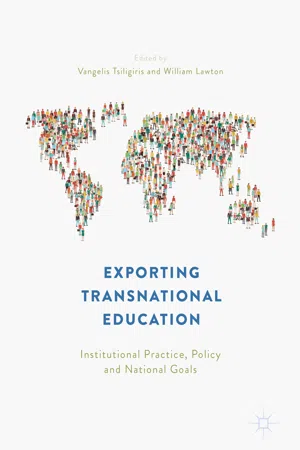
Exporting Transnational Education
Institutional Practice, Policy and National Goals
- English
- ePUB (mobile friendly)
- Available on iOS & Android
eBook - ePub
Exporting Transnational Education
Institutional Practice, Policy and National Goals
About this book
This book focuses on the dynamic and rapidly expanding field of transnational higher education (TNE). Despite the increasing importance of TNE and the interest it has attracted from various stakeholders, there is a lack of theoretical and empirical evidence on several aspects pertaining to its operation and governance. This book provides a unique combination of contributions from researchers and practitioners in a wide variety of case studies from TNE exporting countries in Europe and Asia. In doing so, the editors, with added support from Dr Christopher Hill, examine how this gap between research and practice can be bridged. This valuable edited collection will be of use to researchers and practitioners in transnational education, as well as students and scholars of international education and higher education policy.
Information
Topic
EducationSubtopic
Comparative Education© The Author(s) 2018
Vangelis Tsiligiris and William Lawton (eds.)Exporting Transnational Educationhttps://doi.org/10.1007/978-3-319-74739-2_11. TNE 2.0: Informing Practice Through Research
Vangelis Tsiligiris1 and William Lawton2
(1)
Nottingham Trent University, Nottingham, UK
(2)
Higher Education Consultant, London, UK
William Lawton
Keywords
Research in transnational educationFuture trends in higher educationInternationalisationGlobal higher educationThe idea for this book emerged during planning for a research symposium titled Bridging the gap: Research and practice in transnational education, which was the inaugural event of the TNE-Hub in June 2016. The TNE-Hub is a community of researchers and practitioners in transnational education (TNE) created in an effort to bring together those of who work, research, and have a wider interest in the area of TNE.
Over the past 20 or so years, there have been significant developments in the field of TNE. This does not refer only to the organic growth of TNE (e.g. number of students enrolled) but also to the range of TNE delivery arrangements and the countries involved. The major exporting countries are still the UK, Australia, the USA , Germany, and the Netherlands, while the main importing countries are China, Malaysia, Singapore, Hong Kong, and many others. However, in recent years we have witnessed a disruption to this taxonomy of TNE importing and exporting countries. For example, countries like India and China have started exporting their higher education (HE) programmes to other countries through international branch campuses . This trend, of TNE being offered by non-western institutions, will continue to grow as economic activity and demographic trends shift in favour of non-western countries.
The rise of new players in the global higher education market has accelerated the negative impact in the flow of international students, a process which is further worsened by the rise of protectionist policies at national level (e.g. the UK) aiming to reduce the number of international students. Overall, TNE has become a central mode of international higher education, allowing access to higher education for hundreds of thousands of students, in most countries around the world, while at the same time, competition in the global TNE market is intensifying.
Despite this significant growth and the fundamental challenges faced by higher education institutions (HEIs) and national governments, TNE continues to be sidelined as a subject for research and scholarly activity. Often, we refer to TNE researchers as “lone wolfs” who struggle to find support and resources within their academic departments for their TNE research. As result, TNE researchers find themselves in a situation where, while they strive to conduct research in such a dynamic field, they have to work in isolation, thus missing out vital opportunities for collaboration.
At the same time, following a range of developments in exporting countries (e.g. Brexit in the UK) and importing countries (e.g. HE capacity development in Southeast Asia), TNE has been under the spotlight of governments and HEIs. Thus, TNE has been identified as a cure for all ills by several HEIs and government bodies that belatedly discovered it.
However, despite the recent hype in TNE, there is still an absence of systematic market research and accurate data—a well-known and persistent problem of TNE. This is partly caused by the disregard of TNE as an area of HE strategy and policy that deserves its own space in the research agenda of HEIs and government bodies.
This lack of systematic research and accurate data creates a range of challenges for those who engage in TNE activities. Intense competition—now emerging from non-traditional TNE exporting, and previously importing, countries such as China and India—requires careful planning and swift implementation of TNE projects. This requires comprehensive market analysis, use of accurate data, and careful evaluation of institutional resources before embarking on any TNE project. Additionally, TNE activities vary in resource requirements, timescale, risk, and institutional strategic commitment. As such, TNE should be carefully considered in the context of the institutional capabilities and wider strategic aspirations. However, the reality is that TNE projects continue to be a result of individual initiatives, usually emerging as result of personal connections of academics, administrators, and researchers. As result, TNE projects often lack the necessary strategic alignment with the institutional wider strategic objectives, which then affects their success and sustainability.
By providing a selection of chapters on different areas of TNE (strategy, quality, organisational culture, and student experience), this book aims to capture some valuable “lessons learnt” that can be useful to TNE practitioners and researchers. For practitioners, we believe that there is the need to use an evidence-based approach to plan and manage sustainable TNE projects. Using research and experiential evidence is the best way to manage risk and avoid failure in TNE activities.
This evidence-based approach should be supported by those who conduct research in TNE. Considering that TNE is primarily a business and policy-related activity and less of a theoretical field, TNE researchers should aim to highlight the practical applications of their research findings in a way that supports the evidence-based approach required to plan and manage sustainable TNE projects. As such we believe that research and practice in TNE should be considered as inseparable, and the chapters of this book aim to present how this might look like.
We have had the privilege to work with a superb group of authors who represent a diverse set of roles within the wider TNE world. The diversity of our authors’ background allows to provide valuable inputs from a range of different areas and perspectives, which is a key strength of this book.
This book is organised in four parts: (A) models and strategic considerations; (B) organisational culture ; (C) managing quality; and (D) student experience.
Part A starts with Chap. 2 where Stephan Geifes and Sussane Kammükker, from DAAD in Germany, outline the recent developments of German TNE and explain the fundamental differences it has in comparison to UK and Australian TNE. This chapter provides a valuable and rich source of information to the German TNE model which, as the authors explain, is a result of a national strategy aiming to strengthen the internationalisation of German HE and to boost regional and bilateral cooperation of a wider scale.
In Chap. 3, Rosa Becker from EP-Nuffic writes about the TNE policy evolution in the Netherlands in the recent years. TNE in the Netherlands is a rather dynamic area which has been at the centre of the HE policy debate. It is indicative of the dynamic nature of TNE in the Netherlands that the author has been updating this chapter until the last minute before the book manuscript submission.
Part A concludes with Chap. 4, where Ofelia Palermo and Angelo Bisigiano from Nottingham Business School and Simon Mercado from ESCP London share their experience on designing and managing dual degree programmes. Considering the increasing popularity of dual degree programmes—especially amongst traditional HEIs that have been reluctant to embark on TNE activities—this chapter provides a valuable insight on how to build and manage sustainable arrangements of this type.
Part B begins with Chap. 5 where Albina Szeles from Coventry University explains how the Online International Learning (OIL) model is used as a tool for connecting domestic and TNE students and empowering them to become global graduates. Also, this chapter unpacks the concept of intercultural competence as an integral part of internationalisation process for all students.
In Chap. 6, Vicky Lewis, founder of Vicky Lewis Consulting, reports the findings from an interview-based study of international branch campus (IBC) marketing. The study provides insights on the challenges and potential solutions at each stage of the IBC development process. Specifically, this chapter explains how differences in organisational culture , stage of development, and operating context must be recognised in order to optimise relationships and outcomes in an IBC context.
Part C consists of two chapters providing alternative viewpoints on TNE quality management. In Chap. 7, Christopher Hill, from the British University in Dubai, presents that the challenges and opportunities of creating an international research degree programme. The author employs a case study approach using the Malaysia Nottingham Doctoral Programme —a dual PhD programme between Nottingham UK and nine public Malaysian universities. In his chapter, Christopher Hill outlines the value and rationale of partnership programmes and discusses the lessons learned throughout the initial and development stages. This chapter provides insight into key factors to consider and explores the opportunities for institutional growth and development as a result of external activity.
In Chap. 8, Fabrizio Trifiro’, from the UK Quality Assurance Agency (QAA), analyses the Agency’s approach to TNE, focusing specifically on its strategies to strengthen cooperation with host countries’ quality assurance agencies to ensure the efficiency and effectiveness of its oversight of UK TNE. This chapter emphasises the importance for quality assurance agencies to engage with governments, cross-border providers, and TNE students to develop international approaches that are capable of fully harnessing the benefits of TNE for societies while avoiding regulatory gaps and overlaps.
The fourth and final part of this book contains three chapters on TNE student experience. Part D begins with Chap. 9 where David Cockayne, from the University of Liverpool, and Heather Cockayne, from the University of Manchester’s Institute of Education, explore the nature of teaching innovation in TNE. Rather than seeing innovation as stimulated by management, the authors utilise a practice-based approach and argue that teaching innovation is derived from the day-to-d...
Table of contents
- Cover
- Front Matter
- 1. TNE 2.0: Informing Practice Through Research
- Part I. Models and Strategic Considerations
- Part II. Organisational Culture
- Part III. Managing Quality
- Part IV. Student Experience
- Back Matter
Trusted by 375,005 students
Access to over 1.5 million titles for a fair monthly price.
Study more efficiently using our study tools.
Frequently asked questions
Yes, you can cancel anytime from the Subscription tab in your account settings on the Perlego website. Your subscription will stay active until the end of your current billing period. Learn how to cancel your subscription
No, books cannot be downloaded as external files, such as PDFs, for use outside of Perlego. However, you can download books within the Perlego app for offline reading on mobile or tablet. Learn how to download books offline
Perlego offers two plans: Essential and Complete
- Essential is ideal for learners and professionals who enjoy exploring a wide range of subjects. Access the Essential Library with 800,000+ trusted titles and best-sellers across business, personal growth, and the humanities. Includes unlimited reading time and Standard Read Aloud voice.
- Complete: Perfect for advanced learners and researchers needing full, unrestricted access. Unlock 1.5M+ books across hundreds of subjects, including academic and specialized titles. The Complete Plan also includes advanced features like Premium Read Aloud and Research Assistant.
We are an online textbook subscription service, where you can get access to an entire online library for less than the price of a single book per month. With over 1.5 million books across 990+ topics, we’ve got you covered! Learn about our mission
Look out for the read-aloud symbol on your next book to see if you can listen to it. The read-aloud tool reads text aloud for you, highlighting the text as it is being read. You can pause it, speed it up and slow it down. Learn more about Read Aloud
Yes! You can use the Perlego app on both iOS and Android devices to read anytime, anywhere — even offline. Perfect for commutes or when you’re on the go.
Please note we cannot support devices running on iOS 13 and Android 7 or earlier. Learn more about using the app
Please note we cannot support devices running on iOS 13 and Android 7 or earlier. Learn more about using the app
Yes, you can access Exporting Transnational Education by Vangelis Tsiligiris, William Lawton, Vangelis Tsiligiris,William Lawton in PDF and/or ePUB format, as well as other popular books in Education & Comparative Education. We have over 1.5 million books available in our catalogue for you to explore.