This book proposes an interdisciplinary, multicultural and contemporary approach to examining the controversial links between migration and crime. It includes empirical research on migrants and crime to explore the risk and realities of crime and migration, as well as how mass media in different regions of the world has covered violent acts that have involved migrants (as victims or aggressors). The chapters are written by authors from various countries including the UK, Turkey, Slovenia, Iraq, Albania, Chile, the Republic of Moldavia, and Romania, and from different fields of research including: criminology, sociology, political sciences and communication. They bring to light new ideas, new methodologies and results that could be taken and developed further. This volume allows readers to explore the impact of migration on crime.
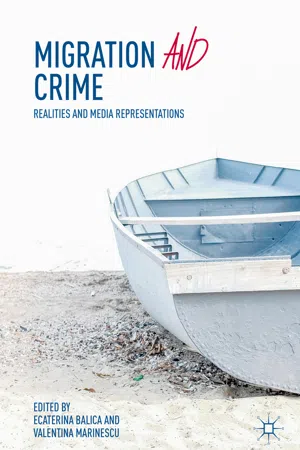
eBook - ePub
Migration and Crime
Realities and Media Representations
- English
- ePUB (mobile friendly)
- Available on iOS & Android
eBook - ePub
Migration and Crime
Realities and Media Representations
About this book
Information
© The Author(s) 2018
Ecaterina Balica and Valentina Marinescu (eds.)Migration and Crimehttps://doi.org/10.1007/978-3-319-95813-2_11. Human Trafficking and Labor Exploitation of Migrants
Heidi Stöckl1
(1)
Department of Global Health and Development, London School of Hygiene and Tropical Medicine, London, UK
Keywords
Human traffickingLabour exploitationMigrantsAbuseToday, human trafficking is one of the most profitable international crimes , after the trafficking of drugs and weapons (Limanowska 2002). Human trafficking affects nearly every country in the world, as countries of origin, transit or destination, or as internal trafficking.
1.1 Definition of Human Trafficking
The United Nations Protocol to Prevent, Suppress, and Punish Trafficking in persons, especially women and children, supplementing the United Nations Convention Against Transnational Organized Crime, Article 3 (a-d), G.A. res. 55/25, annex II, 55 U.N. GAOR Supp. (No. 49) at 60, U.N. Doc. A/45/49 (Vol. I) defines human trafficking as:
The recruitment, transportation, transfer, harbouring or receipt of persons by means of threat or use of force or other forms of coercion, of abduction, of fraud, of deception, of the abuse of power, or of a position of vulnerability or of the giving or receiving of payments or benefits to achieve the consent of a person having control over another person, for the purpose of exploitation. Exploitation shall include, at minimum, the exploitation of prostitution of others or other forms of sexual exploitation, forced labour or services, slavery or practices similar to slavery, servitude or the removal of organs.
Due to the illegal nature of human trafficking, the level of substantiated information on it is very low, and few reliable statistics exist. There are few analytical studies. Existing research either tackles the problem from a theoretical standpoint (Aronowitz 2004; Doezema 2002) or focuses on a single country or region (Baicherikov and Nishanov 2000; Limanowska 2002); connections between the countries of origin, transit and destination in human trafficking are seldom researched. There also are a variety of interpretations of its definition; for example, human trafficking is often thought to be identical with migration into sex work (McDonald 2004; Miriam 2005), a view which is opposed to groups who accredit trafficked women the agency of choosing sex work out of free will and therefore strongly distinguish between migration into sex work and forced prostitution (Chapkis 2003; Jordan 2002). Additionally, there is a lack of clarity regarding the separation between migrants in exploitative circumstances and human trafficking – how much exploitation does there need to be before it is defined as human trafficking or labor exploitation?
The line between human trafficking and smuggling is slightly clearer: smuggling is a crime against a country’s border, involving transportation and illegal border-crossing; human trafficking is a crime against a person, involving forced labor or commercial sex acts; transportation can play a role but is not required, and where there is smuggling, debt can be used as a means of initial control (Polaris Project n.d.).
Human trafficking is now acknowledged as not only the sex trafficking of women but also that the trafficking of women, men and children into diverse industries, such as construction, manufacturing, industrialized fishing, agriculture, domestic service, mining, food processing and forestry.
1.2 Push and Pull Factors of Human Trafficking
Most studies on human trafficking use the “push and pull factor” framework to explain migration and to outline the reasons for human trafficking. The origins of the framework can be found in the work of Peterson (1958) and Lee (1966). Peterson’s main contribution was to make it clear that to fully understand push and pull factors, one needs to distinguish between migrants’ motives and aspirations and social causes. Economic hardship in a nation alone cannot explain migration; one must take into account people’s individual reasons – personal lack of opportunity and material improvement that migration might bring (Petersen 1958). Lee refined Peterson’s model by noting that intervening obstacles also need to be taken into account, since they might deter people from migrating, despite the existence of personal reasons and convincing push and pull factors (Lee 1966). Examples of intervening obstacles include geographical distance, physical barriers and restrictive migration laws. Lee also elaborated on the impact of personal reasons on push and pull factors. Some push factors might drive some people but be irrelevant or perceived differently by others. Personal characteristics and aspirations, which depend on a person’s sensitivity and awareness of conditions elsewhere, are also not fixed and may change over the life-course (Lee 1966). One can therefore only classify a few factors for migration which seem of general importance for most people (Lee 1966). The factors or circumstances that “push” a woman out of her country, and the factors that “pull” people towards another country are believed to be the root causes of human trafficking.
Frequently cited push factors are bad socioeconomic conditions, such as high unemployment, underemployment, low income, lack of educational opportunities and bad healthcare systems. The feminization of poverty forces women to take higher risks to support themselves and their family. Gender-specific discrimination may play a huge role in this respect if it restricts women’s access to employment and resources, reduces their legal rights and results in a diminished status in family and society. Violence against women in the family is another push factor leading women to consider migration (Nikolic-Ristanovic 2002), as is corruption. Corruption is often the reason why women cannot access education, employment or social services. Furthermore, corruption helps women to bypass immigration laws through the help of their traffickers and to cross borders by paying a bribe or by obtaining essential legal documents (Pearson 2001; Tavcer 2007).
The most important pull factor is the myth of the rich West, especially potent in former communist countries that are geographically distant from the West (Nikolic-Ristanovic 2002). The prospect of increased opportunities for work, higher income and a better quality of life tempt women to try their luck away from home. For middle-class women, migration is perceived as a chance to experience life outside the boundaries of their family, to find new economic opportunities, to fulfil themselves and to broaden their horizons (Gülçür and İlkkaracan 2002). Many destination countries also have a high demand for foreign women in their sex and entertainment industry since local women cannot or will not satisfy the market demand (Kelly 2004).
The push and pull factor framework has only limited capacity to explain human trafficking: it cannot explain internal trafficking well and it does not take account of the involvement of criminal networks or the deception and force that many trafficked persons endure.
1.3 Health
The health effects of human trafficking have largely been neglected, despite the growing number of reports on abuse that occurs during the process. What evidence there is most often based on the health effects on women victims of sex trafficking between Europe and South Asia (Oram et al. 2012). The review by Oram and colleagues found that women and girls trafficked for sexual exploitation experienced high levels of physical and sexual violence and displayed a high prevalence of physical, mental and sexual health problems The most commonly reported health symptoms were headache, back pain, stomach pain and memory problems. A number of studies found symptoms of posttraumatic stress disorder (PTSD) to be quite common, with one study reporting that depression and PTSD were diagnosed among 16.7 percent and 35.8 percent of trafficked women who had returned to their country of origin. There seem to be indications that the longer the duration the experience of human trafficking the higher are the levels of victims’ mental distress. The studies included in Oram and colleagues’ review suggest that trafficked women are at increased risk of violence during or shortly after entering into sex work (Oram et al. 2012).
This key review exposed the lack of evidence on the health outcomes of the trafficking of men, and boys and all those trafficked into other sectors of exploitation, such as construction, manufacturing, industrialized fishing, agriculture, domestic service, mining, food processing and forestry (Oram et al. 2012). Human trafficking and labor exploitation in these industries carries a high risk of health damage, such as accidents and injuries, violence, abusive working and living conditions, extensive hours with few breaks, lack of adequate training in a language that victims’ understand, and lack of personal protective equipment.
The human trafficking process model developed by Zimmerman et al. (2003, 2006, 2008, 2011a, b) acknowledges that migration is a process of movement and considers human trafficking as a series of event-related stages during which various risks, including to health, may arise. These risks, that accumulate over time, include the compounding harm from multiple physical or psychological hazards. Their model divides human trafficking phases into the recruitment stage, travel, exploitative situations and reintegration and re-trafficking, each of which will be detailed in the following sections.
1.4 The Recruitment Stage
Recruitment is the stage when individuals are vulnerable to deceptive offers to migrate for work or, in rare cases, are abducted or tricked for the purposes of exploitation. Research across the world has shown that recruiters have a wide range of profiles – they may be individuals or agencies that offer travel or employment abroad, sometimes linked to professionally criminal or merely local, opportunistic, trafficking networks. In many cases, the recruiter is someone the trafficked person knows: a family member, a friend of the family, a neighbor or a community member. Even though it is not appropriate to speak of health outcomes at this stage, the health of individuals may play a role in the recruitment process as it might be linked to various personal characteristics or exposures related to a trafficked pe...
Table of contents
- Cover
- Front Matter
- 1. Human Trafficking and Labor Exploitation of Migrants
- 2. The Middle East Refugee Crisis. Syria and Iraq Case
- 3. Risk Factors of the Irregular Migratory Waves on the Western Balkan Route: Implications in the European Union Countries
- 4. The Securitization of East-European Migrants. The Occurrence of Liminal Identities in the European Union
- 5. Making the Headlines: EU Immigration to the UK and the Wave of New Racism After Brexit
- 6. Tales of Migration from the Global South. The Civilized and Uncivilized Migrant in the Narratives of La Tercera and El Mercurio
- 7. From Neglect to Crime – The Role of Media in the 2015 European Migration Crisis. A Comparative Study in Three ECE Countries: Romania, Hungary and Slovenia
- 8. Violence Against Refugees and the Turkish Mainstream Media
- 9. Victims or Aggresors? Framing Romanian Migrants and Crime in Two British Newspapers
- 10. Changing Images of Migrants and Crime in Romanian Mass Media
- 11. Online Media Representation of Moldovan Emigrants and Crimes
- 12. Prisoners’ Emigration Goals and Achievements Before and After Release
- Back Matter
Trusted by 375,005 students
Access to over 1.5 million titles for a fair monthly price.
Study more efficiently using our study tools.
Frequently asked questions
Yes, you can cancel anytime from the Subscription tab in your account settings on the Perlego website. Your subscription will stay active until the end of your current billing period. Learn how to cancel your subscription
No, books cannot be downloaded as external files, such as PDFs, for use outside of Perlego. However, you can download books within the Perlego app for offline reading on mobile or tablet. Learn how to download books offline
Perlego offers two plans: Essential and Complete
- Essential is ideal for learners and professionals who enjoy exploring a wide range of subjects. Access the Essential Library with 800,000+ trusted titles and best-sellers across business, personal growth, and the humanities. Includes unlimited reading time and Standard Read Aloud voice.
- Complete: Perfect for advanced learners and researchers needing full, unrestricted access. Unlock 1.5M+ books across hundreds of subjects, including academic and specialized titles. The Complete Plan also includes advanced features like Premium Read Aloud and Research Assistant.
We are an online textbook subscription service, where you can get access to an entire online library for less than the price of a single book per month. With over 1.5 million books across 990+ topics, we’ve got you covered! Learn about our mission
Look out for the read-aloud symbol on your next book to see if you can listen to it. The read-aloud tool reads text aloud for you, highlighting the text as it is being read. You can pause it, speed it up and slow it down. Learn more about Read Aloud
Yes! You can use the Perlego app on both iOS and Android devices to read anytime, anywhere — even offline. Perfect for commutes or when you’re on the go.
Please note we cannot support devices running on iOS 13 and Android 7 or earlier. Learn more about using the app
Please note we cannot support devices running on iOS 13 and Android 7 or earlier. Learn more about using the app
Yes, you can access Migration and Crime by Ecaterina Balica, Valentina Marinescu, Ecaterina Balica,Valentina Marinescu in PDF and/or ePUB format, as well as other popular books in Social Sciences & Criminology. We have over 1.5 million books available in our catalogue for you to explore.