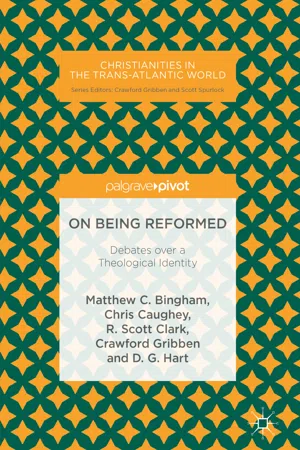
This book provides a focus for future discussion in one of the most important debates within historical theology within the protestant tradition - the debate about the definition of a category of analysis that operates over five centuries of religious faith and practice and in a globalising religion. In March 2009, TIME magazine listed 'the new Calvinism' as being among the 'ten ideas shaping the world.' In response to this revitalisation of reformation thought, R. Scott Clark and D. G. Hart have proposed a definition of 'Reformed' that excludes many of the theologians who have done most to promote this driver of global religious change. In this book, the Clark-Hart proposal becomes the focus of a debate. Matthew Bingham, Chris Caughey, and Crawford Gribben suggest a broader and (they argue) more historically responsible definition for 'Reformed,' as Hart and Scott respond to their arguments.
eBook - ePub
On Being Reformed
Debates over a Theological Identity
- English
- ePUB (mobile friendly)
- Available on iOS & Android
eBook - ePub
On Being Reformed
Debates over a Theological Identity
About this book
Information
Topic
StoriaSubtopic
Storiografia© The Author(s) 2018
Matthew C. Bingham, Chris Caughey, R. Scott Clark, Crawford Gribben and D. G. HartOn Being ReformedChristianities in the Trans-Atlantic Worldhttps://doi.org/10.1007/978-3-319-95192-8_11. History, Identity Politics, and the “Recovery of the Reformed Confession”
Chris Caughey1 and Crawford Gribben1
(1)
Queen’s University Belfast, Belfast, UK
Chris Caughey (Corresponding author)
Crawford Gribben
Abstract
Engaging with the arguments of Clark and Hart, this chapter explores the various ways in which some major Reformed confessions have changed over time. The authors ask whether it is possible for contemporary Protestants to be Reformed in the senses in which the sixteenth- and seventeenth-century ecclesiastical assemblies who drafted the original confessional documents—and the members of those churches—understood the term “Reformed.” The authors argue that if being Reformed in this way is not possible, then greater latitude ought to be extended to various contemporary groups which want to self-identify as Reformed.
Keywords
BaptistPresbyterianReformedPuritanismEarly modern BritainHistorical theologyIn March 2009, TIME magazine listed “the new Calvinism” as one of ten ideas “changing the world right now.”1 It was, in many ways, the most significant indicator of the success of the resurgence of Reformed theology that began with the first publications of the Banner of Truth in the late 1950s and has continued more recently among the very different demographic of the “young, restless and Reformed.”2 Fifty years ago, the Banner of Truth began republishing older classics in a marketplace in which Reformed theology seemed deeply unfashionable. But a number of books produced by the Trust encouraged readers to believe that the system of theology to which they had been attracted would one day be extraordinarily revived in popular appeal.3 The readers of the Trust’s first publication, Thomas Watson’s Body of Divinity (reprinted 1958), could hardly have expected that the movement they were in many respects beginning would five decades later feature on the front cover of TIME magazine. It has—but many traditionally minded Reformed Protestants are now wondering whether the “new Calvinism” attracting this unprecedented media interest is in fact the revival of the true religion they had been encouraged to expect. Their difficulty is that “Calvinism” has evolved as it has gone mainstream, and, as even its advocates admit, the “new Calvinism” is quite different from the old. D. G. Hart has recognized that “Calvinism’s original leaders” could not have “predicted or planned the outcome of their initial efforts to reform Europe’s churches.”4 For, as R. Scott Clark has noticed, “significant segments within the Reformed communion … define ‘Reformed’ in ways our forefathers would not understand.”5
The resurgence of Reformed theology, and the revolution it has precipitated within the leadership of the movement, has sparked a series of religious turf wars. A number of theologians have moved to defend more traditional articulations of orthodoxy, denying that the “new Calvinists” have the right to be identified as “Reformed.” The fact that the terms “Reformed” and “Calvinist” are historically loaded is part of the challenge of this debate.6 Some of those reacting have gone further, identifying themselves as the “truly” or “confessionally Reformed,” and attempting to police the boundaries of the “Reformed movement” to exclude from its ranks many of the most able and articulate defenders of Calvinistic soteriology, including John Piper, Mark Dever, and other members of such organizations as the Gospel Coalition. Their argument is simple—anyone who denies any element within the Reformed confessions cannot be regarded as “Reformed”—and it is directed most obviously against those Calvinists who are charismatics or who argue against the baptism of infants. So, these polemicists continue, the term “Reformed Baptist” is an oxymoron, however closely a baptistic believer may adhere to Calvin’s soteriological scheme or to an early modern theological symbol in which that soteriology might be embedded, such as the second London Baptist confession of faith (1677/1689). Noting that the “Calvinism” label denotes much more than soteriology, self-identified confessional conservatives have responded to the broader appropriation of “Reformed” identity with criticism and concern.
Part of the difficulty, of course, is that identity boundaries cannot effectively be policed. These charismatic or baptistic “Calvinists” are not the only Christians to insist that they share the “Reformed” identity with those who think it more properly their own. Even such “mixed” communions as the Christian Reformed Church, the Reformed Church in America, the Presbyterian Church in Ireland, the Church of Scotland, and the Presbyterian Church USA (PCUSA) claim to be Reformed. For example, a search of the term “Reformed” on the PCUSA website yields 1780 results (though some of these results use the term to refer to the process of change rather than to the theology of the Protestant Reformation).7 While their theological terminology is common, there is little doctrinal agreement between liberal or Barthian denominations and their broadly conservative “others”—whether the movement of the “young, restless and reformed,” or those historic or confessionally prescriptive Reformed and Presbyterian denominations, whose members critique the “young” and “restless.” Thus the descriptor “Reformed” has been drawn into a struggle related to broader concerns about religious identity politics in the contemporary United States. And yet the paradox of so much of this discussion is that many of those who are most vocal in denying the title of “Reformed” to the “young,” the “restless,” the “liberal,” and the “Barthian” are operating with a definition of “Reformed” that is itself both a-historical and geographically specific, and that may, consequently, beg the question of what “confessional” actually means. The “truly Reformed” require their “others” to measure themselves against the body of creeds produced during and immediately after the Reformation. But, as we will argue in this chapter, these standards may provide an unstable foundation for a contemporary “Reformed” identity, for these texts were first published as competing statements of faith, and some of them have been so radically revised as to now exist in multiple and contradictory versions, the most advanced of which move their modern subscribers into theological territories that their original subscribers would have regarded as “Anabaptist.” The “new Calvinism,” as its advocates admit, is quite different from the old—just as the old Calvinism differed from the much older Calvinism it also once replaced, and by which, for similar reasons, it might also have been rejected.
I
It is our contention that the recent attempt to recover “the Reformed confession” as part of the broader articulation and defense of “Calvinism” has been both necessary and problematic. The difficulty relates in part to trends in historiography, in which older models of confessionalization, which focused on German territories and were most famously expounded by Wolfgang Reinhard and Heinz Schilling, have given way to geographically broader and more troubled reconstructions of early modern religious change within “anti-papal Latin Christianity” that pay closer attention to the phenomenon of religious radicalism.8 Part of the difficulty, as Alec Ryrie has recently noted, is that Lutherans and the Reformed adopted very different attitudes to the confessions of faith that they published. While “Lutheranism in the age of orthodoxy was … precisely … a Confession, with its principal spiritual parameters defined at Augsburg in 1530 and its legal parameters at the same city in 1555,” there “was never a single Reformed confession of faith,” and attempts to create a “single, harmonised” confession always failed.9 This did not “prevent the Reformed family from recognising one another as brethren,” partly because “their confessions were understood to be limited, provisional documents, subject to revision and improvement,” with similar, though not identical, emphases.10 Calvinism, Ryrie has concluded, “should be seen not as a unified ‘confession’ in any strict sense, but as an ecumenical movement for Protestant unity,” which was “broad, discursive and dangerously soft-edged,” with a tendency to “leak into radicalism” in territories where Reformed ideas did not enjoy strong state support.11 For, as Willem van Asselt has similarly argued, “there was not one, but several trajectories” within early modern Reformed thought, “a whole series of Reformed theologies of the sixteenth and seventeenth centuries.”12 And so, he continues, the “Reformed tradition is to be examined on its own terms, and to be considered against the backdrop of its own historical and theological context,”13 for if we fail to remember the “variety and breadth of the later Reformed tradition,” we may not “do justice to historical phenomena.”14 Our definition of “Calvinism” should not reduce a complex and variegated phenomenon to a “kind of uniform and even ideological movement … to legitimize the present position of the historian or theologian.”15 For, as John Leith famously put it, the Reformed churches were “prolific in the production of creeds”—he refers to around 60 such examples—and these creeds “exhibit a variety that is the nemesis of all those who would write the theology of the Reformed confessions.”16
In this chapter, we argue that the recent attempt to “recover the Reformed confession” and its broader ecclesial significance has not paid sufficient attention to this historical reality, nor to its contemporary implications. One of the most common assumptions in the literature discussing the question of nomenclature is that “Reformed,” when it appears in the title of a congregation, denomination, or institution, has a stable meaning, which refers to an allegiance to that part of the Protestant tradition that traces its intellectual and spiritual origins to the theology of John Calvin, or, often more accurately, to a combination of his theology, anthropology, and soteriology with the ecclesiological experiments of John Knox and the advanced covenant theology and sometimes (but, controversially, not always) the experiential emphasis of seventeenth-century English and Dutch puritans. But this is not always the case: the “Reformed” descriptor does not always precisely refer to this body of knowledge. The United Societies of Scottish Covenanters that formed the Reformed Presbytery in 1743, for example, adopted the label “Reformed” not to indicate that their ministers were Calvinistic—this hardly being distinctive in the Scotland of the mid-eighteenth century—but to indicate that they were “re-forming” in the sense of re-establishing a national church for Scotland on the basis of a renewed commitment to the Solemn League and Covenant and other denominationally particular documents.17 This instance is a useful reminder that the “Reformed” tradition does allow for the use of this descriptor to indicate something other than a commitment to a specific set of early modern confessional texts.
Neither can “Reformed” be effectively defined in relation to the creeds and confessions of faith produced during the sixteenth and seventeenth centuries.18 First, despite the widespread use of the definite article, as Ryrie has noted, there is no single “Reformed confession.”19 It is true that any intertextual comparison of various Reformed confessions, such as that edited by Peter Hall in the mid-nineteenth century, will demonstrate a vast amount of agreement.20 There can be surprising omissions: the Scots Confession (1560), for example, does not refer to the doctrine of justification by faith alone. Agreement does exist on such loci as Holy Scripture, the Trinity, predestination, creation ex nihilo, original sin, atonement, justification, sanctification, the sacraments, and the civil magistrate. Yet, in early modernity, these similarities were not expressed in a single statement of faith: there were, and still are, many Reformed confessions, and in the sixteenth and seventeenth centuries these confessions to some extent competed with each other. When the divines in the Jerusalem Chamber abandoned their attempt to improve the 39 Articles, they did not simply adopt one of the better Continental alternatives, or even the Irish Articles (1615) that had provided the doctrinal basis for an earlier and more proximate Reformed church. Instead, the Westminster Confession of Faith (1647) which they published in some sense competed with the Three Forms of Unity (1619), encoding di...
Table of contents
- Cover
- Front Matter
- 1. History, Identity Politics, and the “Recovery of the Reformed Confession”
- 2. “Reformed Baptist”: Anachronistic Oxymoron or Useful Signpost?
- 3. Baptists Are Different
- 4. A House of Cards? A Response to Bingham, Gribben, and Caughey
- Back Matter
Trusted by 375,005 students
Access to over 1.5 million titles for a fair monthly price.
Study more efficiently using our study tools.
Frequently asked questions
Yes, you can cancel anytime from the Subscription tab in your account settings on the Perlego website. Your subscription will stay active until the end of your current billing period. Learn how to cancel your subscription
No, books cannot be downloaded as external files, such as PDFs, for use outside of Perlego. However, you can download books within the Perlego app for offline reading on mobile or tablet. Learn how to download books offline
Perlego offers two plans: Essential and Complete
- Essential is ideal for learners and professionals who enjoy exploring a wide range of subjects. Access the Essential Library with 800,000+ trusted titles and best-sellers across business, personal growth, and the humanities. Includes unlimited reading time and Standard Read Aloud voice.
- Complete: Perfect for advanced learners and researchers needing full, unrestricted access. Unlock 1.5M+ books across hundreds of subjects, including academic and specialized titles. The Complete Plan also includes advanced features like Premium Read Aloud and Research Assistant.
We are an online textbook subscription service, where you can get access to an entire online library for less than the price of a single book per month. With over 1.5 million books across 990+ topics, we’ve got you covered! Learn about our mission
Look out for the read-aloud symbol on your next book to see if you can listen to it. The read-aloud tool reads text aloud for you, highlighting the text as it is being read. You can pause it, speed it up and slow it down. Learn more about Read Aloud
Yes! You can use the Perlego app on both iOS and Android devices to read anytime, anywhere — even offline. Perfect for commutes or when you’re on the go.
Please note we cannot support devices running on iOS 13 and Android 7 or earlier. Learn more about using the app
Please note we cannot support devices running on iOS 13 and Android 7 or earlier. Learn more about using the app
Yes, you can access On Being Reformed by Matthew C. Bingham,Chris Caughey,R. Scott Clark,Crawford Gribben,D. G. Hart in PDF and/or ePUB format, as well as other popular books in Storia & Storiografia. We have over 1.5 million books available in our catalogue for you to explore.