Employing a three-dimensional approach, this book discusses inclusive innovation for socio-economic growth and development, and the implications for human security within the context of developing and emerging economies. Focusing on a new and innovative area of research, Inclusive Innovation for Sustainable Development explores new social and technological processes that are created within, and for the benefit of, marginalised populations. Considering policy and issues surrounding technology, business strategies and best practices, theoretical underpinnings and a broader contextualisation, the authors interrogate the concept of the inclusivity of innovations. Written from the perspective of the new UN paradigm which states that "no one will be left behind", the book considers the potential contribution of modern technology to human security and develops frameworks that counter the potential increases in inequality that this may bring. With contributions from leading international scholars in a range of disciplines, as well as practitioners in international development organizations and private sector actors Inclusive Innovation for Sustainable Development provides a way forward for excluded majority populations to take control of innovative technologies and business processes.
eBook - ePub
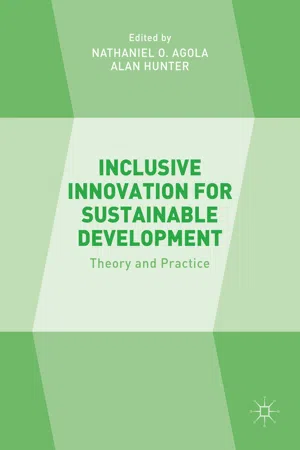
Inclusive Innovation for Sustainable Development
Theory and Practice
- English
- ePUB (mobile friendly)
- Available on iOS & Android
eBook - ePub
Inclusive Innovation for Sustainable Development
Theory and Practice
About this book
Information
Innovation, Technology, and Policy
© The Author(s) 2016
Nathaniel O. Agola and Alan Hunter (eds.)Inclusive Innovation for Sustainable Development10.1057/978-1-137-60168-1_11. Introduction
Nathaniel O. Agola1
(1)
Graduate School of Global Studies, Doshisha University, Kyoto, Japan
1 Inclusive Innovation for Sustainable Development
In the twentieth and twenty-first centuries, private sector companies, entrepreneurial state agencies, and civil society organizations have emerged as dominant actors in the creation and provision of goods and services. Innovation has been at the centre of these processes. Innovation within the private sector has been, and still is, mainly driven by a focus on those markets and market segments that pay the highest premium on goods and services. This business approach, and its conception of innovations and their outcomes, is justified by the private sector on the grounds that because heavy financial investments and other resources are committed up front in research and development, companies must therefore recoup their investments from markets that can pay the justifiably high premiums. Unfortunately, the outcome of this practice is the exclusion of the four billion segment of the world population comprising low-income earners and the desperately poor.
However, at the turn of the twenty-first century, there has been an evolving paradigm shift in how some companies view their innovations in relation to inclusion of low-income earners and the poor. In addition, new forms of quasi-private sector entrepreneurship models have emerged, leading to social enterprises whose main mandate is serving low-income groups and those living in poverty, therefore demonstrating the viability of an inclusive socioeconomic development agenda.
This term ‘bottom of the pyramid’ (BOP) was first used by then US President Franklin D. Roosevelt in his April 7, 1932 radio address, The Forgotten Man (Roosevelt 1932). Roosevelt saw great potential and general benefits of inclusion of the neglected low-income groups in economic development. In fact, he candidly expressed the indispensability of such inclusion. In the late 1990s the work of Prahalad and Hart brought the BOP concept to mainstream academic debate and research; in this case, the term refers to the low-income group of around four billion which forms the majority of the total global population. Prahalad (2004) emphasized not only the underlying business opportunities represented by BOP as a market, but also made a strong case that BOP citizens should be viewed positively as entrepreneurs and engaged consumers. Although his arguments have attracted some critics, the moral imperative to ensure people no longer live in poverty, together with the logical persuasion of the need to engage the energies of entire populations to foster economic growth and development, remains an unshakeable position.
Since the work of Fritz Schumacher in the 1970s and the emerging concept of appropriate technology, there have been alternative models of innovation that seek to develop and deliver innovative technologies for goods and services, incorporating the needs and interests of the poor, and which also seek to stimulate growth for those on the lowest incomes (Kaplinsky 2011). Recently, there has been an extension in practice of these alternative models with significant involvement of the private sector and global value chains, and the development of poor consumers as an accessible mass market. Moreover, we have witnessed within developing countries the growth of technological capabilities, and the creation of new technologies, especially information and communication technologies (ICTs) such as mobile phone applications. Recent academic debate has been using terms such as ‘pro-poor innovation’ and in particular ‘inclusive innovation’ (II) which we adopt here as it seems to have the widest currency. As a guide to what this may involve, the Global Research Alliance Organization suggests that some key features of II are: affordability, based on extreme reduction of costs; sustainability; quality; accessibility for marginalized populations; and widespread uptake (Heeks et al. 2013).
To explore the potential of this broad variety of considerations involved in II, this book uses a three-dimensional approach to discuss inclusive innovation for socioeconomic growth and development, and the implications for human security within the context of developing and emerging economies. The three dimensions are those of policy and issues relating to the technology itself, business strategies and best practices, and theoretical underpinnings and broader contextualisation.
Using this approach, we interrogate the concept of inclusivity of innovations with incisive and in-depth analyses whether it is in terms of affordability of products and services based on frugal engineering, the income and welfare enhancing scope of innovations, scale of business opportunity within low-income segments of populations, or just exclusive pro-poor focused attention by private sector products and services. We cover nonconventional considerations of innovations such as those initiated by organizations targeting social mobilization, conflict prevention, justice, and equity among many other social agendas. Alongside this, we consider the potential of modern technology to contribute much to human security while presenting certain risks. Thus, although we appreciate that technology may bring more knowledge and mobility, citizen journalism and enhanced information for political decision-making, better disaster prediction and response, improvements in medicine and food security, we also aim to develop frameworks that counter the potential increase in inequality that may accompany this.
This collection is the result of cooperation between leading international scholars in a wide range of relevant disciplines, including economic development, strategic management, innovation studies, and other relevant social and natural sciences. There are also contributions from practitioners in international development organizations and private sector actors working on inclusive innovation products and services. Our geographical focus centres on Asia and Africa, however, we hope the cases and critical issues presented are found to be relevant to other regions such as Latin America and the postindustrial economies, as well as providing comparative studies for global research. Moreover, we believe that, considering the many levels of the social ramifications of sustainable development, the constructive and judicious application of the concept of inclusive innovation can be of benefit to many sectors, as listed below:
• Water, Agriculture, and Food Security Issues • Health Care and Education • Environment and Climate • Personal and Community Security • Social and Political Mobilisation • Job Creation Initiatives • Governance | • ICT and Social Science research • Media and Economic Development • Mobilisation and Financial Inclusion • Artificial Intelligence and Robotics • Mobile Communications • Geographical Information Systems • Big Data • Scientific research |
2 Clarity and the Importance of Provoking Further Questions
In this work, we seek to fulfil the twin goals of bringing clarity to our understanding of inclusive innovation, on the one hand, and provoking further questions regarding the subject matter. Consequently, a characteristic of this book is the clear presentation of new and ground-breaking ideas regarding inclusive innovations coupled with in-depth consideration of the practical, theoretical, and philosophical relationships between inclusive innovation and human security.
To reflect the three-dimensional approach of the book, it is divided into three broad sections relating to (1) technology and policy, (2) business strategies, and (3) human security and the theoretical underpinnings of inclusive innovation. However, these are not necessarily mutually exclusive and although cases presented in each section cover only limited socioeconomic sectors, our expectation is that lessons from each chapter can be judiciously combined to inform a three-dimensional understanding of the subject.
In the first section of the book, we discuss the policies supporting or obstructing the development and diffusion of innovative technology. We look at issues relating to innovation in terms of the technology itself and in design processes developed to involve and cater for low-income sectors more directly. Such issues include problems relating not only to assessing needs and desires of low-income sectors but also to access and adoption, as well as the importance of considering multistakeholder perspectives beyond the laboratory. Using case studies from Nepal, Kenya, and Japan, we explore the effects, implications, and challenges of new technologies including recent significant developments in the use of ICT and renewable energy. Through these, this section explores issues involving systemic problems, the significance of interactive processes between a wide range of stakeholders, and the potential of community projects to influence mainstream innovative approaches. The main focus here can be described as a disciplined attempt to answer questions that need to be asked within the public policy realm. Those given below illustrate the wide range of questions addressed:
- What types of innovations encourage inclusiveness, and how can these be targeted by governmental policies?
- How can policy facilitate formalisation of innovations from the informal sector so as to reach a wider audience?
- How should governments optimally support inclusive innovations targeting poverty alleviation and human security issues?
- What is the ecosystem of inclusive innovations, and how can governments develop this?
- How can BOP members participate more fully in inclusive innovation processes and outcomes as consumers, producers, and as market entrepreneurs?
The second section deals with business strategies and practices; here, we suggest that inclusiveness calls f...
Table of contents
- Cover
- Frontmatter
- 1. Innovation, Technology, and Policy
- 2. Business and Inclusive Innovation
- 3. Human Security, Morality, and Sustainable Development
- Backmatter
Trusted by 375,005 students
Access to over 1.5 million titles for a fair monthly price.
Study more efficiently using our study tools.
Frequently asked questions
Yes, you can cancel anytime from the Subscription tab in your account settings on the Perlego website. Your subscription will stay active until the end of your current billing period. Learn how to cancel your subscription
No, books cannot be downloaded as external files, such as PDFs, for use outside of Perlego. However, you can download books within the Perlego app for offline reading on mobile or tablet. Learn how to download books offline
Perlego offers two plans: Essential and Complete
- Essential is ideal for learners and professionals who enjoy exploring a wide range of subjects. Access the Essential Library with 800,000+ trusted titles and best-sellers across business, personal growth, and the humanities. Includes unlimited reading time and Standard Read Aloud voice.
- Complete: Perfect for advanced learners and researchers needing full, unrestricted access. Unlock 1.5M+ books across hundreds of subjects, including academic and specialized titles. The Complete Plan also includes advanced features like Premium Read Aloud and Research Assistant.
We are an online textbook subscription service, where you can get access to an entire online library for less than the price of a single book per month. With over 1.5 million books across 990+ topics, we’ve got you covered! Learn about our mission
Look out for the read-aloud symbol on your next book to see if you can listen to it. The read-aloud tool reads text aloud for you, highlighting the text as it is being read. You can pause it, speed it up and slow it down. Learn more about Read Aloud
Yes! You can use the Perlego app on both iOS and Android devices to read anytime, anywhere — even offline. Perfect for commutes or when you’re on the go.
Please note we cannot support devices running on iOS 13 and Android 7 or earlier. Learn more about using the app
Please note we cannot support devices running on iOS 13 and Android 7 or earlier. Learn more about using the app
Yes, you can access Inclusive Innovation for Sustainable Development by Nathaniel O. Agola, Alan Hunter, Nathaniel O. Agola,Alan Hunter in PDF and/or ePUB format, as well as other popular books in Business & Business General. We have over 1.5 million books available in our catalogue for you to explore.