- English
- ePUB (mobile friendly)
- Available on iOS & Android
eBook - ePub
About this book
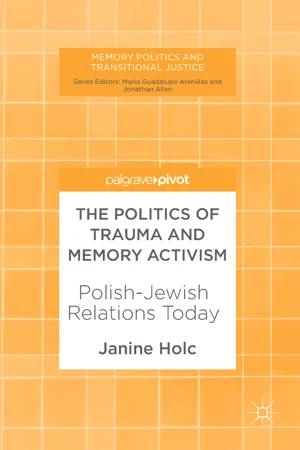
This book analyses four case studies of Holocaust memory activism in Poland, contextualized within recent debates about Polish-Jewish relations and approached through a theoretical framework informed by critical theory. Three cases are advocacy groups, each located in a different region of Poland—Lublin, Kraków, and Sejny—and each group is presented with attention to the local context and specific dynamics of its vision and strategy. The fourth case study is the state, which has emerged as a powerful memory actor. Using research based on extensive fieldwork, including interviews and direct observation, the author argues that memory activism must grapple with emotional attachments to identity if it is to move beyond a reconciliation paradigm. Drawing on works from semiotics and critical trauma studies, the volume analyzes the assumptions each memory actor makes about three dimensions of Holocaust memory: 1) the relationship of the individual to Polish national identity; 2) the possibility of a reconciled Polish-Jewish history; and 3) the assignment of traumatic suffering to a particular group or event.
Information
© The Author(s) 2018
Janine HolcThe Politics of Trauma and Memory Activism Memory Politics and Transitional Justicehttps://doi.org/10.1007/978-3-319-63339-8_11. Introduction
Janine Holc1
(1)
Political Science Department, Loyola University Maryland, Baltimore, MD, USA
Abstract
“Memory activism” is public advocacy for change in how the past is recalled and represented, and it has taken many forms in Eastern Europe after 1989. Much of this activism has centered on the difficult issues surrounding the history of Jewish life and death in Poland; scholars have documented Poland’s “Jewish spaces” and debates over memorialization of the Holocaust. This chapter frames these issues as problems of representation, ideology, and attachment to national identity, drawing on the work of Kaja Silverman. It critically assesses the “reconciliation paradigm,” a frequent model for memory work; addresses the impact of Jan Gross’s Neighbors on Jedwabne; and presents an approach to memory activism that attends to the assignation of the “traumatic” and the possibility of ideological rupture.
Keywords
Memory activism PolandReconciliationNeighborsIdentityJewsEvery year, in late October, residents of the town of Płońsk, Poland, take a walk together. Since 2008 the townspeople, led by their mayor, walk silently along the same road that Jews from Płońsk were forced to march along in 1942 by the Nazi SS (Płoński Marsz 2008) . This silent vigil ends at the train station where Nazi authorities forced the Jewish families who had been living and working in the Płońsk ghetto to board trains leaving for Auschwitz , where they planned to kill them. Once the group arrives at the station, their silence is broken with readings of eyewitness accounts. They add their own commitments to remember. A priest and a rabbi together offer a prayer.
The Płońsk ghetto was in the center of town, on both sides of the main street. At the time of the German occupation many of the non-Jewish Poles of Płońsk encountered the ghetto boundaries (usually houses with boarded-up windows and doors) and the German persecution of its residents in their everyday public activities. It is the recorded testimonies of these witnesses that are read aloud during the present-day “March of Silence .” These are Czesława Stawiska’s words, from a 2004 interview by a local archivist and read aloud in 2008:
“I was once a witness to something that I cannot forget to this day. It was when Germans caught Jews who were trying to flee out of the Płońsk ghetto . They would do public executions—they gathered every Jew from the ghetto to the plaza at Warsaw Street, more or less across from the furniture store, and ordered them to bang together tins, to show that they ‘enjoyed’ the event… that they would remember that those who ran away would meet the same fate. And they brought out this Jew and beat him to death. Right when the Germans had killed him, that is exactly when I was going to Mrs. Mossakowski’s for milk. I saw him. It was a young boy. I heard what he cried out: Mommy! My mommy! For a long time I could not forget those cries, that pleading. Because I heard it. Miss, he wanted his mother. The mother” (Stawiska 2004).
This event at Płońsk captures the contours and layers of memory activism , the central focus of this book. Czesława Stawiska’s words recall Jewish life and death through the material culture of the town, its streets, and buildings, as well as through the everyday routines of life. She presents her experience with the Nazi occupation as an interruption that is both physical, in that Warsaw Street bisects the ghetto , and psychological, in her confrontation with extreme SS terror tactics. The mayor and town residents, who in the 2000s incorporate Stawiska’s memories into their own commemoration, do so through a public enactment at the sites of past persecution. They are memory activists, in that the location and form of the enactment allow for expressions of grief and the deliberate, scripted recall of a specific moment from the past. Their practice creates a historical narrative of Płońsk in which the Jewish past figures prominently.
Płońsk’s “March of Silence ” also raises some difficult questions about Polish–Jewish relations and memory. First, Stawiska’s testimony is not detached ethnographic observation. She represents her own traumatization as well as the event of Nazis killing a child to intimidate a captive community. The calling out, until death, for a mother who cannot respond seems to be more than she could take in. She begins at a distance, describing “Germans” and “Jews,” but then she moves closer, stunned at the “young boy” who is no longer identified as a “Jew” but just a child who needs a mother, as she possibly was. Stawiska is herself traumatized by first witnessing, and then, identifying with the pain of the boy. What are we to make of this witness’s trauma? What exactly does it represent, and what purpose does it serve for the present-day participants in commemoration? Second, and in parallel with the first, what are those participants grieving and acknowledging? Is it their own losses, the extremity of genocide as it occurred on their own streets, or the pain and loss borne by past Jewish neighbors? And third, what new meanings does the public march create for the participants and observers? Is it an act of reconciliation, and if so, reconciliation to what?
This book seeks to respond to these difficult questions through an analysis of a series of memory activist projects in post-1989 Poland. Memory activism , or the public advocacy for a change in how the past is remembered, became more frequent after the end of Communist Party government throughout Central and Southern Europe. In Poland, it was part of the proliferation of advocacy initiatives that filled the newly open space of civil society, a space that Padraic Kenney called “carnival” in his study of the late 1980’s (2002). Like the March of Silence in Płońsk , memory activism engaged residents of local communities to participate in scripted enactments aimed at challenging taken-for-granted understandings of Polish history, and creating new meanings—often based on the historical truths that had long been obscured or neglected—that the activists hoped would lead to specific outcomes.
In the cases presented in this book—Brama Grodzka in Lublin, Pogranicze Sejny in Sejny, and the Center for Jewish Culture in Kraków —these historical truths centered on the relationship of Polish national identity to ethnic and religious “others,” especially Jewish “others.” Geography plays a powerful role here. Because of the location of these sites—Lublin, Sejny , Kraków —on territory that so many Jewish families lived in, that so many nation-minded Poles wanted to claim for a Polish state, that empires wanted to contain and Nazis wanted to wipe clean, today’s eastern Poland has legacies of hierarchy, exclusion and mass violence running through its past. Moral and historical questions about the role of non-Jewish Poles in the Holocaust as well as in other excisions and exclusions, such as of Ukrainians, Roma, and Belarusians, arose in the late 1980s and continue to be painful and unsettled.
At the core of much of the reflection, rhetoric and debate about these legacies of violence is the question, what does it mean to be Polish? Barbara Engelking , writing for a Polish audience, puts it this way: “The experience of the Holocaust seems to me to lay an obligation on us all. An obligation which is paid off individually, on the basis of recognizing that particular event in the history of mankind as part of our own heritage” (Engelking 2001 [1994], p. 330). Taking the lead from Engelking’s contextualization of history as a summons to responsibility, one could restate the core issue as two steps: to what degree were non-Jewish Poles implicated in anti-Jewish violence, and in what way should Polish national identity accommodate or disavow such implication? These two steps structure the environment in which historians in Poland and elsewhere have pursued these questions, as they publish work documenting the “particular events” (step one) that constitute “our own heritage” (step two). Examples include Bożena Szaynok’s Pogrom Żydów w Kielcach (1992), which brought to the forefront the 1946 murder of Jews who had survived the war by civilian Poles; Jan Gross’s Neighbors (2001 [2000]), which documented the round-up and mass killing of the Jewish members of a small town by their non-Jewish neighbors; Jan Grabowski’s Hunt for the Jews (2013 [2011]), about the practices by Poles of seeking out Jews in hiding during the war to turn them over to the Nazis ; and Barbara Engelking’s Such a Beautiful Sunny Day (2016 [2011]), about the refusal of rural Poles to take in Jews fleeing violence. Each of these was published in Polish prior to publication in the United States; the Polish publication date is in brackets.
Each of these works also sparked controversy in Poland upon publication; Jan Gross’s Neighbors provoked perhaps the most deeply probing response. Scholars had documented postwar pogroms before his book and indeed had published articles on the town of Jedwabne during the Nazi occupation. But Gross’s determined pursuit of the numbers of the dead, his privileging of testimony, and his insistence on connecting historical findings to questions of moral obligation elevated Neighbors to what one might call a memory crisis event. There was no easy way to downplay the truth that civilian Poles—indeed, Catholic Poles—had taken advantage of their long-time neighbors’ sudden disempowerment under German law, and had forced Jewish men, women, and children into a barn to be burned to death.
Many readers reacted to Gross’s arguments with defensiveness and anger, in part because of their challenge to the preexisting understandings of Polish national identity. Deep disillusionment was also a common reaction. The prominent liberal and editor of Res Publica Nowa, Marcin Król, led off a special issue on history and memory with these observations: “For me, [Jedwabne means] an end of the possibility of Poles thinking about ourselves in a certain way, bound up with tradition… I have written about how this ‘fatherland’ [ojczyzna] is essential for us… No longer. That ‘Polishness’ and that ‘fatherland’ are no longer alive” (Król 2001: 6). In the same issue, Paweł Śpiewak worried about the attacks on Gross, which included challenges to his evidence: “This [criticism of Gross] is not about information, but rather about a mode of thinking about ethnicity,” that is, Polishness (Król 2001: 8). For Śpiewak the uproar over Neighbors came from its threat to a specific view of Polish national identity.
The reality that people who were Polish behaved immorally, not as individuals, but as a community, and not only any community, but one defined in the Jedwabne case as almost all those in the town who were not Jewish, challenged the taken-for-granted notion of Polishness as essentially moral. In this default position, Polishness is essentially moral because of the Polish nation’s ostensible historic powerlessness (ignoring periods of dominance over others). Expanding empires and states had taken away by force the territory of Poland, in the 1700s, the 1800s to 1919, and then again in 1939. International actors had dictated and shaped Poland’s borders and place in Europe, in 1919 and then again in 1944. This history renders Poland, in terms of this commonly accepted identity, an innocent.
Moreover, Neighbors provoked such emotionally charged reactions in part because the individual’s attachment to the innocence of Polishness is itself a matter of emotion rather than historical fact. Indeed, we can say for many communities across the globe, attachments to “homeland,” patria, ethnic identity, or religion were and are highly charged. They are part of the “practice of nationalism,” in Brubaker’s terms (1996)—the process of creating and sustaining a unified concept of “Poland.” In the case of Poland, this charge is organized such that “particular events” outside of its rationale cannot be integrated into it. Engelking labels this attachment a “martyrology” (2001); Joanna Tokarska-Bakir calls it an “obsession with innocence” (2001). These terms may not be precise enough. The psychic investment in one’s community’s innocence is, as these terms suggest, outside of the realm of historic argument, but this is the case with any psychic investment. It may be enough to say that such an investment is a formidable obstacle to those who would like to create change, be they historians or memory activists.
The challenge for activists, who do not pursue these questions via research, was and is to develop strategies that can somehow work with the investment in a pre-existing attachment to a specific dominant identity to create room for an alternative. One risk is that their intended audience may reject or evade their efforts, either to preserve the long-standing identification or to continue on in complacence. Another is that a superficial version of acknowledging Poland’s implication in past violence may arise, as a substitute for the more difficult alternative.
This book chooses to focus on three organizations, out of the many memory activist initiatives that dotted Poland’s social landscape after 1989, for several reasons related directly to the discussion above. First, as will be outlined below and developed further in the chapters of this book, these organizations took up the unsettled and still painful issues of Polish identity ...
Table of contents
- Cover
- Frontmatter
- 1. Introduction
- 2. Memory Activism Challenging the Reconciliation Paradigm
- 3. Memory Activism in a Historic Borderland
- 4. Memory Activism in a Porous Field
- 5. The State as Context and Competitor in Memory Politics
- 6. Conclusion: Memory Beyond History
- Backmatter
Trusted by 375,005 students
Access to over 1.5 million titles for a fair monthly price.
Study more efficiently using our study tools.
Frequently asked questions
Yes, you can cancel anytime from the Subscription tab in your account settings on the Perlego website. Your subscription will stay active until the end of your current billing period. Learn how to cancel your subscription
No, books cannot be downloaded as external files, such as PDFs, for use outside of Perlego. However, you can download books within the Perlego app for offline reading on mobile or tablet. Learn how to download books offline
Perlego offers two plans: Essential and Complete
- Essential is ideal for learners and professionals who enjoy exploring a wide range of subjects. Access the Essential Library with 800,000+ trusted titles and best-sellers across business, personal growth, and the humanities. Includes unlimited reading time and Standard Read Aloud voice.
- Complete: Perfect for advanced learners and researchers needing full, unrestricted access. Unlock 1.5M+ books across hundreds of subjects, including academic and specialized titles. The Complete Plan also includes advanced features like Premium Read Aloud and Research Assistant.
We are an online textbook subscription service, where you can get access to an entire online library for less than the price of a single book per month. With over 1.5 million books across 990+ topics, we’ve got you covered! Learn about our mission
Look out for the read-aloud symbol on your next book to see if you can listen to it. The read-aloud tool reads text aloud for you, highlighting the text as it is being read. You can pause it, speed it up and slow it down. Learn more about Read Aloud
Yes! You can use the Perlego app on both iOS and Android devices to read anytime, anywhere — even offline. Perfect for commutes or when you’re on the go.
Please note we cannot support devices running on iOS 13 and Android 7 or earlier. Learn more about using the app
Please note we cannot support devices running on iOS 13 and Android 7 or earlier. Learn more about using the app
Yes, you can access The Politics of Trauma and Memory Activism by Janine Holc in PDF and/or ePUB format, as well as other popular books in Politics & International Relations & Eastern European History. We have over 1.5 million books available in our catalogue for you to explore.