This book compares the thought of Michael Oakeshott and Leo Strauss, bringing Oakeshott's desire for a renaissance of poetic individuality into dialogue with Strauss's recovery of the universality of philosophical enlightenment. Starting from the conventional understanding of these thinkers as important voices of twentieth-century conservatism, McIlwain traces their deeper and more radical commitments to the highpoints of human achievement and their shared concerns with the fate of traditional inheritances in modernity, the role and meaning of history, the intention and meaning of political philosophy, and the problem of politics and religion. The book culminates in an articulation of the positions of Oakeshott and Strauss as part of the quarrel of poetry and philosophy, revealing the ongoing implications of their thinking in terms of the profound spiritual and political questions raised by modern thinkers such as Hobbes, Hegel, Nietzsche and Heidegger and leading back to foundational figures of Western civilization including St. Augustine and Socrates.
eBook - ePub
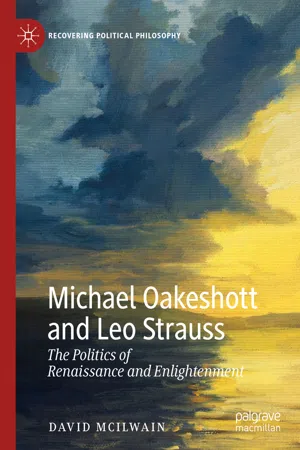
Michael Oakeshott and Leo Strauss
The Politics of Renaissance and Enlightenment
- English
- ePUB (mobile friendly)
- Available on iOS & Android
eBook - ePub
About this book
Information
© The Author(s) 2019
David McIlwainMichael Oakeshott and Leo StraussRecovering Political Philosophyhttps://doi.org/10.1007/978-3-030-13381-8_11. Introduction
David McIlwain1
(1)
Department of Modern History, Politics and International Relations, Macquarie University, North Ryde, NSW, Australia
Michael Oakeshott and Leo Strauss are primarily known for their conservatism, but their true significance as thinkers is more to be found in their radical commitments to the highpoints of human achievement. Oakeshott’s desire for a renaissance of poetic individuality would lead him to seek a human understanding of the Judaic tradition of creativity and imagination, while Strauss’s aim of recovering the universality of philosophical enlightenment would mean facing the unintelligibility of the ground of the Greek tradition of rationalism. These projects would find their expression in politics but, as this study will demonstrate, “conservatism” is far too narrow a term to characterize the politics of renaissance and enlightenment.
In referring to the politics of renaissance and enlightenment I have sought to avoid the limitations of an approach that would position Oakeshott as a partisan of modern thought against Strauss as a proponent of a return to the situation of classical thought. While both engaged in the creation of memorable intellectual myths and legends, Oakeshott and Strauss refused to reduce the possibilities of the human mind and the cycles of history to simple narratives of progress and decline. It is not the case that Oakeshott embraced modern pluralism without exception or that Strauss was nostalgic for an ancient “natural law.”
While Strauss argued that the ancient philosophers required renewed consideration, he acknowledged that modern thinkers had also upheld the aims of philosophy. Strauss fostered the ongoing possibilities of enlightenment in identifying the philosophical significance of Heidegger, a man whom he considered the most radical of the historicists of modernity. The ancient philosophers were aware that the ultimate ground or substratum (hypokeimenon) of the intelligible causes observable in the cosmos was unknowable. This awareness informed the Socratic turn to speeches in order to rationally confront a problem which cannot be settled by science. Strauss intimated that this openness to the ultimate problem and mystery of being had once again become a possibility for philosophy in the epoch of Nietzsche and Heidegger.
It is similarly restricting to cast Oakeshott as a “modern.” Oakeshott expressed great foreboding about the impetus which modern technology and ideological politics had given to societal mobilization. He had also witnessed the tendency of modern pluralism to decline into a scramble for economic gain that betrayed the achievements of the renaissance figures he celebrated. While it has been argued that Oakeshott advocated “a particular kind of modernist individualism,”1 he did not place its emergence within any account which might subsume the self in a rational achievement of “modernity” and his skepticism of such rationalist accounts makes it possible for Oakeshott to be described with perhaps equal plausibility as a critic of the Enlightenment.2 Oakeshott’s individuality was not the neutral thing of modern liberal utopias, implying rather the poetic and, in the broadest sense, religious achievement of a self. Though its rebirth in Western Europe may be traced to the nominalism of the twelfth and thirteenth centuries, its achievement was for Oakeshott as fragile as the individual human being. While the main emblem of this individuality is the artistic passion of the Renaissance, it remained contingent on such heritage as the Judaic tradition of the will, the Roman legal tradition, and an attitude of “political skepticism.” The coming together of these traditions was threatened by a consciously progressing modernity, and Oakeshott avoided Hegel’s “Gnostic” account of political history in favor of the continued importance of Augustine whose political thought he introduced to students as “the pax Romana seen sub specie aeternitatis.”3
Yet these distinctions are complicated by the fact that, from the metaphysical perspective, both Oakeshott and Strauss appear to be undeniably modern. In rejecting the dualism of a supersensible realm, both men reworked the premodern strands in their thought toward the inspiration and desire to achieve completion and a kind of transcendence in this world. Nevertheless, Oakeshott and Strauss inherited opposing attitudes toward this transformation, reflected in the contrast between what I refer to in this study as the “German” and “English” responses to theory and practice and the experiences from which the German Jewish Strauss and the English Christian Oakeshott approached the problem of historical identity.
Indeed, it has been suggested that one of the most significant questions on which readers of Oakeshott must reflect is whether there can be “any absolute breaks in the seamless web of historical change.”4 Oakeshott relied on “a kind of quantitative sameness” within the changing historical identity of Christianity.5 This sense of merciful continuity was the antithesis of Strauss’s experience of an inexorable break in the Jewish nation and religion with modernity. For Oakeshott—in the words of Andrew Sullivan—“a tradition of religious belief is extraordinarily fluid, resting in no way upon the primacy of the prior, even if, [as in Christianity,] the doctrine has long been that the prior was articulated by an incarnate Godhead.”6
In starkest contrast, Strauss’s early adherence to political Zionism reflected his keen awareness of the impossibility that the religious life and identity which had nourished and protected premodern Jews might be recovered and continued. As Michael Zank has phrased it, the question facing Strauss was, “How [is] a return to Judaism possible if the world of the ghetto [is] irretrievably lost, while modern Judaism (even if transposed to Palestine) [is] inextricably European?”7
As this predicament makes clear, these religious inheritances of both Oakeshott and Strauss intersected with the question of national tradition. In their separate ways each man perceived that in modernity, a “German” dedication to theoretical radicalness stood against a practical “English” conservatism. Oakeshott wrote of “that love of moderation which has as frequently been fatal to English philosophy as it has been favourable to English politics.”8 Oakeshott’s understanding of historical Christianity bears an obvious relation to this English response to modernity which, after his sojourn in London and Cambridge, Strauss would speak of as “[t]his taking things easy, this muddling through, this crossing the bridge when one comes to it.” Strauss was impressed by a society that had managed to preserve something of the classical outlook. “Whatever may be wrong with the peculiarly modern ideal,” he wrote in the draft of a lecture while his land of birth faced the British in 1940, “the very Englishmen who originated it, were at the same time versed in the classical tradition, and the English always kept in store a substantial amount of the necessary counterpoison.”9
Opposing this English phronesis was a German mania most apparent in the brilliance of the German critique of modern civilization, a critique which nevertheless threatened to break disastrously upon practical life as an extreme form of political nihilism. Developing their ideas in the interwar period, Oakeshott and Strauss would each find themselves influenced by and forced to respond to the cultural and intellectual achievements of the German mind.
Oakeshott and Strauss embodied something of both of these national inheritances and intellectual outlooks. Strauss has been recognized as an Anglophile,10 while Oakeshott has even been called a “German thinker” for his close attention to the thought of that country.11 Oakeshott studied in Germany in the early 1920s and, like Strauss who was involved in the Jewish Wanderbund, even participated in the Wandervögel movement.12 Oakeshott followed the developments in German theology and historical inquiry and was aware of the break which modernity represented when viewed in these terms. However, these complementarities are only a rewarding aspect to what remains a portrait of contrasting approaches. For while Oakeshott enjoyed a familiarity with German thought beyond that which is often found in Anglo-Saxony, it is noteworthy that the scholar who called him a “German thinker” finds ultimate significance in Oakeshott’s thought as “th...
Table of contents
- Cover
- Front Matter
- 1. Introduction
- 2. Political Moderation and Practical Conservatism
- 3. Liberal Education and Classical Republicanism
- 4. Historical Interpretation and Philosophical Intention
- 5. The Philosophical Intention and Legacy of Hobbes
- 6. Leo Strauss and Alexandre Kojève on Tyranny and Theory
- 7. Michael Oakeshott and Alexandre Kojève on Play and Practice
- 8. Leo Strauss and Socratism After Nietzsche and Heidegger
- 9. Michael Oakeshott and Augustinianism After Hobbes and Hegel
- 10. Conclusion
- Back Matter
Trusted by 375,005 students
Access to over 1.5 million titles for a fair monthly price.
Study more efficiently using our study tools.
Frequently asked questions
Yes, you can cancel anytime from the Subscription tab in your account settings on the Perlego website. Your subscription will stay active until the end of your current billing period. Learn how to cancel your subscription
No, books cannot be downloaded as external files, such as PDFs, for use outside of Perlego. However, you can download books within the Perlego app for offline reading on mobile or tablet. Learn how to download books offline
Perlego offers two plans: Essential and Complete
- Essential is ideal for learners and professionals who enjoy exploring a wide range of subjects. Access the Essential Library with 800,000+ trusted titles and best-sellers across business, personal growth, and the humanities. Includes unlimited reading time and Standard Read Aloud voice.
- Complete: Perfect for advanced learners and researchers needing full, unrestricted access. Unlock 1.5M+ books across hundreds of subjects, including academic and specialized titles. The Complete Plan also includes advanced features like Premium Read Aloud and Research Assistant.
We are an online textbook subscription service, where you can get access to an entire online library for less than the price of a single book per month. With over 1.5 million books across 990+ topics, we’ve got you covered! Learn about our mission
Look out for the read-aloud symbol on your next book to see if you can listen to it. The read-aloud tool reads text aloud for you, highlighting the text as it is being read. You can pause it, speed it up and slow it down. Learn more about Read Aloud
Yes! You can use the Perlego app on both iOS and Android devices to read anytime, anywhere — even offline. Perfect for commutes or when you’re on the go.
Please note we cannot support devices running on iOS 13 and Android 7 or earlier. Learn more about using the app
Please note we cannot support devices running on iOS 13 and Android 7 or earlier. Learn more about using the app
Yes, you can access Michael Oakeshott and Leo Strauss by David McIlwain in PDF and/or ePUB format, as well as other popular books in Politics & International Relations & Political Philosophy. We have over 1.5 million books available in our catalogue for you to explore.