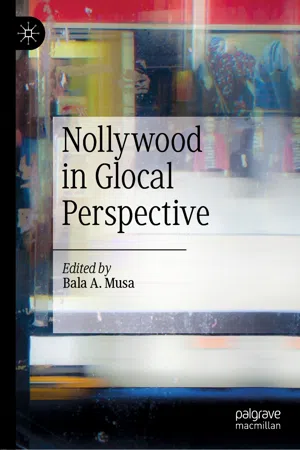
This book gives a panoramic view of the rise and growth of Nollywood, Nigeria's movie and home video entertainment industry, into the second largest and most prolific movie-producing industry in the world. It offers an analysis of Nollywood's influence as a local and global cultural force. Scholars from Africa, the African Diaspora and beyond examine the factors that have shaped Nollywood's unique story-telling, production, and distribution system. The volume shows how internal and external economic, social, cultural and technological changes intersect to define Nollywood's film-making and entertainment ethos. It is grounded in sound theoretical perspectives that help readers understand the texts and subtexts of the industry's emergence, transformation, and impact. The range of subjects covered span Nollywood's historical roots in Nigeria pre-colonial traveling/community theatre to colonial era film-making, and its contemporary spin-offs and inspired cousins across Africa andin Europe. It illuminates the interface of artistic, business, cultural and technological innovation and creativity at the heart of Africa's local and global pop culture explosion.
- English
- ePUB (mobile friendly)
- Available on iOS & Android
eBook - ePub
Nollywood in Glocal Perspective
About this book
Information
Subtopic
Film & Video© The Author(s) 2019
B. A. Musa (ed.)Nollywood in Glocal Perspectivehttps://doi.org/10.1007/978-3-030-30663-2_11. History and Evolution of Nollywood: A Look at Early and Late Influences
Adesina Lukuman Azeez1
(1)
Mass Communication, University of Ilorin, Ilorin, Nigeria
Introduction
Every day, an estimated three video films are released into the Nigerian market. These films are commonly shot in an average of less than ten days with, in most cases, a budget of less than twenty thousand US dollars. The industry releases an average of 1200 titles a year with an average cost of production put at 20,000 US dollars. According to the record of the National Film and Video Censor Board, a total of about 1055 movies were released into the market in 2011. It is thought that an average of 50,000 copies are sold per title at a retail price of $2.5 per copy.1 On this basis, the Nigerian film industry generates more than three billion US dollars a year.2 This makes it the third largest growing film industry in the world after Hollywood and Bollywood. This, of course, excludes the possible residual rights of the titles and further income and expenditure from ancillary costs such as making posters and jacket printing, importation of blank tapes and CDs, dubbing, publicity and marketing distribution costs.
However, with the new wave in the Nigerian film industry beginning, from 2000 to date, the industry has witnessed a tremendous improvement in its production and distribution techniques. High-quality films are now being produced with considerably bigger budgets averaging between ₦40 million (US$250,000) and ₦120 million ($750,000). Thus, by the end of 2013, the film industry reportedly hit a record-breaking revenue of ₦1.72 trillion (US$11 billion). As of 2014, the industry was worth ₦853.9 billion (US$5.1 billion), making it the third most valuable film industry in the world. It accounted for about 1.4% of Nigeria’s economy. This was attributed to the increase in the number of quality films produced and more formal distribution methods.3
Some credit Matt Steinglass with popularizing or legitimizing Nollywood, at least the industry, through his article, “When There is Too Much of a Not-Very-Good-Thing.”4 Others credit BBC journalist Nick Moran’s, investigation of the production/marketing of Nigerian films and their popularity within Africa and the wider African community, as helping popularize Nollywood, the term, though not coined by him. The term mirrors the names of Hollywood in America, and Bollywood in India. Moran produced a documentary entitled “A Game of Life,” which looked at the phenomenon in detail. He was exposed to various elements of filmmaking that were unusual. For example, he was forced to shoot the documentary within ten days, as is the usual practice with the feature films produced in Nigeria.
A seemingly innocuous term, Nollywood actually brought to the fore the debate associated with the third space of visual articulation and third cinema. The term placed the practice of popular video film in Nigeria in the context of peripheral visual cultures, and in a way that distinguished its outside-ness and otherness from the dominant cinema. It rekindled the abandoned notion of the “Third cinema,” which the Glasgow Screen Conference of 1983 positioned as practical guide to filmmaking in the Third World.5
The notion of Nollywood impelled the recognition of another regime of visual culture and practice outside what we already knew. It re-established/reinvigorated the need for what Wole Soyinka calls “inter-mutual interaction” between theatre and cinema.6 The Nigerian video film industry revalorizes what, to Soyinka, is a unique quality of the Yoruba cinema, the quality of being able to conquer the lure of the “aesthetic precepts that are moulded by Western cinema, which are expensive to produce in an African film.”7 Therefore, Nigerian video films fit the description Soyinka had given about the earlier Yoruba cinema that, they are “not only relevant to the social conditions of Nigeria,” because they “reflect stories and spectacles based on everyday life and on the collective myths, but also because they provide aesthetic and economic alternatives to the Western super productions.”8
Landmarks and Key Influences in Nollywood’s Evolution
This article reviews the history of the Nigerian film industry and how it developed into what is known today as the Nigerian video film industry or Nollywood. It traces the development from its beginning with the establishment of a Colonial Film Unit by the British for producing propaganda newsreels, which set the pace for the development of filmmaking in Nigeria, to the emergence of indigenous filmmakers who produced indigenous films to satisfy Nigerian people’s yearnings for local films that reflected their cultural realities. It accounts for the factors that led to the shift from celluloid production to video production.
Although this chapter deals mainly with the historical landmarks in the development of the medium’s technology, it provides a context to understand the influence each historical stage in the evolution of the industry has had on the films’ content and how each stage in the evolution could have possibly shaped audience reception.
The Colonial Era
The foundation of what we could call the Nigerian film industry today was laid by the British colonialists. They introduced film to Nigerians as a form of entertainment, but they actually had the intention of using it to justify their imperialism and to transmit British’s values and norms. A European merchant, Stanley Jones, who screened the first newsreel material to an audience at Glover Memorial Hall in 1903, strengthened their interest in the use of films for their propaganda objectives because it confirmed to them that a large number of people were thrilled and attracted by the medium of communication. Although, Stanley’s aim was to relieve the monotony of elite social life in the burgeoning Lagos metropolis with the newsreel material, the great popularity of the novelty among the people in Lagos demonstrated its potential as a means of reaching and manipulating the people whose resistance to colonial rule was growing steadily.9 For propaganda purposes, the colonial government, set up a Colonial Film Unit in early 1906. The films unit produced newsreels and documentary films, which the Information Department of the Colonial Office screened to the colonial subjects, using mobile cinema technology. Projection units were built into Landrovers that travelled from one town square to another to screen the propaganda films, which depicted Britain’s pomp and power. Thus, the major role of film at this time was to “further the overall aim of colonialism; to portray the development and civilizing mission of the British, with the hope that this would neutralize the rising wave of nationalist agitation for independence, and to convince the colonies that they had a common enemy in Germany.”10
Until the First World War, the British colonial government, in partnership with the missionaries, monopolized the production, distribution and exhibition of films in Nigeria. But after the First World War, the Colonial government realized how greatly film had fascinated the majority of urban dwellers as a medium of entertainment and thus, allowed other expatriate settlers, like Lebanese, Greek and Syrian nationals, to set up and operate film distribution and exhibition companies. This then led to exhibition of feature films in theatres for more commercial objectives. The pioneer distribution and exhibition company, West African Pictures, was established in 1930 by Arif Barakat and Raakh Khali, both of whom were Lebanese.11 A few years after the inception of this distribution and exhibition company, many others, such as the Nigerian Motion Pictures Company, Plateau Cinema Limited, and the Algadama Company Limited sprang up all over the country. The business became so competitive that by 1970, Nigeria boasted approximately 250 cinema houses, most of which were equipped with 35 mm projectors.12 The cinema houses predominantly exhibited foreign films, such as American Hollywood movies, British spy films, Indian films and, much later, martial art/Kung Fu films from Hong Kong, China and Japan. Some researchers have noted that cinema audiences were particularly large in South Western Nigeria (in places like Lagos and Ibadan, which are predominantly occupied by the Yoruba), and the Northern parts of the country (like Kano and Kaduna that are majority Hausa).13
The Missionary Influence
Christian missionaries, who were interlocked with the colonial enterprise, also realized the potential of films in influencing and indoctrinating the colonized people. As a result, they produced films that were evangelical and meant to facilitate the conversion of the native peoples. These films were mainly screened in churches. It is on record that as early as 1907, the Catholic fathers who were stationed in Lagos screened religious films as part of their concerted efforts to proselytize in the colony. The Lagos Standard, which was then the most influential newspaper, criticized one of the films screened, as being biased, because “the film’s portrayal of Judas as a Blackman and Simon Peter as a light-skinned person quietly insinuated a racist undertone.”14
The film format used by the missionaries has exerted a powerful influence on the home video phenomenon in Nigeria, particularly those that were produced in the English Language, given their religious/moral content and context. Most of them had evangelical themes, while a handful of them were fundamentally didactic. In fact, some formed a specific genre, which Obododinma termed Christian videos.15 These Christian videos continue till to...
Table of contents
- Cover
- Front Matter
- Part I. Evolution and Historical Perspective
- Part II. Socio-cultural Perspective
- Part III. Local and Global Influence
- Back Matter
Trusted by 375,005 students
Access to over 1.5 million titles for a fair monthly price.
Study more efficiently using our study tools.
Frequently asked questions
Yes, you can cancel anytime from the Subscription tab in your account settings on the Perlego website. Your subscription will stay active until the end of your current billing period. Learn how to cancel your subscription
No, books cannot be downloaded as external files, such as PDFs, for use outside of Perlego. However, you can download books within the Perlego app for offline reading on mobile or tablet. Learn how to download books offline
Perlego offers two plans: Essential and Complete
- Essential is ideal for learners and professionals who enjoy exploring a wide range of subjects. Access the Essential Library with 800,000+ trusted titles and best-sellers across business, personal growth, and the humanities. Includes unlimited reading time and Standard Read Aloud voice.
- Complete: Perfect for advanced learners and researchers needing full, unrestricted access. Unlock 1.5M+ books across hundreds of subjects, including academic and specialized titles. The Complete Plan also includes advanced features like Premium Read Aloud and Research Assistant.
We are an online textbook subscription service, where you can get access to an entire online library for less than the price of a single book per month. With over 1.5 million books across 990+ topics, we’ve got you covered! Learn about our mission
Look out for the read-aloud symbol on your next book to see if you can listen to it. The read-aloud tool reads text aloud for you, highlighting the text as it is being read. You can pause it, speed it up and slow it down. Learn more about Read Aloud
Yes! You can use the Perlego app on both iOS and Android devices to read anytime, anywhere — even offline. Perfect for commutes or when you’re on the go.
Please note we cannot support devices running on iOS 13 and Android 7 or earlier. Learn more about using the app
Please note we cannot support devices running on iOS 13 and Android 7 or earlier. Learn more about using the app
Yes, you can access Nollywood in Glocal Perspective by Bala A. Musa in PDF and/or ePUB format, as well as other popular books in Media & Performing Arts & Film & Video. We have over 1.5 million books available in our catalogue for you to explore.